Showing posts with label characters. Show all posts

Wednesday, December 3, 2025

Palladium Characters: Amazingly Good

I created a character for my throwback 1980s Palladium Ninjas and Superspies game last night, and there it is. That incredible feeling came right back to me. This is a character I want to play. Wow, what a fantastic experience, and this is a character with depth, real meat, and substance. When I am done, the character feels substantive, authentic, and seriously cool.

You must be able to follow instructions! Most modern players do not have the patience for this process and will never be able to figure it out, but that 'speed bump' is not gatekeeping; it is a skill test to see if you are worthy of putting in the time and attention the game demands. If you can't get past character creation, other games are going to be better for you.

This was true of games like Advanced Squad Leader in the 1980s; the rules were a certain way, creating a natural barrier, so more casual players would play other games, while players who appreciated the level of detail the game delivers would stay. This creates a filtering system so people who want to put in the time will stay, and those better suited for casual games will go elsewhere.

And this is not bad design; it is a feature. Those people on gaming YouTube saying "it is common wisdom this is a bad design" have no idea what they are talking about. They just want to sound smart and push everyone into casual games so they can get on the monetization gravy train. This is also why the First and Second Editions of AD&D (OSRIC or For Gold & Glory) are better for me than BX or BECMI.

I will take devoted, attentive, and patient players over the casual crowd any day. It is the difference between home cooking and fast food. While fast food is great every once in a while, it never satisfies me, nor is it worth going out of my way to eat. Meals made with care and time are always better, and the people who share that love are the ones I can relate to and speak to about food. The same goes for gaming; simple, casual, easy games feel pointless to me.

That is not to say the system could be more organized. Keep listing the skills and their modifiers that your training packages provide. In the end, sort both the primary and secondary lists, go skill by skill in the book, and write down your base percentage (plus the education bonus for primaries) and the per-level bonus. Some skills also have a negative modifier when chosen as a secondary, so secondary skills are better for no-percentage physical skills.

I create my characters in a LibreOffice document in double-column format, with fixed tabs, and type all the values by hand. Who needs a silly character sheet? Real players use LibreOffice and Linux for their character sheets. If you know how to create columns and tab stops every half inch, you have everything you need. You will never be taken advantage of by a paid online character storage site or Windows and its AI reading your documents ever again.

I even prefer this method to many "crafted" character sheets that are too fancy or take up too much space. At least here I can set a half-inch gutter margin and three-hole punch the character sheet for binder storage. LibreOffice character sheets are the way to go these days, and you will get a greater sense of DIY attachment and accomplishment once you create a sheet that is better for you than what others can provide.

Once you create one character, strip it down and use it as a blank template for others. There is your blank character sheet, and you can do a better job of organizing things yourself. Make sure to use LibreOffice's "sort" feature (Tools->Sort) when you select a list of skills so you can alphabetize them quickly.

This works very well for me, and I can fit an entire character on a single double-sided page. Also, note that I listed the skills as a base percentage plus X%/level, so if the character levels up past level one, I will not need to go back to the book and find all these "per level" modifiers again.

This also works for any Palladium game, and you can even export to PDF or text to import into a VTT. It sounds primitive and like a lot of work, and while it is more work, I feel an in-line two-column character sheet that I design is superior to most anything I could find online. For one, I have infinite space, plenty of room, and I can create custom sections for things that I want the campaign to focus on.

You will get double skills in character creation, and only the highest level applies. Also note that the character's education bonus (if they have one) is added to all primary skills, and not the secondaries! Some skills will modify other skills, so take note of that.

And do those physical skills early, so they modify your stats and SDC.

Also note, this is an old-school game. If your character is missing a skill, you can either wait until the OCC says you get a new one or you can figure out a way to get it in-game. Let's say I want my agent to get a "combat motorcycle driving skill" and they don't have it, or I forgot to give it to them.

Your first option is to swap an unused skill for that one, but be careful with physical skills, since they modify stats! Another option is to wait for the OCC to grant you a skill pick.

The third option is to figure out how long it would take to get that skill through a training course, if they can take it, who they would take it from, and how much in-game time it would take to attend classes. Three months for a secondary and six months for a primary sounds right, and you are trading time for advancement. If the skill is more in-depth, this time may be 2 to 4 years in fields like medicine, and it will take place over a more extended period.

You are trading time away from adventuring and adding time to the character's age in exchange for that advancement, so it works out. If you wanted to start with this skill, add the time to the character's age and give it to them. You are trading lifespan for a skill that is more than fair.

Also, I added a few sections to this character sheet that the "official" one lacks. I created a background section for the character's background and family, including the university they attended and when they graduated. I made a training programs section to list the packages I took during character creation. I added a date of birth. I made a section for their cover that can also expand if contacts or other special notes are needed. I listed all their martial arts moves and abilities. I made a section that lists the strike modifiers for different weapons and attacks.

The combination of the time it took to create the character, craft the sheet, and go through the selections and picks made me excited to play. I don't get this feeling with other games, and games that are much simpler than this. This character means something, and I get that "excited to play" feeling that I do not with other games.

Fantasy characters done this way are likely just as good, and clearly a step above anything 5E gives me.

Friday, August 30, 2024

Pet Characters

We have had "pet" characters all our lives, and D&D and many games encourage this. Part of me feels they damage the hobby and our gaming enjoyment.

A "pet character" is your favorite character, the ideal ranger, the best fighter, the best mage, the trickiest rogue, self-insert, a perfect character modeled after fiction, "you in the game," which you always play in MMOs, and basically who you simp for. If someone asks you to "play a bard," this is your default choice.

For me, 'pet characters' are more of a game-killer than a game-enhancer.

I want them to be perfect, but the rules always need to meet my expectations. They are the same old, and they always react the same way. They never change. They are stuck in the past. You seek out games that give them more powers to further reinforce why they are so great. They are "too close" to us, and "risking them" forces you to cheat or play games where characters never die.

I am beginning to resent the pet character.

They are destroying my enjoyment of gaming.

In a way, this "pet character" ideal is the entire superhero genre. Batman is the only vigilante in the DC Universe; if there is another, it is always "female Batman." There may be a few others, but they are just a collection of "not Batman" characters. In roleplaying, we have "our Batman," the only vigilante-style character we play.

No other vigilante character will ever be given any "air time" or a chance in anyone's mind as long as Batman is around. You see the same thing with the goofball character and Harley Quinn; time and time again, it is the same old her, and there can be no one else.

Why would you waste time developing any new ideas?

We have our old standby pet characters ready to go!

If you are new here, there is the door; that role is filled. Best of luck in your future endeavors.

And companies use this ideal of a pet character as identity marketing against us. Would you buy cosmetics for a randomly generated character? Probably not. Would you buy cosmetics for your pet character? Where do I put in my credit card, and what do you have? Would you buy a game that puts your pet character on a golden pedestal and throws rose petals at their feet?

Soon, Wall Street will begin tracking our "pet characters" and creating databases to market against us and exploit our weaknesses for these ideals. All it takes is AI-generated imagery appearing in advertisements resembling our pet characters. Would you be more likely to buy something if this happened? Let's say your pet and all your friends' characters were happily drinking the same soda. Would you be more receptive? Does Wizards really know what it has in that character database? I called this here first.

Part of me feels like retiring all my pets and only playing games with randomly generated characters is the best way forward. I will "embrace the rando" and begin living life again. With random characters, I get to see new things; I can invest in them or not, and I am free to take them on new adventures and "see what happens." With a pet, I know what they will do and what to expect. That story has been done a million times.

What is the fun of playing it again? I would rather see something new!

I love my pets, but it is time to put them away. I need to grow, discover new things to love, and enjoy characters who may surprise me. Banning the pets will give room for new characters to grow.

And I am tired of doing the same old thing.

I want to see things I have never seen and watch new characters amaze me.

Monday, August 12, 2024

Tales of the Valiant: Lineages & Heritages, Supplement 1

Man, these titles are getting long. One problem with "fixing words" is that the replacements for the old ones are often twice as long and wordy, and they, too, will someday be deemed inappropriate and need to be replaced with even longer words. The meanings are not as clear; back in the 1990s, this would have been called race and background options, six syllables versus the nine of this title. Also, "Supplement 1" tacked on there makes an even wordy title so long it probably rolls over on my post title.

I was raised on the use of clear and concise language. Using more words than was needed was disrespectful to your reader and their time.

That said, this book is good for ToV players. ToV desperately needs more options! This is a good first step, even if it is PDF-only at this point. I would love to see many more titles come out in this line and for them to be collected into a hardcover.

We get six new lineages, ten new heritages, and a background here, covering some less-popular options but important ones like goblin, lizardfolk, gnoll, dryad, and dhampir. Eonic is a time-traveler who would work better as a background (and allow for different lineages to be from the future, too). They can't time travel; they just randomly see the future.

This supplement is a step in the right direction for ToV players, but it's just the beginning. We're hungry for more, especially in the form of new class options and character development. The Midgard character option department, in particular, is in urgent need of expansion. We're ready for more, and we're ready now.

The downside? Five of the six lineage options have a dark vision ability. I swear this is a massive problem with all of 5E these days (addressed in Level Up A5E and Shadowdark), and most of 5E being a "dark vision party" is a joke at this point in gaming. Tales need to keep compatibility, so they suffer.

Dark vision for nearly everyone is one of the laziest design decisions in 5E, and at this point, just get rid of light sources and assume everyone (even humans) can see in the dark. This is also why many are leaving for Shadowdark, a game that takes light mechanics seriously appeals to so many, and that "fear of the dark" thing ingrained in humans that "in-humanist designers" fail to see in their rush to make everything play fairly like a mobile phone game rigged to sell stamina and currencies.

Nobody wants to play a "light game" in D&D, so they give everyone dark vision and hand-wave it away as a non-problem.

This book needed a few more backgrounds; only having one feels like a mistake. The PDF could have gone two more pages and given us at least four to six new ones. Level Up Advanced 5E blows ToV out of the water when it comes to character background choices, and once you start designing them and pulling in others from 3rd party books, you have almost too many - and that is a good thing.

This book highlights the differences between Tales of the Valiant and Level Up Advanced 5E. ToV needs to maintain D&D compatibility, so they must take D&D's flaws into account and make it work. Level Up threw out parts of D&D that were garbage and fixed the systems to make them fun and support the classic pillars of play.

I feel that maintaining D&D compatibility (which is different from 5E compatibility) will drag your game down with the hot mess from 2014 to 2024, with ten years of broken expansion books. I love ToV, but Level Up is the more radically redesigned and fixed version of 5E on the market. Outside the new "Queen of the Throne" of dungeon crawling, the excellent Shadowdark.

It also tells that the games that fix the dark vision problem are seen as better experiences. We live in strange times.

A great book; more of this is needed; please keep them coming, Kobold Press.

Saturday, July 13, 2024

Level Up: Gateway

https://www.levelup5e.com/news/announcing-level-up-gateway

This is exciting news, Level Up Advanced 5E is getting a character creator. See the announcement above. This is big news since creating A5E characters is a chore, especially since there are nearly double the things to note and write down compared to a game like Tales of the Valiant. It takes me 30 minutes to go through the process, and the official "form fill" character sheet is a bit too tight for all you need to record.

"Character sheets" are a massive weakness in gaming; every game has a different one, and none of them import into VTTs without serious software development time. I swear the industry needs to develop a "common character sheet format." like a PDF-style form (or accepted file format), and standardize that on all platforms.

Even Tales of the Valiant's work with Hero Lab feels very beta. At this time, exporting to PDF and printing aren't even supported. I want Kobold Press' other books added to the system. A better option for many games is still the highly moddable classic desktop app.

I wish Level Up well and would love to join in the beta. I know these projects are huge and take a lot of time and development work, so I know how huge this is and how it could go wrong. Still, I am hopeful and will be using this tool since the game needs it desperately.

Wednesday, July 10, 2024

Tales of the Valiant: Roll Your Own

One of the best parts about Tales of the Valiant is they went for a more straightforward character design process, with fewer things to write down in each step. I designed the same character in Level Up Advanced 5E and came out with twice the special powers, notes, and different abilities on my sheet than a comparable ToV sheet.

Level Up Advanced 5E is a game that truly embodies the 'more is more' philosophy. A level one character can easily have 12-15 special ability notes, compared to ToV's six. This abundance of abilities adds a profound depth to the game and makes character creation more time-consuming, which is a testament to the game's complexity.

When I am in the mood for it, it is excellent.

When I am not, it is not great.

Character sheets in Level Up must be done by hand since no program does them. It first took me 90 minutes to make a character, and I have gotten this down to 30 lately. Getting everything set up and recorded is still a long time, but the details are worth the effort.

ToV has Hero Lab, which makes the basic rules well, but the system can't be expanded for custom entries, so if you want to create a custom lineage or heritage, you are out of luck. However, I am hopeful that the ToV version of Hero Lab will improve and add the spells from Deep Magic and the Monster Vault creatures and the ability to add custom entries for items, spells, heritages, and lineages. I eagerly anticipate the inclusion of the Midgard and Southlands heritages and lineages!

The other Kobold Press 5E books should be available for ToV, but they are not. Since ToV is 5E compatible, we should have the option to use any 5E books we have for Hero Lab in this system, primarily since Midgard and Southlands are supported on the desktop version and are nowhere to be found in the online part.

I like Hero Lab for ToV; it is so limited that it is hard to recommend without seeing more new things to buy and support for custom entries. Even the "notes" section for characters is not present in this writing, despite this text box being in other games. Since the game is 5E compatible, the online version needs a custom content manager and a way to add our favorite things.

So, at this point, roll your character sheets and do them by hand. This way, you can pull in as much 3rd party content and subclasses as possible. Using online character creators is convenient, but it is anti-competitive. It can lock out almost every 3rd party who makes books for the game, and it especially hurts small independent publishers.

If a game is so complicated that you need computers, consider playing another game. This is especially true if that character creation system is locked behind a paywall and "everyone can't come inside." My answer is to do them by hand and play games where it is not too much of a hassle.

Level Up pushes the boundaries of my tolerance for complexity, but then again, that is the game. It is the Aftermath! of 5E and details everything.

Tales of the Valiant is streamlined and simplified, and it feels more like a B/X version of 5E. The game is more accessible for new players, which D&D can't claim (especially with 10 years of backward compatibility being critical parts of many character builds).

ToV is also a one-book implementation of 5E (for characters). It is a fresh start. While you can pull in your favorite 3rd part books, you don't need to, but the door is open.

That...I like.

Saturday, April 27, 2024

The Scaffolding

One of the worst parts about Wizard's D&D is all the rules scaffolding they brought from Magic: The Gathering. The team invents unique sorts of actions, like bonus actions and reactions, and this is just one area—but there are many. Then you get into problems like double-casting spells with a bonus action.

TSR D&D wasn't like that; the designers understood the game to be more straightforward without many of the frameworks card game designers brought in. Again, you only get into some of these layered rules, which are primarily designed to be cheated and taken advantage of, like in a card game, where they create card synergies and situations for one particular card or deck build to shine.

Wizards' D&D also has the concept of "deck builds" in characters, which is what multiclassing and subclasses provide. A character is like your deck; each subclass, power, spell, and ability gained is your deck composition.

This is why some love 5E and some hate it. It is also why the break with Critical Role is inevitable. They are story gamers, and they need a system that appeals to that audience. It is unacceptable to ask their fans to do these 5E "deck builds" and constrain their stories to those few viable options. This is also why the OSR exists; we remember the TSR D&D as it used to be for the first 30 years of its life. Even Paizo is an offshoot of the Wizard's model, with many of the same 3E designers.

D&D and Pathfinder are character-builder games, like MtG is a deck-builder game.

GURPS has far more rules, so it should be worse. It is more of a character builder than 5E. The rules here are all built to maintain a simulation and character-builder system; when you get to combat, you take one action on one turn. It is even more fine-grained than D&D since readying a weapon is all you can do. It is just one thing; moving and attacking inside one turn is penalized. You don't have a lot of action types here or bonus actions to try and turn stuff before another 45 minutes go by for the table to decide what they are all doing next.

While you can "deck build" to take advantage of a rule in GURPS, it is usually bad form and highly unrealistic since the build system is supposed to reflect a lifetime of learning and experiences. In any Wizards' version of D&D, optimizing is typically seen as a good thing, and the same is true in Pathfinder 2, where optimization goes much harder regarding gameplay.

I can only play GURPS with 3 characters, which is a huge ask. It is better-played solo, as a single hero game, and doing that hardcore simulation.

But I don't see GURPS as a character-builder game, unlike how 5E or Pathfinder are designed. In those games, paths, and synergies are built into your limited choices. In GURPS, you have unlimited options and no paths to follow. The 5E designers put in trick builds and good combos; in GURPS, you are what you are and the game designer.

Cypher is a rules-light system, so it should be the best. Not really; while I love Cypher, I sometimes must be in the mood for the game's abstract nature. Running many characters in this rules-light game is also as much of a chore as GURPS, since after a while, the numbers, pools, edges, and abilities all start to blur together in a jumble of rules-light game linguistics and special terms make my head spin. The more rules-light a game gets, the more abstract and conceptual it gets, and I feel my brain slowly leaving reality in some FATE-induced mental haze. I still love Cypher.

With these new games, my eyes glaze over when I see 5E and Pathfinder 2 "tier lists" for classes and abilities for builds and videos going over this on YouTube. Don't take this. It's the wrong choice! It's a garbage-tier ability. Overall, it's the best pick. Why would you go with this? Terrible pick.

It has come to a point where I am selling all these other character-builder games. GURPS is my favorite; I can build with my own choices, and I will stick with it.

Shouldn't your story take priority over optimization if it is all about the story? Or are people steering their stories into optimized builds? I feel that this is why Critical Role is doing its own story system; how can players' stories be vital if they are beholden to the builds that Wizards decides are "hot" this season?

With a digital game, prepare for seasonal builds and options that are moved out of live support and into legacy. This will be like the ever-changing ground of an MMO, Magic the Gathering, or even Warhammer 40K, with entire armies or cards removed from active play. A digital game will never stay the same and be constantly flipped over like a compost pile to keep options fresh. Prepare for classes, races, subclasses, spells, powers, magic items, gear, and every other game part to move to live service models. Legacy options may still be supported, but I feel 'official play' builds will only be allowed with choices the designers think are viable and in "live rotation."

To their credit, Pazio has avoided live service models, and they deserve to be commended. If GURPS did not exist, I would be doing PF2. GURPS keeps random game designers out of my character builds, and I make the choices based on what suits my story.

Modern character-building games are one step away from a live service model. Don't be fooled.

This is the MtG and Games Workshop model, which has proven to work and drive profits. I don't have to like it to acknowledge it exists. And this is precisely how I would move D&D if I were in charge and had to answer to shareholders. It's the same thing; you get put in that position and don't have a choice.

Answering fans is a different thing.

Thursday, February 29, 2024

The Joy of Equipment to the Last Pound

I am in the minority on this, but, oh, do I enjoy creating equipment load-outs for my character to the last pound. In many games, they write for the "please make it easy" crowd; those games just don't do it for me. They will simplify encumbrance straight out of the game, handwave it to coins to movement, or ignore the weight of essential gear.

Yes, crafting an equipment load takes time.

But this is just as enjoyable as character creation, especially if your weight matters. And you are playing a system where you can point-buy your strength up to levels where your combat statistics and movement improve, and you can see that improvement on the battlefield. GURPS and Dungeon Fantasy are like that. My low-level tanks are slow and unable to dodge. They are designed to drop those backpacks to at least get to light encumbrance so they can get an extra point of movement.

My first priorities are buying strength and the character's basic movement allowance. If I get magic gear that is lighter, great. If I can upgrade the armor, I need to recalculate. I may earn money for new stuff, and shopping is a character improvement.

Look at that loadout. I added six rations after this and spent 12 copper, but those went in the backpack, and I am ready to go. This loadout is "dressing for success" in an old-school game - and your weight allowance game is the difference between life and death.

I've lost half the people reading this by now; I know that equipment list is atrocious. This is the GURPS Character Sheet, by the way (please support the creator on Patreon, this is an awesome application, far more worth subscriptions to anything), and it makes organizing and picking gear easy. I organized the list so pouches would go on the belt, the backpack would be last in case I wanted to drop to get to light encumbrance, and my weapons and armor would come first.

She is a cleric with a light spell; no torches are needed (sorry, Shadowdark). This candle-like light isn't torch-worthy, but it will keep her out of the dark. And I know the image below is a plate mail set when my gear says scale. This is later in her career.

Note to gamemastering games like this. Don't you dare make those heavily armored orcs have a complete, unencumbered movement allowance! That is not fair! If the players are tracking to-the-pound weight allowances, knock points off the move/dodge EVERY humanoid enemy depending on their armor and load. Stronger enemies will have fewer points knocked off, but armored (usually fast) goblins may suffer more.

This isn't D&D where goblins can run in full plate at full speed.

If I am running one or two characters in a solo play, I can manage this. That gear list is a part of the character design. My gear will force character point spending. If my STR goes up, my move and dodge improve, and so will my melee damage, so I get a triple benefit. Better equipment will change her load out, especially magic items.

Gear, once set, usually doesn't change all that much. Typically, it will be "X pounds of treasure carried" in a dungeon, and when the adventure is over, we go shopping and recalculate our gear. This is also "character improvement" without raising the power level as characters improve their gear and optimize.

In games like GURPS, I don't give out too much magic treasure. I am rethinking that and will be more generous in my solo games since magic items are fun.

If you simplify the gear game, a lot starts falling apart. The Fantasy Trip simplifies gear but has the GURPS assumptions built in. Armor sets movement rate. You have limited slots for items; some take up more 'item slots' than others. The gear game is here, and it matters. It is simplified for multi-unit skirmishes, but the design principles are the same.

Dungeon Fantasy and GURPS are built on that core assumption, but the game goes into more detail. You track encumbrance, and strong characters can negate the movement penalties. There is a concept of dodge linked to the encumbrance level. You can drop backpacks before you go into battle. You can increase base speed. Character points let you play with these values so you can level up and tweak your gear load and build.

Some games handwave it all off for simplicity, and there is a market for that. I find that many 'ease of use' OSR games toss out that complexity, and there isn't much to replace it. Movement and hauling treasure, the core of the OSR dungeon game, is simplified to an extent where all the tactical (and escape) options are meaningless. It becomes walk up and bonk each over the head until the bag of hit points is depleted. Having archers to target fast enemies isn't needed. Your tanks being slow isn't a consideration in tactics, battle movement, and evasion.

It's all just too simplified to the point of being bland.

Thursday, January 25, 2024

A5E Play Report, Part 2

Do you know how some 5E players feel about B/X characters compared to 5E characters?

"They are way too simple! I got nothing to work with here!"

This is how I feel about 5E characters compared to A5E characters.

I went through all the characters I built for my A5E game and designed them in Hero Lab for straight 5E, and time after time, all the fun stuff was missing. The 5E characters were flat and uninteresting. Parts of the rules dealing with resting, navigation, survival, environmental hazards, and social encounters were flat-out missing.

The DMG would say, "Make it up yourself!"

I don't have to; the A5E game gives me all this plus more.

Do you know how GURPS players fall in love with the detail level of their characters? Where is every skill, disadvantage, advantage, and other particular facets of the player character mapped out in intricate detail? While A5E does not go as far as to-the-point GURPS, I can say having 9-12 special abilities (a mix of combat, social, and exploration) for my 5E characters makes all the difference in the world between a flat, combat-only, generic race-plus-class-plus-subclass build.

A5E is 5E with a semi-GURPS level of customization, all done through background choices.

In A5E, I can swap out these specials for anything I can imagine when I start to homebrew and custom-hack my characters. Like swapping the cosmopolitan option's "discreetly armed" feature for "expertise die for getting into royal events." Or anything else, wine tasting, area knowledge, criminal gangs, or any other area of knowledge where an expertise dice will make a character shine above everyone else.

One of my characters in A5E is a sailor berserker who gets angry like Popeye and kicks butt with his giant boarding axe. In 5E, generic barbarian. In A5E, this guy can talk him and his friends onto a ship voyage for free (you may have to do a little work), hire a ship crew (or cargo handlers) for half price, know ship captains and ships, talk salty language to intimidate people, and get information from the local sailors by drinking hard and telling fish stories.

Sorry, D&D, you are boring. Your game gives me nothing to work with. Your advice is, "The DM makes it all up!" or, "The player's backstory gives you ideas!" I have played for 40 years, and none of that would have immediately come to mind. It helps to have a little inspiration and guidance.

He also has an AC of 15 without armor because of his toughness and cool tattoos, and he moves at a base speed of 35' per round. He does a d12 + 2 slashing damage a turn.

In A5E, this guy is fantastic.

Parts of him directly work with the game's unique pillars-of-play systems. He can learn fighting styles at level 2 and have unique attacks and defenses linked to a stamina-like resource.

He is like a freaking Danny Trejo Popeye.

His ability to socialize his way into any waterborne adventure gives me ideas for adventures for this group. If I were doing a game based around ocean travel, this is the guy I would want in my party. Even on land, this guy kicks butt. And he only gets better as he levels.

A lot of the complexity is never seen in A5E and melts away; it plays like 5E. When you need it, it is there. The options and extra systems are only in the places where the original game has a void.

I don't need D&D anymore.

I have this.

Sunday, August 6, 2023

A5E Characters vs. 5E Characters

This is almost a no-contest comparison. This isn't even fair.

I created a few 5E characters (using Hero Builder), and then I recreated those same characters in A5E. With every character I created, the original 5E characters seemed almost too simple, like B/X characters, compared to 3.5E characters. Now, I like both B/X and 3.5E, but when a game goes out of its way to give me a beefy character design system that links my character to a world's culture, gives them history, and makes them a part of the setting's factions - I take notice and listen.

My A5E characters feel connected with the world and much more capable at everything.

My 5E characters feel like character names with combat stats.

Not even Tales of the Valiant (Alpha) does this. I love this game too, but even ToV seems like an AD&D to the level of detail and customization A5E offers. My A5E characters have twice the unique features that ToV characters do - in some cases, the same combo of heritage and background ends up with 4 features in ToV, and 8 in A5E. ToV needs to double the features they give you just to compete (but I am sure it will be a tremendous 5E replacement game with Kobold Press' excellent support).

In A5E, I am getting social features, exploration features, combat features, and cool toys to play with.

My 5E characters pale in comparison to either, and they feel like "generic combat playing pieces" compared to both ToV and A5E - but A5E takes the cake on building the three old-school pillars of play into the game and supporting them with both rules and character options backed into character creation.

My ranger in 5E? Mostly a combat guy with very few "ranger things" to do. He feels like a "weak fighter" with a few boilerplate nature abilities that rarely get used.

My A5E ranger? Much more remarkable, and he gets to pick Exploration Knacks that let him pull off all sorts of cool tricks during the exploration game. My guy can build a shelter concealed from enemies and as restful as a room at an inn. He can also forage daily for 5 people (if you like eating bugs and plants). He could have picked huntsman or could travel long distances without getting fatigued. There are a lot of picks here, and my ranger is a Bear Grylls in A5E compared to the 5E ranger, which seems like a tourist with a full shopping cart at Bass Pro Shop.

And my A5E ranger at level 2 gets combat maneuvers and can pick two and have a pool of 4 exertion points (regained on short or long rests). He could get a double shot, and a point-blank shot (both use a bonus action). The incredible resource-based "fighting moves" that 4E martial characters had? They are back, baby! Even my bard has them. Why do casters have all the fun choices? Oh, and I can pick ranged or melee-focused styles; there are a bunch to choose from, which allows many types of rangers to be created.

My 5E ranger at level 2 gets a "fighting style," primarily a static bonus.

This is the difference between a Rambo and a paintball warrior.

New edition, same mistakes - are what we want to avoid regarding new 5E games and backward compatibility.

My A5E characters took a little time to build, with me making meaningful choices along the way. The bonuses and abilities here remind me a little of Palladium Fantasy characters (another fantastic game), and you get the feeling, "If the rules give me abilities, I want to play and use them." There is such a thing as a character design system that uses complexity to increase player attachment, and A5E has this in spades - even over the already excellent ToV.

Another thing, my A5E characters have built-in connections to the world. They do not feel like they were "dropped in from space" like a 5E character can be; you are making choices and building connections to the setting during character creation. You could be a "guard from a town on the map" and get called back to the town if there is trouble. You can be a loner. A member of a guild. Someone from a circus. If I were running this for friends, the campaign map is a must-have for character creation, and players can point to places and ask to be a part of that area.

This has all the fun of Pathfinder 2 character creation without the character sheet that looks like a tax form. I love you, Pathfinder 2, but please do better regarding simplification and the new player experience. And you don't have to change to a new system to get it either, so if you like the 5E rules but want better character design, both ToV and A5E have you covered, with A5E being the more in-depth option.

My set of 5E characters was simple to create.

My A5E characters are the ones I want to play with.

Hands down.

Saturday, March 25, 2023

Cypher: One Note Characters


Ah, the Empathic Speaker who Entertains.

I was trying to create a bard character in Cypher System, and I came up with this combination, and she was heavily overloaded with social abilities but could not do much else.

She was a 'one note' character; please forgive the pun.

She couldn't do much else than break the will of people's minds in roleplaying and then assist in combat - cheering on other characters as they fought the bad guys. She could not make any potent attacks; all she did was cheerlead.

She felt useless in anything other than social situations, and then she completely blew those out.

So I redesigned her with an alternate ability, gave her a secondary that did not double up social, and let her make some combat moves. After that, she was 100% better, and I felt she could contribute in more situations than just social interaction.

She was weaker in social situations but still better than everyone else. The trade-off here is that she gained many new abilities to help out in combat and skill tasks and could contribute more towards the group's success in various situations.

This is one of those pitfalls in the system, especially for new players, where you would not know you fell into a one-note trap. Stop if you see something you pick, starting to double-up on powers and bonuses. Come up with an interesting secondary set of abilities and pick that instead. Is your bard sneaky? Does your bard animate objects into dancing forms when they play? Can your bard focus sound into powerful sonic attacks?

I see a few "let's play" videos about Cypher System, and I seen one where a player felt their character could not contribute meaningfully. This may be a character design issue, a refereeing issue - or both.

Don't be afraid to pause after your first few sessions, review characters with the players, and tweak their designs based on how things are going. This can be done through XP and buying abilities, but some designs can be so tragically one-note that they should be rethought, and the player's ideas about "what they are really doing in the game" factored into a design that makes the player happy.

Suppose you have a one-note bard like that, and the player is trying to sneak around and have fun being stealthy without any help from their character's abilities. That is a warning sign that a thoughtful redesign is needed to better reflect what the player wants from the game.

Sunday, February 19, 2023

Cypher Character Creation

I got through character creation. While it appeared very obscure and complex to follow at first, the procedure on page 17 with the PDF hyperlinks is the way to go. Go through exactly as they tell you, and do not even think about backtracking! Here's a tip:

Copy and paste every power, choice, and selection you make into the form-fillable character sheet.

The official Cypher form-fillable sheets have the room to do this, as long as you put enablers on the second page and "point costing" abilities on the first page. Use the page-2 background box for your arc, player intrusions, GM intrusions, and other notes.

So, what do I think?

This system makes a lot of "narrative system games" obsolete for me, such as FATE, Index Card RPG, Genesys, and a few others. I still love these games, but this does all of them so much better. This also makes 5E obsolete for me since it does so much more under the same sort of framework.

In 5E, your characters are limited to what Wizards gives you. You need to open your wallet to get more options.

In Cypher, you DIY build the character of your choice out of a menu of powers organized into grouped and themed selections, and some of these sections "level up" with you. One book does it all.

It is like a version of 5E where you break component classes down into building blocks, like a druid's natural powers, a fighter's battle abilities, and a thief's sneakiness - and you allow players to mix and match those blocks any way they like to build characters. You can ever do X for Y swaps if you really want something.

I need to do some play sessions, but once you have characters built, the system melts away into the background. The GM presents the story and sets pass-fail challenge difficulty for every critical moment. This part of the game feels indistinguishable from D&D's flow, except the referee never rolls dice.

And the Cypher system is setting-neutral; it can do anything from cavepeople to end-of-time sci-fi.

The characters are interesting. Even ones without "tons of combat skills" feel robust but slightly more prone to failure (and need to exert more effort to do the same thing as a skilled character). I have a party of characters without "trained combat skills," and I still feel good about them. Will I buy weapons and combat skills? The game only allows that when it is explicitly said by abilities, like the second-tier warrior "Skill with Attacks" or "Skill with Defense" abilities. So you can't just increase combat power with generic skill picks.

In short, the base combat effectiveness of all characters feels good. Warriors are better, but everyone can have fun fighting and feel capable.

I can see why some call this their perfect "desert island game." I could replace four boxes of 5E books and three shelves of Pathfinder books with just this one book. Would I play those games exactly? No. Would I be doing the same things? Yes, with a better framework for how the game is run and flows and infinite options for creating characters in any genre.

When I was done, the characters felt like 5E characters, but this was for a modern setting, and everything worked smoothly. My options "per character" felt like great 5E classes, and any concept I came up with worked well with the design system and gave me the opportunities I expected.

Do I lose low-level rules granularity? Yes, but I have GURPS if I want to play games where goblins get shot in their right hand by an arrow and know what exactly happens. This game does that "narrative streaming" sort of play you see on steaming "let's play" shows like the game was made for online play. If the referee never needs to roll dice, there is no need to show that; the referee can act as the storyteller in a more decisive and assertive role. If the difficulties are known by all, there are no "secret dice rolls," and the play is much more followable.

Overall, this is an impressive system once you get past character creation. Well worth your time and investment since it replaces the need for many games and opens up your creativity across a wide range of genres.

Monday, January 16, 2023

GURPS: Disadvantage Limits


When designing GURPS characters for solo play, I limit the self-control checks to four total for either a character or 4-6 for the entire party. Too many self-control checks thrown around gets tiring to keep track of and make and slows down play.

I will combine and stack self-control checks, too. If you have a thief who hates the rich and likes stealing from the rich and giving to the poor, it could be one "Robin Hood" obsession instead of two disadvantages. A more-specific disadvantage with a lot of story flavor is better than a bunch of generic disadvantages that cover many situations. It keeps your "party management" complexity down if you run multiple characters in a solo game.

Also, I limit the number of disadvantage rolls per scene to one or two of the "best ones that apply," and that also keeps the rolling down. You want to avoid rolling too much for minutia and letting the dice control the game. Take control! Decide what problems or opportunities a scene would contain, and only roll for the best ones that affect the story.

Also, don't ignore the ones where you don't need self-control rolls, like "sense of duty" which is just a referee yes or no toggle to actions given the situation, or "social stigma" which is just a modifier to interaction rolls. It is nice the book asterisks the disadvantages with self-control rolls since you can sort through them quickly.

Remember, you do not need to roll a self-control roll either! You can have the character give in, which is considered good roleplaying and worth a bonus character point award at the end of the session. Too many or frivolous uses of self-control rolls are also considered harmful and may penalize the character awards.

But given "giving in" could sidetrack the adventure, it is typically better for a party to reduce the number of them overall or, as a referee, take control and make them happen less often or only when the story depends on the outcome.

Monday, October 10, 2022

Advanced 5E Level Up: Basic Character Builder

Check out the character builder on the A5E site; this is pretty cool!

https://www.enworld.org/tools/a5e/

The menu link on the tools site does not work at this time, but this link does.

You can create a basic level one A5E character from this site and generate a PDF for your character sheet. This is an incredible resource, and it makes it super simple to get started.

Sunday, September 25, 2022

Level Up A5E: Creating Characters

I have done two of these, my first two, which take about an hour each. My pro tips for getting through this process follow. It isn't bad; only the first time through is tricky.


Online Tools are a Must

Use the A5E Tools website instead of the book! This is also in the sidebar. You will save so much time flipping, and you can have multiple tabs open to reference everything.


Download the Pre-Gens

Download the pre-generated characters and use those as a guide! This site also has form-fillable character sheets that will save you a lot of time. Copy and paste as much as you can and type instead of writing; you will save a lot of time. Especially features & traits, copy and paste all of them.


Other Notes

Remember specialty skills! This tripped me up, especially when I saw the pre-gens having all these specialty skills, and I had no idea where they came from. This is a 2 + INT bonus (knowledge skill specialties only for the INT ones) total.

The supply max is STR, and 1 supply is food and water for 1 medium or small-sized creature per day. Give everyone 2 supplies to get going.

Use the pre-created equipment packages to start; this will also save you a lot of time shopping.


Compared to 5E Characters?

These characters are fantastic. This game sits between 5E and Pathfinder 2e in terms of complexity, so if you want more detail about your characters, you can have it all here. I created a wood elf druid who wanders the woods and is the new chief of a loosely organized tribe of wild elves. She had special abilities that helped her play that role, which was very cool. She is driven to help her tribe, and help them prosper and grow.

I also spun up a tiefling town guard (fighter) and focused her abilities on spotting hidden items, lie detection, and a combat style where she fights better alongside others and can take sudden advantage of opportunities. She is driven by excellence in her work and military achievements and someday hopes to lead armies to make the lands of the kingdom safe.

Both of them can get adventure and advancement opportunities from their backgrounds. The tribe could bring up a threat to my druid, and she would need to help them. The town could put together a raid to break up a thieves' guild and call on the help of my fighter to assist. If help is given and the mini-adventures work out, there could be assistance from both groups given to the characters for a while, such as aid, spells, supplies, information, or even soldiers to help in a special mission.

Advanced 5E is an excellent system if you want to build characters with mechanical benefits granted by their origins and backstories. I like that these characters play well with the world and do not feel apart from it, and the backgrounds matter and can pull in adventure opportunities, NPC interactions, and news of events in the world.


Replaces 5E Character Rules Entirely

This is the sticking point for a lot of 5E die-hard players. A5E does not really play well with traditional 5E character creation and is sort of its own 5E-based game. Inside this beautiful sandbox, you can do a lot of cool stuff. You just won't be pulling in 5E classes or third-party 5E classes all that well. You can fight 5E monsters, cast 5E spells, and have 5E adventures - just using the characters in A5E instead of the original 5E.

Me? This is cool; I like it. This is a fun system that ties characters to their backgrounds, origins, and the world tightly. With our 4E game, characters felt disconnected and like they "floated" into town with no connections. I have little original 5E experience, so I can't speak much to that. In A5E, I have this really cool character creation system that ties my characters to the sandbox I am playing in; the characters, as designed, have established connections to the world.

This is so cool. Since I dislike that floaty, disconnected, planar style 5E play and love set worlds and sandboxes, having a 5E system that ties characters to specific factions and places on the map feels really good. I have characters with mechanical ties to the world, with exciting sub-systems and widgets built into the classes that make them act cool and unique. My town guard fights differently than other fighters; she has unique combat techniques and fighting styles. She feels and plays differently from other fighters, the same for my druid.

Even Pathfinder 2e characters feel a little floaty by comparison. People who say this is an easier 5E version of Pathfinder 2e are missing the point. I designed characters that fit into the 4E Nerrath Nentir Vale sandbox, and they feel like they belong there. My Pathfinder 2e characters, by comparison, felt unique and mechanically excellent; but they still felt like generic, be-anywhere adventurers. They had that disconnected from the world feeling many OSR games have, like the random level one fighter who walks into a generic fantasy town.

Now I know why they completely replaced the 5E character creation system. You can't get this level of tight integration, world meshing, and mechanical backstory importance by just "modding" 5E. You might as well go the entire way, fix the broken parts, and overhaul the system so it is focused on characters and their place in the world equally.

There is something more to this game that many of the reviews and articles miss.

Pick a medium-sized sandbox and start creating characters for it, and you will realize there is something more here than a "fixed 5E" or a "5E version of Pathfinder 2e." Advanced 5E is going in a different direction than One D&D, and I like it.

If you want a grounded, sandbox-strong, background-oriented version of 5E, check out A5E.

Monday, July 18, 2022

Dungeon Crawl Classics: The 5x8 Card

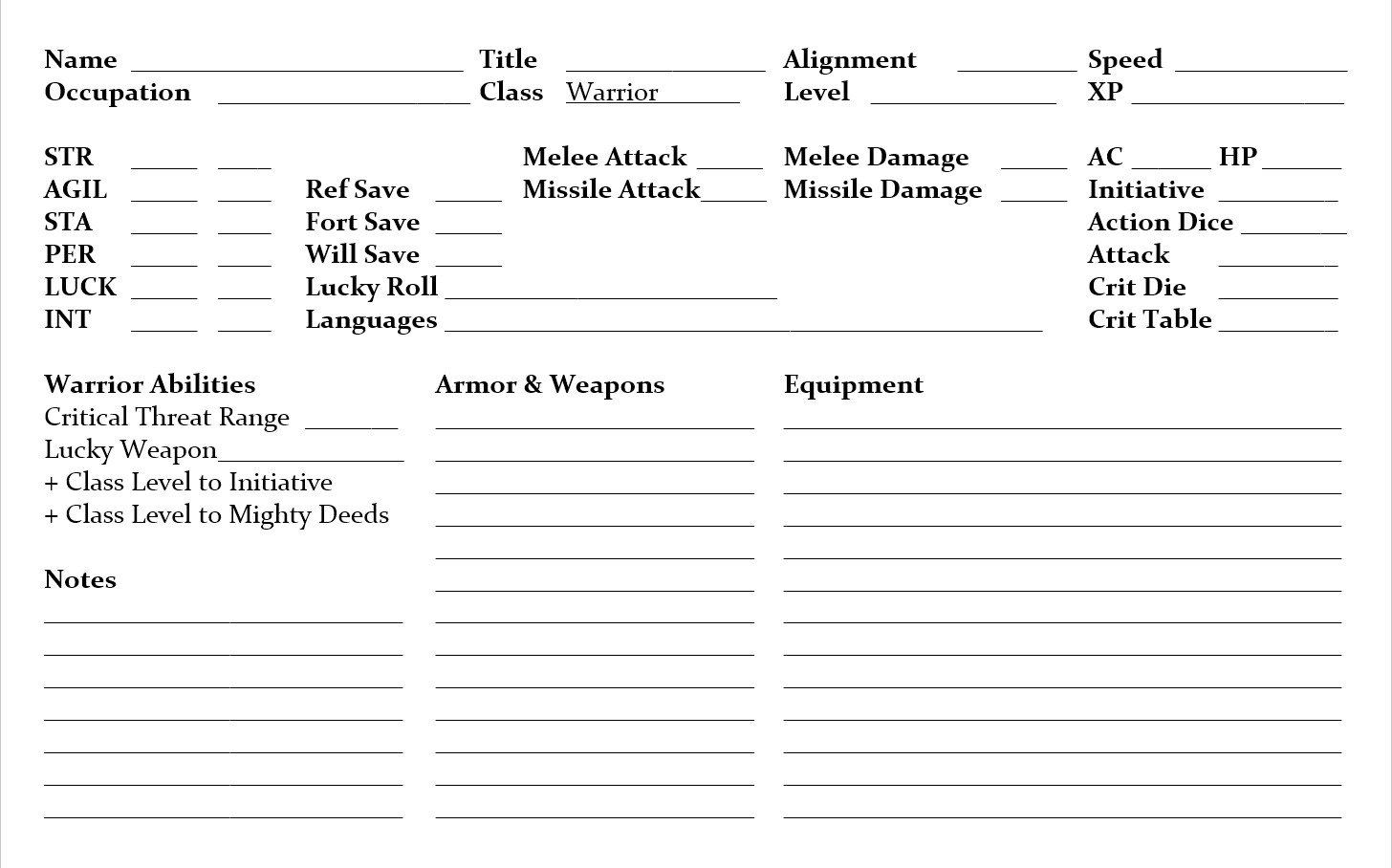
I tried making a 4x6 card for Dungeon Crawl Classics (DCC) and I couldn't. I ended up going to a 5x8 size and this worked a lot better. On the downside, these no longer fit in my notebook journals. DCC puts a lot of extra info on a character sheet, just like B/X and 3.5, things you need in order to play quick and not reference the book, and this information is specific to each class.

The design roughly follows the official character sheet designs, and you will notice things roughly in the same place. AC and HP ended up near the combat info on the far right, but that works since all that info is typically used in combats. The top-center of the card follows the left-to-right fill-in-as-you-go method of the official sheet. DCC has one character sheet per character class, and while they are somewhat similar, they vary in information and structure, with some needing space for spells and other information.

I like games that do not put heavy record-keeping requirements on players, especially if I am playing four or more characters in a game. There are times when I will roll up a four-person party and play. There are games where I want to create several of those parties and run little stories for them.

It is impossible in any game that requires character printouts of 2+ pages of 8.5 x 11 paper. I end up with dozens of PDFs, or stacks of printouts I just do not want to maintain. Starfinder, Pathfinder 1e and 2e, and most newer games fall into this category.

Castles & Crusades remains my best work for a 4x6 card, and the game strips a lot out and makes a compact character card possible. I still need space on here for Base to Hit (oops), I want a space for race and sex, add a column for primary ability checkmarks, and I will probably shrink the save information lines to free up more space.

I also get a feeling while I can do Savage Worlds Pathfinder on a 4x6 card, the game will feel and play better with a 5x8 card for the character. Some games get too cramped on a 4x6 card, and many do not even fit on the 5x8 cards.

Friday, July 15, 2022

Savage Pathfinder: 4x6 Printable Cards

Making a 4x6 printable character card for Savage Worlds Pathfinder is not easy. The skills take up a lot of space since there are 20+ in the game, and while you do not need them all you still need an open list. And the SWADE skill defaults are on there with "Com Know" being the common knowledge skill.

Ancestry for humans is one item, but for other races can be a long list of items. Edges and class features get six spaces each, whereas hindrances get four. Gear gets the rest with 12 spaces, but you can go straight across if you want. I may make gear straight-across lines like the top ancestry line.

I do not have a power section on this card so that is a problem.

My C&C design uses a lot of space for the save types, and that is a lot of wasted space, so I may be revising that design. This is a design and space optimization challenge, and it is fun to try and be efficient while still being able to write on the card.

Saturday, May 7, 2022

GURPS Character Assistant: Dungeon Fantasy Optimizations

The above is my recommended load list for GURPS Character Assistant 5 and Dungeon Fantasy. You will notice a few missing, and that is because I was going through them one at a time and seeing what they added. If they added a ton of junk, such as modifiers to spells or skills that bloated the lists terribly for not great gain - I deleted them from my load order. With that said, I do not recommend the following:

  • GURPS Dungeon Fantasy 1 - Adventurers
  • GURPS Dungeon Fantasy 3 - Next Level
  • GURPS Dungeon Fantasy 4 - Sages
  • GURPS Dungeon Fantasy 7 - Clerics
  • GURPS Dungeon Fantasy 9 - Summoners
  • GURPS Dungeon Fantasy 12 - Ninja
  • GURPS Dungeon Fantasy 14 - Psi

Sages, Ninja, and Psi are so rare I say leave them out unless you are using them. Clerics and Summoners are the worst offenders, but even Next Level and Adventurers add "Holy" and "Unholy" domains. Adding a dozen new subdomains for clerics and spirits is just not worth the skill and spell list bloat for hundreds of extra spells, all very specialized variants like the following:

These are just two spells, with 18 specialty options each - and this goes on and on for many spells! With my load order list, this is what it looks like:

The only power types in the game are Clerical and Druidic - which match the base game, and these are the only power variants you will see. Holy or Unholy cleric? I don't really care since we already have Cleric in the base game, and being evil or good is your thing. You are a Cleric. Or a Druid.

When we base the game off of the GURPS Basic Set, things get a little different...


For GURPS Dungeon Fantasy

The above is what it looks like for my GURPS Dungeon Fantasy load order. I am not even sure "GURPS Dungeon Fantasy 1 - Adventurers" is supposed to be used with the base Dungeon Fantasy game since it adds those Holy and Unholy modifiers, and without Cleric present, it makes more sense for this GURPS setup:

Without Cleric in there, the Holy and Unholy power sources make sense in terms of the main game, and if you scroll down you notice Druidic - which is perfect. Three power sources I can live with.

I am also free to add Bio-Tech, Powers, Thaumatology, Low Tech, or anything else in there. I just did these since they get you the Dungeon Fantasy experience, plus the race options from Template Toolkit 2.

Also, I am using a hacked GURPS Magic 4e file that removes all those insane Herb Lore and Alchemy subskills, and having those appear on skills like Cartography (Herb Lore) and Sex Appeal (Alchemy) makes no freaking sense whatsoever, and it all but makes the GURPS Magic 4e file worthless to me. I backed up the file, deleted those huge blocks of code that add a few hundred worthless variant subskills, and my skill list and load times are thanking me. I still have the "pick a specialty" versions of Alchemy and Herb Lore, so I am not losing anything of value.

Also note my hacked Remove Unnecessary Traits file at the end there, as we created in a previous post.


Pick Only What You Need

GURPS Character Assistant is a great program, but it comes with way too many options and if you start adding anything and everything to your libraries, things get unplayable and unmanageable really fast.

I like being able to scroll through a spell or skill list and pick out things I want. Add a few thousand mostly worthless repeat options on there and my eyes glaze over and I go back to Pathfinder 1e.

Being selective with your libraries, and not being afraid to edit the files and make them your own is the key to getting the most out of this program. Also, please BACK UP your edited and unedited files, as any updates will likely blow them away without warning.

Setting Up GURPS Dungeon Fantasy

I like Dungeon Fantasy, I really do.

You can probably see where this is going.

But I LOVE character tweaking. Giving my dungeon fantasy character wings out of GURPS Bio-Tech? Um, well, in GURPS Character Assistant 5 you have to load the Bio-Tech library. Okay, cool, add that to my current Dungeon Fantasy library and, what's that?

I need the Flight advantage from the main GURPS rulebook. And that isn't compatible with the base Dungeon Fantasy book. So it throws an error.

Argh!

Well, there is a solution. It took me a while to figure out, and it means understanding load order and copying and editing a file - but this works.


GURPS Dungeon Fantasy

Okay, we have to understand the difference between the basic Dungeon Fantasy rules and the GURPS Dungeon Fantasy rules. Wait, they are the same game, right? Well, not exactly.

Dungeon Fantasy is its own game, with standalone rulebooks. Spells have been removed and tweaked. The advantage and disadvantage lists have been cut down. The game is 100% focused on dungeon crawls, and that is a good thing.

GURPS is the superset game. It covers all genres. To get something roughly equivalent to Dungeon Fantasy you will need to combine a few books: GURPS Basic, GURPS Fantasy, and GURPS Magic. You will have more spells, more advantages, more disadvantages, and more of everything in this mix - even high-tech items that don't belong. Your experience will not be the same as Dungeon Fantasy, but it is a classic game.

There is a hybrid creation in GURPS Character Assistant users refer to as "GURPS Dungeon Fantasy," and this is essentially the same game but using GURPS Basic Set, GURPS Magic, and GURPS Fantasy as the base game instead of the Dungeon Fantasy rulebooks, and adding in all the Dungeon Fantasy world books in the character creator.


GURPS Character Assistant

The nice thing about the Dungeon Fantasy setup in GURPS Character Assistant (GCA) is it gets rid of a lot of the stuff you don't need, and only includes things from the base Dungeon Fantasy game. Let's look at a setup in the library of a standard Dungeon Fantasy game:

This is sort of how a library works in GCA. Load the base book first, and then your expansions, and the load order matters or you get an error. The thing to remember is the base "Dungeon Fantasy RPG" book is the rulebook you will use to create characters as your primary source.

But what if you wanted to use GURPS Basic Set, GURPS Magic, and GURPS Fantasy as your "base rules?" Just get rid of "Dungeon Fantasy RPG" and replace it with the three books, as shown:

Notice the first three books, the GURPS books took the place of the Dungeon Fantasy RPG! But also, look at the last file, this one called "Dungeon Fantasy Remove Unnecessary Traits." What is that? This is the file that removes all the modern, sci-fi, and other unneeded traits that Dungeon Fantasy does not include - but are in the main game. Functionally, your game will be equal to Dungeon Fantasy, but you will be using the original GURPS Magic spell lists instead of the Dungeon Fantasy ones.


It Removes Too Much!

But what if you wanted those sweet powers from GURPS Bio-Tech, like angelic wings? We would just add the GURPS Bio-Tech book in there, right? Well, you could, but you try and add those wings and the wings will have a missing dependency on a file that "Dungeon Fantasy Remove Unnecessary Traits" removed - the flight advantage from the Basic Set.

How do we add it back?

Well, we keep it from being removed in the first place.

The "Dungeon Fantasy Remove Unnecessary Traits" file still does a lot of great things, like getting rid of a lot of modern skills and gear so our character creator does not get cluttered up with stuff we never want to look at or ever use. But it is a hammer of a solution, and it removes a lot of cool advantages and disadvantages that we may want to use to create characters.

What if I want angelic (or demon) wings? A mermaid with a fishtail? A naga with a snake tail? Use the classic "Enemy (Formidable group)" disadvantage many GURPS players love when their character is hunted by others? Or make a rabbit or frog person with super jump? A one-armed pirate?

We need to hack the "Dungeon Fantasy Remove Unnecessary Traits" file and remove the section that adds all the cool base game advantages and disadvantages. This also enables add-on books that have requirements on this file (like Bio-Tech) to function correctly.


Hacking Time

*** BACK UP ALL YOUR FILES BEFORE YOU CONTINUE!!!! ***

With that warning out of the way, let's hack that file. You will the file "Dungeon Fantasy Remove Unnecessary Traits" file in:

C:\ProgramData\Steve Jackson Games\GURPS Character Assistant 5\books\worldbooks

...in a default install. Open that up in a text editor, and I use Notepad++. First, save this file under a new file name. Now go in the file and scroll down to line 105, and you will see the script lines that delete the advantages. Clear out all the deletes except for the first three:

#Delete "AD:Ritual Magery 0"
#Delete "AD:Ritual Magery (%skill%)"
#Delete "AD:Ritual Magery ([skill])"

Those delete the Ritual Magery advantage, and we don't need that in our Dungeon Fantasy setup - so DO NOT delete those lines. Instead, delete lines 106-333 and 338-486 and save the file with a new filename, as instructed.

Now, instead of using "Dungeon Fantasy Remove Unnecessary Traits" in GCA, use your new file, and this will delete all the high-tech gear and skills, but keep that advantage and disadvantage list of the basic game intact. You will have some strange ones in there, like stretching, but hey, you may have a blob character that uses it, so it's all good.


My Setup

This is a custom setup I made, and this includes a lot of cool GURPS books, and you may notice the file on the end, "GURPS Dungeon Fantasy Remove Unnecessary Traits (Keep Advantages)" - which is my hacked file that removes the modern gear and skills, but keeps those cool and sweet advantages! I could add GURPS Supers to this list as well if I wanted since that has main rulebook dependencies.

My setup has since changed as I am adding in a lot of cool books, but you get the idea!

And best of all, this setup throws no validation orders on load and gives me an expandable (and clean) GURPS Dungeon Fantasy setup I can expand with any GURPS book I want and not worry about dependency errors with advantages or disadvantages.

Note, again, this is a "GURPS Dungeon Fantasy" setup, and NOT a "Dungeon Fantasy" setup, so you are using GURPS Fantasy and GURPS Magic for your game instead of the Dungeon Fantasy main rule and spells books. If you like base game compatibility and prefer the spells out of GURPS Magic (or Thaumatology), this is the way to go. And you WILL have ALL the Dungeon Fantasy 250-point templates to choose from, so you are not losing those. Very cool.

Personally, I would rather have the expanded magic list out of GURPS Magic, even if the spells are a little unbalanced for dungeon crawling. I get to use GURPS Thaumatology! My corruption magic GURPS Bio-Tech mutations are in there and work correctly! I have GURPS Low Tech! If I want to design monsters with superpowers, so be it!

And if there is anything else in the GURPS Basic Set I see missing, I know where to go and how to edit that file to bring it back. And, if you find some you are still not using or just don't want to see, like "Digital Mind" how to put them in your custom exclusion file to clean up your library, but the way you want to see it cleaned up.


More Soon...

I am still tweaking things and finding things in the base scripts I want to be cleaned up, like the reference to air traffic controllers they left in there (in the unedited script). Also, I am working on a recommended list of books to keep the skill list short and tweaking the load order to make things right.

I also don't want to eliminate Digital Mind since there may be automation-type characters in the world.

The tweaking goes on, and I will have more to post soon.

Learning GURPS Character Creation

There are a couple good resources for helping create a GURPS character, but nothing beats experience. The GURPS for Dummies book has some good basic descriptions of abilities and skills, and it is a getting started resource that helped me some until I started to get deeper into the subject.

Nothing beats iterating over a character design until you get it perfect. The GURPS Character Assistant program is great for this, just be expecting to be loading up, tweaking, printing, loading up, tweaking, and printing your character until all the "cool to have" skills are gone and you are left with the "must-have" ones. You will forget some of the skills you need! And you will be swapping skills out of templates (such as the Dungeon Fantasy ones) to switch up for the skills you really want - even if they are off template some (get GM approval for swapping skills and tweaking your design and tell them why).


History Required

The best piece of advice I have is to create your character history!

Once I did this, picking skills became way easier for me. 

Instead of aimlessly wandering a supermarket randomly throwing things in a cart, I had a history I could go through, say yes, she learned this skill growing up, and she needs this because this is in her background, and she fights with a spear instead of a mace (and does not need two shield skills and a generic throwing when throwing/spear is a much better pick). She spent her youth in the woods and doing a lot of exploring, along with traveling in her seminary years, so she has a few wilderness survival skills focused on the colder climates. She knows how to ride and care for a horse. She fights with a shield and spear, the weapons of her goddess.

I ended up dropping a few of her more social skills, such as ones she has not developed yet such as public speaking and leadership. Those were "nice to have" but I can see her buying those as she does that in the game and needs to improve in those areas. Nothing in her history said she really needed them either, so I dropped them for a few more survival skills.

Would I like to have them and are they a part of my character concept? Yes! Are they something she could buy later as she leads people and gives rousing speeches? Yes. Some skills fall under that category of "future history" and go on your shopping list for character advancement, but she may not ever need those or end up buying them given the adventures she has, so it is better to wish-list them and save the points for skills you should have given your character history.


Loadouts and Gear

Another great tip is to use the equipment list, put things in backpacks or containers, and track those separately as weight. The loadout manager lets you create loadouts, so I created three load-outs for her:

  1. Town (clothes, armor, no spear, no shield, and no backpack)
  2. Combat (clothes, armor, spear, shield, and no backpack)
  3. Travel (clothes, armor, spear, shield, and backpack)

Since things are heavy and combat speed matters, she now has a few options for tracking weight carried and her current speed. When she is in town, she is not typically carrying a spear and shield around everywhere unless she is just passing through. When she has enough money and needs a "casual" loadout with nice clothes for temple day or visiting royals in a castle, I will create another for her. The combat loadout is travel with her backpack dropped on the ground. The backpack by itself weighs 24 pounds, and could carry 16 more, and dropping it bumps her up to light encumbrance instead of medium, giving her a better dodge and a move of 4 instead of 3.

Oh, how I love weight tracking and standard load-outs in old-school games. A lot of people are deathly averse to per-pound encumbrance, but I see creating load-outs as an integral part of character design and the icing on the cake of a well-designed character.

Create standard "load-outs" for different situations and modify them from there.

When you design a character, especially for fantasy where the weight of armor and weapons really starts to matter, you realize the tradeoffs you are making in that weight to combat speed calculation. Not every character is going to be able to sprint at full speed in plate mail like you can in a pulp game, and your party's "armored nuts" are going to be slower but be able to take a lot of blows up there in the front ranks.

You start buying extra points of STR, and it is not just for damage. You give the heavy bags of treasure to the mages and back rank characters first, so as not to immobilize your already-burdened front-rank fighters. Your choice of armor - for each character - matters a whole lot. That armor choice influences positioning and combat. You build a travel loadout for each character should you need to go without mounts or hirelings, so you can walk all the way there and still have your fighters in plate mail get there without slowing everyone down too much.

Does your armored nut dwarf fighter travel with his plate-mail off, keeping the full set of armor in a pack mule, and wears studded leather armor when on the road? That difference in speed could mean the difference between a one-day trip and a two-day one, and that brings up issues with carrying supplies, traveling at night, camping and being able to move to avoid encounters.

Or maybe you create a lighter loadout for your party for special situations, like raids or other actions where you need to move fast, get in and get out, and avoid pursuit. Maybe your front-rank fighters don't have plate armor for these missions, and focus on speed and hitting power so they can work more effectively in maneuver and tactics.


Encumbrance is Good Character Design

If you look at any book covering war history, and you get the story from the perspective of infantry, you are bound to get a part of the book discussing what they carried and how. You will get information on the lighter weapons they liked and the heavy ones they didn't. How they carried ammunition and pieces of crew-served weapons for other members of the unit. How the unit shared the load with supplies, food, water, and other necessities.

In war, you optimize loads and track detailed weight. Even in camping and hiking, you do the same thing. What you carry and how you carry it are as much a part of your character design as your skills, abilities, spells, and powers. Great gear in itself is a power, and this is that hidden part of old-school gaming so many are adverse to but it is one of the most rewarding parts of the game for me.

I played Skyrim and I loved it when my character slowed to a crawl carrying too much junk. I used survival mods and staying too long in the cold meant death. Slow movement meant increased exposure. There were times I could get to a dungeon in a frozen part of the map, but could not get home after looting it because my character was too slow from all the loot they were hauling and died from exposure. In warmer parts of the map, they were too slow and got killed by pursuing ambushers.

Once you really get into gearing a character and optimizing based on weight, you start to see and play the game in an entirely different light. Without weight tracking, you tend to min-max solely on combat abilities assuming that "full unencumbered move" - and this is completely theory-craft unrealistic, like some sort of video-game character who can vacuum up 1.6 million gold coins and a full backpack of plate mail armor pieces from a Diablo II dungeon and not be weighted down one bit.

And one of the best parts about weight tracking is a great GM will apply the same considerations to enemies. Those plate-mail armored orcs you don't want to fight? Yeah, you are all lightly loaded, you can outrun them all day, or just move at normal travel speed and they will be left in the dust after a few hours. If they ditch that armor and rush to catch up, that is another thing entirely, but when they catch up to you, guess what? That's right, they ditched that armor. And they are probably winded from having traveled at a faster rate to close the gap.

And this lets the players take advantage of situations that would have normally penalized them, and use it to their advantage. As a GM, you just don't use rules to punish players, you use them fairly for everyone, and if the players find a way to work that system to their advantage? You let them have it.


Iterate and Keep Designing

One of the most difficult parts of GURPS is character design. This is why people quit before they even start. I found my cleric designed in Dungeon Fantasy/GURPS took up less sheets of paper to print and read than her in Pathfinder 1e. She was this dense, tightly designed, weight-tracked, and she was a masterpiece of a piece of design and trade-offs. Her skills and abilities reflected her background. She had different "operating modes" depending on her situation and gear.

Just keep designing different characters and be unafraid to make mistakes. If you omit a skill, get approval from your group to make a change to better get a character you are excited to play. Shop for skills and abilities based on your history. Browse the skills in the book, and understand the subtle differences, like between perception and observation. Don't be afraid to drop skills and put them on your wish list. Drop duplicate skills you don't need, like skills in several types of shields. Swap skills for ones you want.

And design characters from other genres and times to understand how setting reflects on character design. In fantasy, transportation means walking, carts, sailing, and horses. In modern times, people drive cars and take mass transit. In a sci-fi game, maybe there are monorails everywhere, and driving and owning a car is not that important for urban characters. These considerations apply to your history. and get reflected in everything from lore, background skills, and hobbies.

I like my more detailed survival cleric. She outshines her Pathfinder 1e version in many ways. Pathfinder 1e has its strengths in variety and structured builds, but Dungeon Fantasy/GURPS lets me play game designer and craft a character based on the limits I create in my mind from a character's history and background.

I don't need a book telling me, "Clerics are this but not that."

I get to do that.

My cleric is this, and not that.

While the structure in Pathfinder 1e is there to speed character design and play, there are times I find it severely limiting. Hero Lab is a program designed to enforce the limits of your choices. With GURPS Character Designer (and Dungeon Fantasy), you start with limits based on profession and you are free to break them. It is a program, and a game system, intended to be a box of Legos used to build any character you can imagine.