Showing posts with label Mutant Crawl Classics. Show all posts

Thursday, October 30, 2025

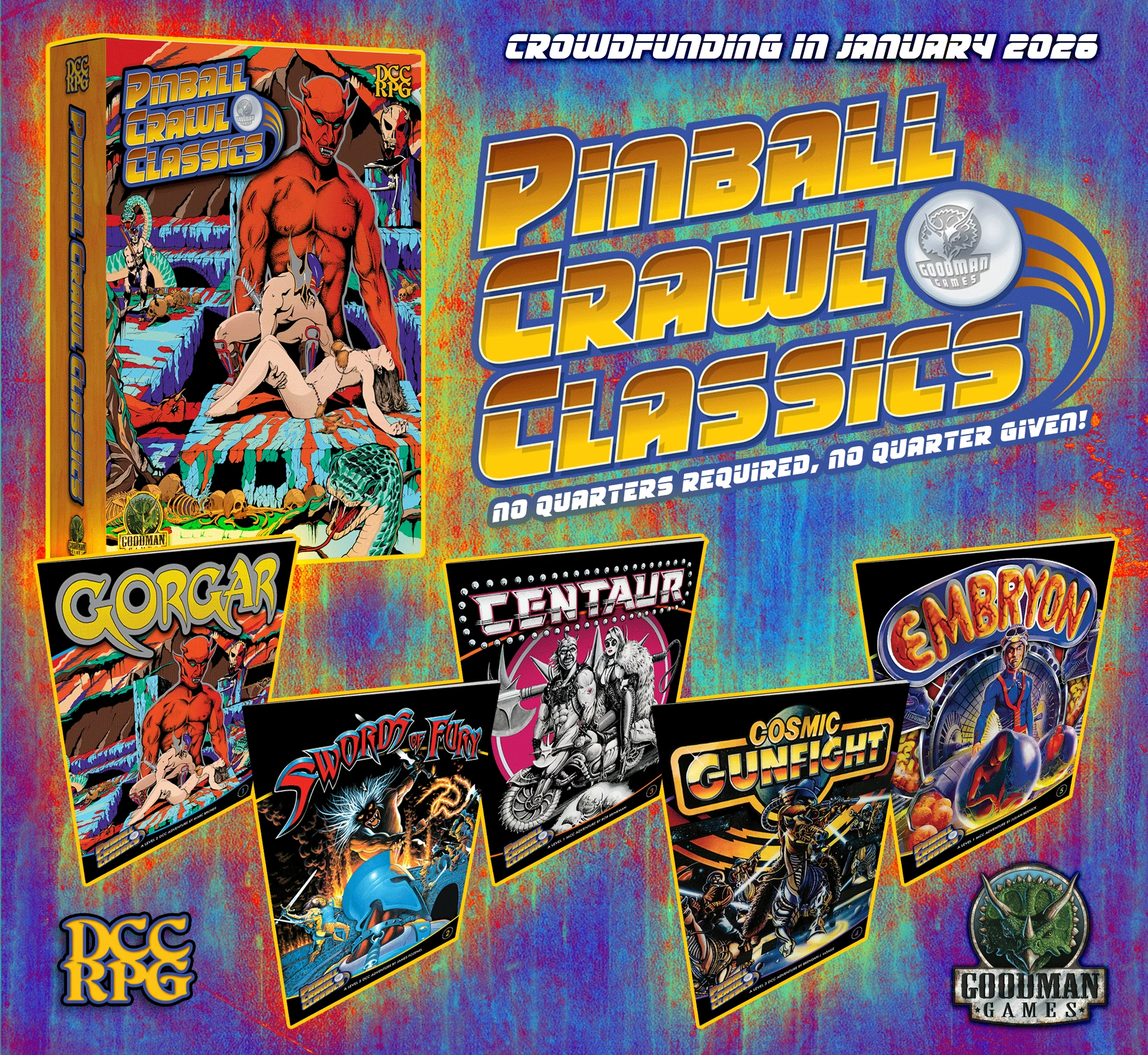
Pinball Crawl Classics

https://www.backerkit.com/call_to_action/891f2362-d05c-43a2-857f-417bb038207d/landing

Okay, this restores my faith in DCC and Goodman Games. A series of licensed pinball-machine-inspired adventures for DCC and MCC. What a cool idea, and this fits the game and brand better than a series of converted 5E adventures.

For a moment, I felt DCC had no direction and was a little lost compared to BX, BXA, and 1E. Now we are back in nostalgia-land again, but on some very amazing and fresh ground that has never been done before.

Thank you.

This is the sort of creativity, inspiration, and fun the hobby needs.

Sunday, April 13, 2025

Mutant Crawl Classics plus Mutant Future

My first game from Goodman Games was Mutant Crawl Classics (MCC), as we were big fans of Gamma World. I discovered DCC later, dismissed it as being "too much," and then spent a little more time understanding the game, falling in love with the system.

Once you understand that everything in the DCC book is optional, including the tables, the game plays like a rules-light 3.5E, functioning as a streamlined, generic, and quick system that handles a wide range of scenarios and genres.

Once I understood why the spells had so many tables and how spell-burn and spell duels worked, the floodgates were opened. Then, lay Rule Zero over the game, and all of a sudden, you have a fantastic toolbox for rules-light 3.5E.

I came to MCC looking for more of my other favorite post-apocalyptic fantasy game, Mutant Future (MF). This is another classic Gamma World-inspired retro-clone, and it still holds up well today. This game is also cross-compatible with Labyrinth Lord, providing you with even more options for reskinning and use in your game.

Mutant Future is one of the best "stuff books" for MCC, offering an impressive selection of equipment, weapons, vehicles, robots, monsters, and other items to utilize in your MCC game. As a resource and a game in its own right, Mutant Future is indispensable for the realism and grit of the setting. The MF game assumes a feudal, long-gone postapocalyptic world, but has that classic Thundarr and Gamma World vibe, where the ruins of the old world are still recognizable. MCC is more fantastical and alien, with the lost world being even farther back in time and relegated to myth and twisted legends.

MF is an excellent, B/X-style science fiction game. It is compatible with Gamma World (1st and 2nd editions) and Labyrinth Lord. By itself, it is a fantastic game.

As an expansion for MCC, it significantly enhances the game. You receive all the low-level details that MCC overlooks, including gear lists, prices, treasures, weapons, primitive water travel, and all the necessary components to support a feudal society, as well as an explanation of how "all the civilization" works. If you want to barter for an oil lamp and a mutant beast of burden, you can find them here.

These two are my "peanut butter and chocolate" post-apocalyptic games, which pair perfectly together and blend seamlessly, or are wonderful on their own.

Sunday, December 1, 2024

The 3.5E Era

The D&D 3.5E era inspired many fantastic games. In addition to D&D's "last best" version, we have a collection from that era and are still keeping tables playing some incredible games.

The most obvious is up first, Pathfinder 1e. This is still an S-Tier game, but I have learned to appreciate the original D&D 3.5E rules. The two are the same game, but their focus is entirely different. D&D 3.5E is purely a dungeon-crawler, whereas Pathfinder 1e is a fantasy story path game. This seems like splitting hairs, but once you look at the skill list of each game, plus the GM guides, you will see the differences clearly.

D&D 3.5E is still the best version Wizards of the Coast has released. The fully supported campaign guides seal the deal for me. If I want to play in Eberron, with Eberron-specific character options, 3.5E is the only way to go. The same applies to the Forgotten Realms, Ravenloft, and the other settings supported during this era. In comparison, 5E is a generic fantasy game. At best, it does rules-light emulation of these settings, though rules-light seems arguable these days.

I can't play the original TSR settings with Pathfinder 1e; the game feels too Golarion-focused, and the unique character setting-specific options are manual imports and unsupported in Hero Lab. I would rather play the OG settings with the OG 3.5E books.

OG Golarion, as it existed in 2010, was still awesome before the PC changes came in. However, the world has been on a downhill path ever since, becoming more steampunk, cute, and too modern for my tastes.

If there were any setting I would play, it would be D&D 3.5E Eberron. I can't get all the special classes, toys, tech, options, and flavor as the original game running the original sourcebooks.

Another game from this era is Castles & Crusades, which is still going strong. This is my 5E-style "simplified emulation" game, but it feels throwback and retro in its style and vibe. C&C feels like old-school AD&D, but it is far easier with near-zero charts to reference during play. This game can be hacked to feel like 5E or an AD&D-style game. The characters are balanced, and you must play with old-school sensibilities.

This was the last game Gary Gygax played and was involved with, so it has his approval. It makes sense, especially for older players who have little time. C&C lets you have a full dungeon-crawl and character-building experience without needing online character sheets, complex rules, action types, or books full of charts. It just "does what it says" without too much fuss.

Any game where I can run characters off 4x6 index cards is a winner. The above is my current design, and I laser print these and have hundreds in a file box, ready to go. If I wanted to emulate a classic setting, such as Forgotten Realms, Castles & Crusades would be my go-to game. The characters are d20, while the rules emphasize simplicity and pulp-action.

Why take all the scaffolding of 5E, the action types, the heavy characters, the strange resting mechanics, the invincible characters, and all these MMO-inspired rules?

C&C does all the d20 I need.

Also, Amazing Adventures is built off this game engine, and it is an entertaining pulp-style modern d20 adventure game. This game needs more attention; it could play any TSR boxed set games (Top Secret, Gangbusters, Star Frontiers, Boot Hill) from back then and still feel like an authentic d20-type game in those genres.

AA is a new game that was published this year, too. So, the 3.5E Era games are still alive and well, and a new version of C&C is on the way, too, devoid of the OGL. AA seems like the beta test for C&C minus the OGL, and the next version looks promising.

OGL-free 3.5E Era games are incredible.

Mutants & Masterminds (3rd Edition) is another game from this era. A d20-based superhero game? This works well and is supported by an excellent line of books and Hero Lab support. M&M is the superhero game everyone forgets. Did you hear about that new Marvel game? The latest DC game? Every few years, the license for "licensed IP" heroes jumps again, and we still have Champions and M&M to use for super-powered gaming.

The superhero genre as a pop-culture phenomenon is stuck in a vast rut these days, as the IP is farmed, and 90% of what Hollywood makes for movies and TV is worthless as a source of inspiration. I suggest buying a few graphic novel collections from your favorite superhero eras, using those as your "team books," and creating the characters yourself. 

Don't look for other people's interpretations of heroes; start small. Choose street-level heroes to start, make them just starting out, pick your favorite two or three characters, choose one villain, and begin there. Also, you don't need to follow a comic story or quickly assemble an entire team. Let them pick the powers they want, and don't follow the official character guides for their builds.

Perhaps in your world, Batman and Captain America reluctantly team up, and the Justice League, Shield, the X-Men, or the Avengers will never be groups. Ban existing groups, factions, and teams, but use the characters and let them find each other, fight, team up, or never meet. Treat the characters as "players who log into a superhero MMO" and let them develop characters and form teams organically. Bad guys may not be bad guys; the books have yet to be written here.

You can write your own stories and comic books with a "new world and cold start," you will have more fun being creative with hero pairings and villains. Use your own heroes, licensed IP ones, or an entertaining mix. Drop everyone into "today's world" a few at a time, with nobody knowing what is going on, and begin the game fresh.

I pick up any "superhero encyclopedia" and instantly get overwhelmed. I am lucky to have the pre-Disney Marvel one, the last one they did as Marvel before the sale in 2009. While these are a good source of heroes' powers, the amount of plots, groups, and stories will overwhelm you.

Another fun 3.5E-aligned game is Dungeon Crawl Classics. This game leaned more towards the B/X and zero-edition style of play, but the Fort/Ref/Will saves give this game away. This is a 3.5E derivative game and goes hard on the gonzo, unpredictable, crazy, and mind-blowing style of fantasy where nothing is familiar, the world is on its head, and characters are larger than life.

DCC feels more like classic Greyhawk than any of these other games, especially the S-series modules, in which characters navigate deadly deathtraps built by liches, a mad wizard's volcano labyrinth, or the inside of an alien spaceship. Many of today's fantasy games have gotten too stale and predictable, with characters feeling set in stone and the same old product-identity monsters occupying differently shaped rooms. Magic has become MMO DPS in 5E, which is also far too predictable and reliable.

DCC is strange; the dice are bizarre, the game is a collection of random charts, and you have no clue what comes next. Even using this to play through 3.5E modules is a fun experience, and the entire "zero to hero" path for a collection of random no-names is like nothing in gaming. No "pet characters" exist here; this is chaos and emergent storytelling.

Mutant Crawl Classics and several other sister games fill out the line and give you a bunch of settings and base characters to choose from, all compatible. You have post-apocalyptic, science fiction, combat sports, superheroes, westerns, and many other "zine games" supported by this system that gives you near-infinite options.

And there are many other 3.5E games out there, including the Conan-inspired Hyperborea, a Traveller 20 clone, and others. You don't need to leave the 3.5E era to have a fantastic library of D&D classics, Pathfinder 1e, Gonzo Fantasy, Traditional Fantasy, Pulp Adventure, Science Fiction, and many others.

The 3.5E Era, and all the games derived from it, are the heart of gaming. There is a sphere of B/X-aligned games in the OSR, but when you just look at 3.5E, there is a lifetime of fun to be had here, both with classic and new systems, all having their roots in that early 2000s era of gaming, and the last, best-supported version of D&D ever published.

Thursday, January 12, 2023

Goodman Games: We Will All Be Fine

https://goodman-games.com/blog/2023/01/12/a-comment-on-the-ogl/

From the above:

Goodman Games has supported tabletop role-playing games in all forms for 20 years, and we plan to continue supporting it for many years to come.

As you may be aware, Wizards of the Coast may consider amending the Open Game License which may include changes to how it manages licenses to third parties. 

We have reviewed the possible changes and determined that they will not impact our line of roleplaying games, including Dungeon Crawl Classics, Mutant Crawl Classics, Xcrawl Classics, and related products; Fifth Edition Fantasy, Original Adventures Reincarnated #7: Dark Tower, Original Adventures Reincarnated #8: Caverns of Thracia, and related products; and our other lines.

Fans, don’t worry. We think we will all be just fine.

Good to hear they are standing strong and keeping the game alive. I love this game, and DCC/MCC are some of the best RPGs out there.

Thursday, November 3, 2022

Freedom is Imagination

One of the best examples of "freedom is imagination" is in Dungeon Crawl Classics. Let's say your level 4 rogue goes to an alien world and finds a green energy flamethrower that does 3d6 in cone or 6d6 to a single target, with a low roll, meaning bouncing the flame back into your face, hitting allies, bringing down the roof, setting the whole room on fire, or it breaking down.

I made that weapon up. It is a silly one-shot fantastic piece of alien tech I made up in my head.

And it is not in the rules, which is the critical point.

DCC encourages you to use your imagination and makeup magic treasure, monsters, traps, settings, weapons, NPCs, and adventures - and just go wild making everything up! They give you a few sample monsters and magic items, and if you read the modules, you will get flooded by custom monsters, magic items, gear, environmental conditions, NPCs, spells, patrons, and all sorts of strange and wonderful stuff. No module honestly re-uses monsters.

My green flamethrower weapon? Same idea. It is something I made up and is probably the rogue's new favorite weapon and toy, and will probably serve the rogue well as long as he or she still is alive to use the weapon.

Does it unbalance the game?

Yes!

But think about this, in the next game, that weapon doesn't exist.

So I do not really care.

When you play a new module, everything in the other modules doesn't exist (unless a character survived one and carried something from it forward). Anything in those modules that breaks the campaign does not break the base game.

The base game is untouched by all the silly ideas you or module writers can come up with. The reset button gets pressed, and the next group of heroes goes into the world and finds all sorts of crazy loot while that may be "campaign-breaking" stuff, it won't last beyond that game, and the base rules will still be untouched for the next time.

But a lot of games have this assumption, "if it is in one module or adventure, it is canon!"

With DCC and MCC, really only the base books are canon - if you can call them that. They are starting points, and they both make a point of only including a few examples of monsters, magic items, technological devices, and other items - and while they give you a lot, the entire focus of the game is the DIY craziness of your own imagination. If what you create is unbalanced, it won't affect the next game, and you are free to use GM Fiat to break it, make it run out of charges, make low rolls hurt, or have it fall down an infinitely bottomless pit of doom. Most of the time, just leave it be and live with it.

So you broke your game, so what?

That is the amount the freedom the game gives you.


5E

Compare this to 5E.

Don't you dare break Wizard's game!

I exaggerate a little, but you get the point. There is this fear and feeling anything that goes into 5E must be balanced, and it must be put on some "equipment list" for use in the future and anyone else's game. If it is a 3rd party "thing," then some players won't even add it to their game - only official books, please! Please don't mess up my game!

This feels like the complete opposite tone and feeling of DCC and MCC. You are supposed to play "game designer" in these games and make most everything up. You should invent crazy skull-headed laser wands with death rays that can bounce around corners and back into the wielder's face. Mind control helmets. Rings of acid skin. Monsters that are giant tongues with legs. Floating eyeballs with freeze rays. Insta death traps. Is it balanced? Who cares?

The less exhaustive lists and giant bestiaries a game gives you, the more freedom you have. There is a sweet spot of including enough types of different things to give you rough parameters, but there is a point where a game stops being a game, and it becomes a "game of lists" that shackles your creativity.

In B/X or D&D, why do I need to imagine a custom "magic aegis of bird control" sword when that "sword, +2" on the magic item list will do just fine? Lists can also turn your game into a buffet of bland choices and remove any creative input you would have had into the game.

Huge lists? Less freedom.

Since I only play OGL versions of 5E, this feeling affects me a lot less since everything in my game is fantastic. There are players who do not play with anything 3rd party, so there is that feeling in the community.


Low Fantasy Gaming

Low Fantasy Gaming does a little of this DIY stuff with the "every 3 levels" class features where players can invent class powers, and also in the "exploit system" where a damaging hit can add a special effect the player gets to invent. It does all this in the 5E framework, which is frankly astonishing, and it also maintains numeric compatibility with the base game.

LFG also tosses out a bunch of 5E rules the game does not need and tells you to make it up if the rule doesn't exist. It puts trust and "game designer hats" on the referee and players. It is less crazy and gonzo than DCC or MCC, so it sticks closer to realism and believability.

Low Fantasy also does not feel brave enough in "dark and dangerous magic," with most magical corruption effects having a duration and permanent effects being terrible rolls. It feels like a "stater game" when it comes to permanently changing player characters, where DCC and MCC are thrilled to have a wizard grow horns and his skin turn green - permanently. There still is that 5E style of "player protection" in LFG, compared to the "it is okay to toss your character sheet in the shredder" DCC and MCC games.

Having a game go out of its way to protect players is also a loss of freedom.

That aside, I still feel LFG is the most interesting 5E clone out there, and I like it slightly better than Level Up 5E since this game makes an effort to bring OSR concepts into a 5E framework. One could argue that OSR concepts do not need all these "minigame frameworks," and that is a valid point, but the amount of 5E rules tossed in the bin by LFG gives me a new perspective on the 5E engine and how good it could be if stripped down and fine-tuned.


You are Not Your Character

This is also why "seeing yourself in the game" and "playing a version of yourself" is dangerous, and back in the day, we were always warned not to do this. These days, I feel companies are pushing games with identity marketing and making it impossible for a character to die - because I feel they are very irresponsibly pushing the idea that "the players are the characters." Back in the day, we were told this was damaging psychologically, and in a game where bad things could happen to characters, this was something you did not do.

Players should never be characters or self-insert into the game, ever.

And yes, a game that encourages you to "be in the game" also reduces your freedom since there will be "safety rails" built into the rules, and your character options and choices will be limited or more focused on either human or pop-culture-centered lineage choices. And I feel this is also a very irresponsible method of retention and marketing that (in my feeling) could damage players' mental health.


Games of Imagination

Going back to Dungeon Crawl Classics (and also MCC), I have a soft spot for this game. This isn't D&D fantasy, nor is it an "early 1980s D&D simulator." There was this specific subgenre for roleplaying in the late 1970s and 1980s that embraced the culture of black-light felt paintings, painted vans, disco sucks 1970s rock culture, the drug subculture, underground 1970s comix, the hippie culture, adult comedy records like Richard Pryor and George Carlin, CB culture, and a lot of the significant underground subcultures of the 1970s that found their way into roleplaying games.

The culture was a middle finger to big corporations, the military-industrial complex, government, organized religion, the sycophant media, and popular entertainment - TV, radio, mainstream comics, and movie studios (Disney too, who were notoriously litigant against underground comics). Pop culture and pop music was trash. Video games were not a huge cultural thing. If you don't know anything about this culture, take some time and learn about it - this was a fantastic period of culture that brought us so many of the classic songs, movies, and TV shows we love today.

People that made these comix and underground culture were arrested, sued, and jailed.

And the stories and tales - the actual Appendix N stuff - were freaky, out there, and wild, man! This wasn't even like today's anime which, for the most part, has high artistic merit and technical skill - but is still primarily either corporate or a higher form of art. I love anime, but it was nothing like Appendix N source material and the "Hippy and Freak Culture" of the 1970s. The underground was very anti-authoritarian, and yes, this would also be anti-big publisher games from billion-dollar companies.

And this culture emphasizes the individual and creativity.

A lot of the social conformity of this era would be frowned upon.

You are you.

And you - that cool, fun, unique person in the mirror, however you choose to be - are remarkable. And a massive part of this is "making stuff up." Because the stuff you dream up is just as cool too.

Unlike other games where you feel looked down upon for adding your creativity, DCC and MCC require your creativity, celebrate it, encourage it, and make it a part of the game. Players get to imagine, too, as creative and imaginative play is critical for success and pushing those dice up the chain.

Creativity is not storytelling in a tightly-controlled rules system, as 5E would have you believe. Creativity is opening the door to you - the players and referee - to create rules, monsters, magic items, spells, worlds, classes, weapons, and anything else you can imagine in your game.

You get to put on the game designer's hat, too.

And the game doesn't handcuff you by giving you giant lists of "stuff" to clog up your imagination and subconsciously tell you "the game's designers are better than you." Again, I exaggerate, but the feeling is there when a game gives you "too much." You will never use everything in the book, so why should you create anything of your own? The characters are simple, so players are not staring at their skill lists with tunnel vision.

Does the game you play discourage you from adding your creativity to the game? Are your contributions seen as "homebrew" or "house rules?" Do you feel to have fun, you need to follow the rules exactly as written?

Or do you want a game that opens that book of creativity in your mind and tells you to "think outside the book?"
Tuesday, July 26, 2022

Gamma World Melee Damage

I love Gamma World, but...

The game using a 1d6 per point of constitution scale for hit points and keeping the original B/X level damages is a mess. With a laser pistol doing 5d6 damage, standard B/X style melee weapons were feeble. The STR adjustment to injury in the first and second editions was STR-15, or STR-6, for a negative modifier.

Vibro-daggers (10 hp damage) and vibro-blades (25) leveled the playing field, but still, there was very little threat from the primitive weapons. This pushes the "loot economy," where the first few rooms need a supply of high-tech armaments just to keep combat balance in check.

Part of me feels they did this to keep high-level AD&D parties viable. By the time an AD&D party is visiting Gamma World, you will need creatures with the 8-12 HD range to challenge the party. The artifacts feel suitable for that level of play too.

Mutant Future kept this hit-point scale for compatibility. It is still my favorite version of the Gamma World style game because of its interoperability with Labyrinth Lord. This game has that perfect mix of the low-tech world and the lost ruins of old that I love, and it is directly compatible with Gamma World, so all your favorites can return. It also has a strong encumbrance and gear system, and you get that low-level "feel" of adventure.

But still, the low-end damage problems with primitive melee weapons remain here as a legacy compatibility "feature" of the main game. You could argue that the world is so dangerous, "only the toughest survive," but I would still want melee weapons to do more damage. A dagger takes 14 successful hits to take out a CON 10 character with 35 hit points; with misses factored in, that is long combat. With 30-second combat turns and a 50% miss rate, that is a 15-minute battle and kind of boring.

There is a 10% chance per level of gaining one attack per round (Mutant Future), so that is a factor, but it still does not really fix the issue. Many D&D-style games try to balance high hit points and low weapon damage at high levels with multiple attacks, power moves, or other damage scaling tricks.

I would be sorely tempted to add a die of damage per +1 damage modifier and introduce a breakage rule on the low end of the 1+ damage modifier (modified by construction materials, which could be lowered to zero). So an 18 STR character is doing 4d8 damage with a longsword and has a breakage chance of 1-4 for a weapon made of ordinary materials. Now my Ookla the Brute character will pick up stop signs and break them over people's heads. With DEX, I would modify missile weapons that rolled dice for damage and leave fixed damage to high-tech guns alone.

Alternatively, I could award those extra hit dice on a per-adventure basis, start everyone off at 1 HD, and increase these up to CON HD at a rate of 1-3 HD per adventure as the characters get in fights, train, and "toughen up." Without messing with the base B/X damages the "bonus HD progression" seems like the best solution. keeps the original damage scaling, and would start most characters and noncombatants off at 1d6 hp.

Though instead of a hack, I wish the weapons and monsters were balanced for a more traditional zero-to-hero experience, where everyone started at 1 HD and leveled up normally. Then again...

Mutant Crawl Classics (MCC) gets the zero-to-hero right regarding damage and monster scaling. This is the standard B/X style progression, though the game does many of the Dungeon Crawl Classics standards, such as mutations being like DCC "spells" with charts and shamans who can access the ancient power of AI Patrons (like gods). This is much like Gamma World in terms of a high-tech destroyed world.

MCC's sister game Umerica also has the same B/X style damage scaling and exists on a lower-tech scale than MCC. Umerica also has a better gear section of weapons, armor, and other gear, so it feels like a more survivalist-oriented game, almost like an Aftermath or post-20th-Century ruin game, but still with the gonzo attitude.

All of these are great games, I would just like a few tweaks on the hit points and damage to the ones on the Gamma World side to get them in line with B/X and not have them make normal melee weapons so weak.

Sunday, July 24, 2022

Star Crawl (DCC)

One of the best things about Dungeon Crawl Classics (DCC) is the community of creators and how crazy and cool this whole scene is. You have this "fan-zine" mentality to many of the projects and products, and the art in these products is just as off the wall as the games themselves.

With many D&D 5 and 5E third-party products, I feel the professional publishers have moved in and taken over the space. You need a degree in InDesign, full-page bleed layouts, tens of thousands of dollars of art from professional artists, dozens of play-testers, and lots of money and influence just to enter the market. You get pushed out of any attention or feedback as a small fan creator.

You can look like a small-press fan publication in the DCC community and be taken seriously. Ensure your typos are taken care of, and the book is laid out well and organized. The art? I love the art in these books; it is very amateurish but lovingly so. For many pieces, you laugh and tell yourself, "this really is horrible," but then you laugh and get the joke.

The art isn't horrible; it is beautiful. This is something I could do. I can dream too.

And you see the art as inspiring.

It sets you free.

This is embracing the early days of the hobby when a kid in their garage would put out a typewritten newsletter and dream huge. And many of these products attract so much interest they can successfully Kickstarter later, pour quality art and layout into the game, and attract prominent OSR artists to help people see the dream. So when you support these fan products, you see them as they develop and get in early to watch them grow.


Star Crawl

From the intro:

Star Crawl is the result of my home DCC campaign and what follows grew from the incredible experiences I’ve had running games with the Tuesday Night Fiend Club. The game is geared towards wild, fun play and letting the players go nuts. What I’ve written is focused on providing a loose guide for play rather than rigid rules surrounding travel, encumbrance, and economy. I hope you have as much fun playing Star Crawl as I have had writing it.

This game is gonzo crazy cool. It is a "what if" DCC and Mutant Crawl Classics (MCC) characters ended up in a space society in the far future. Or what if they started there. Or what if they wander through a magical gate and decide to live here. It doesn't even care where your original class comes from, what game, or what world.

Star Crawl is designed to accommodate characters, classes, and races from any DCC or MCC games. The classes presented here are intended as star borne options to expand your universe a bit. There is no reason you couldn’t have a party consisting of a DCC Wizard, a MCC Rover, a SC Medic, and a Cyborg from Reid San Filippo’s Umerica. The original SC campaign party consisted of all DCC characters who ended up in space, with new SC characters added over time.

Freedom.

If your DCC campaign has an adventure where the characters investigate a crashed gonzo alien starship, and somehow the party manages to fly it away and end up in space? Star Crawl has you covered. You will fly from strange to strange worlds, fight evil, and have crazy adventures. Similarly, with an MCC or Umerica game characters, find a similar starship and head out into space.

And then your adventures come off as homages to campy and horrible sci-fi movies, played through the lens of DCC, and it is perfect. The game plays like an OSR classic, everything is deadly, and the random tables throw chaos into the game. You are also not taking everything so seriously, laughing, and having a good time.

The intro adventure in Star Crawl feels like a tip of the hat to the pirate attack on a luxury liner in The Fifth Element, with players doing a funnel as doomed passengers. You can do similar hilarious funnels based on the colony investigation of Aliens, a War of the Worlds style tripod walker attack, a scientific exploration into a pyramid of the ancients, a Star Trek away team disaster, a Flash Gordon style aerial battle, the final battle of Star Wars (but with a boarding party trying to blow the reactor by hand lol), or any other classic sci-fi scene where dozens of clueless idiots die their way through a hilarious first mission trying to achieve an impossible goal.

This game reminds me of the days when the AD&D Dungeon Masters Guide told you how to port your games into Gamma World or Boot Hill, and the game's creators felt the game should be yours to have fun with. Nobody really cared if it made sense or if they feared breaking immersion, the writers of the game wanted you to have as much fun as they did.

I love this community and the company publishing these gems. They are some of the most creative and insane adventures and games out there, not caring how they look, but completely focused on fun and supporting your creativity and input.

The game is yours.

Play, referee, or participate as a creator, the choice is yours.

Saturday, April 9, 2022

Mail Room: Umerican Survival Guide

Where Mutant Crawl Classics is more "Gamma World" this is way more "Mad Max." There was a period in time with Gamma World (2nd to 3rd Edition) when Mad Max influences were strong and you could see that reflected in the rules, but Umerica takes Dungeon Crawl Classics (DCC) and shoves it directly in the trash heap of Americana and lets it roll around in the giant landfills of plastic culture, television insanity, roadside mythos, and that oh so sweet half-century period from the 1950s to the year 2000 where America was the world.

It is pure Route 66 Post Apoc Trash Punk in its french-fried greasiness with a soggy wax-papered cheeseburger on the side.

And it is glorious.

Everything here is mostly compatible with Dungeon and Mutant Crawl Classics (MCC), with the exception of the armor system in the Umerica Survival Guide (USG) being a piece-based salvage system and the classes in MCC being slightly weaker than their USG counterparts. You could balance that in a number of ways, like giving MCC characters (assumed to be from primitive tribes), 3d6 ability bonus points, extra hit points - or whatever.

Umerica has gritty firearm rules, whereas MCC is more the sci-fi artifact laser pistol style of weaponry, so there is a technology level difference (though it doesn't matter too much since everything is equally deadly). You could mix these games and equipment lists and frankly, it would not really matter that much. One game could be the expansion for the other. All three games could be expansions for each other.


Fun With Timelines!

Mutant Crawl Classics stays closer to the DCC lore, and even DCC itself could be considered a far-future post-apocalyptic game itself, given Appendix N influences and all. If I were to put this game on a timeline, Umerica would be the game furthest back in time:

  • Umerica - The world is destroyed tomorrow.
  • Mutant Crawl Classics - Eventually the world is rebuilt into a sci-fi paradise, and then destroyed.
  • Dungeon Crawl Classics - After all that, people forget and the world goes back to fantasy.

So Dungeon Crawl Classics is the end-timeline game 9000 years in the future. Or if you assume the TSR-isms of the standard accepted notions:

  • Dungeon Crawl Classics - Oh, isn't this D&D, oops!
  • Umerica - The world is destroyed tomorrow.
  • Mutant Crawl Classics - Okay, this is sci-fi now.

Or you could do this with the timeline:

  • Dungeon Crawl Classics - This was once D&D. No robots in my campaign, please!
  • Umerica - The world is destroyed tomorrow.
  • Mutant Crawl Classics - Feels like Gamma World again.
  • Dungeon Crawl Classics - Back to Appendix N, yeah, this is post-apoc fantasy!

And it doesn't matter because, in the end-of-the-world maniac gonzo fantasy reality of the DCC-verse all timelines are collapsing and crossing over, and you could have Umerican motorcycle games fighting MCC death-robots on a volcano where a party of DCC townsfolk is headed up to investigate the "strange thunder on the mountain."

And I am sure there is a way I could put Umerica last on the timeline...

  • Mutant Crawl Classics - This was actually where Earth started, as a destroyed sci-fi colony.
  • Dungeon Crawl Classics - Now this is both D&D and post-apoc sci-fi.
  • Umerica - The world became Earth, and got destroyed tomorrow. Damn it!

Or they all happen at the same time in three parallel universes and they all cross over. Just make sure the DCC-with-robots and the DCC-no-robots worlds are two separate things. Or not. Some people do not like robots in their fantasies.

Me? S3 was a thing, and back in the day sci-fi and AD&D crossovers were a huge deal.


Tone

The only thing to consider when mixing MCC and Umerica is tone. MCC assumes a destroyed sci-fi civilization, like a Gamma World setup, so the classic Americana influences should be toned down and replaced with more of a "mad science" sort of destroyed sci-fi culture feeling.

With Umerica, you are face-first in the dumpster of trash nostalgia culture. Now, you could assume that this sci-fi world started to go on another of their "retro is cool" recycled nostalgia craze culture kicks (sounds familiar, huh), and that sci-fi world became a high-tech, retro-loving, mass-market mess. So you could have both in the same world, parts more commercial, with the underlying strange high-tech society underneath that created this veneer tribute culture refuse pile.

I do like this idea the most since it has the built-in story of a "master controller" caste of the high-tech Gamma World-like overlords, while the mess of the surface world is this artificial post-commercial trash pile. Yes, they had laser and microwave weapons in the far future, but because of pop culture, they still made 20th-century replica firearms because that is what the nostalgia-crazed population wanted. Matter replicators underneath the world, fast food restaurants based on EZ-Bake Ovens on the surface.

A sci-fi civilization that was driven mad by trash nostalgia. I love it.

Not familiar at all. No.

But it does make me feel good.

Or you could have both but kept apart, and assume the MCC areas of the world rejected that culture, while the Umerica areas of the world are just this weird because of all the psychotropic drugs still around that were put into the water supply to make people more receptive to buying and consuming nostalgia culture. Because, you know, that would never happen in real life. And you know, the map of the world does not need to be the same, you could random hex-crawl the whole thing and toss out the road atlas. That high-tech future society and the great disaster shifted things around.

In short, figure out what your gaming group likes, more Mad Science or more Mad Max, and play that game. If they like both, then put these games in the rules blender and have fun.