Showing posts with label Against the Darkmaster. Show all posts

Monday, March 17, 2025

Off the Shelf: HARP

I have a renewed interest in Rolemaster, which brings HARP into the discussion. HARP is essentially a simplified Rolemaster, built to replace the old "Middle Earth" game (now not supported and licensed). HARP is a worthy game, it gives you the Rolemaster hit without all the math and layers of complexity.

Against the Darkmaster cloned the old Middle Earth game and went its own way. This is an excellent game, and it laser-focuses on the cinematic experience of "battling the evil magic overlord" and the overall world plot. HARP is on its own as the "B/X" simplified version of Rolemaster and a solid game.

Why play HARP if you have Against the Darkmaster?

HARP is your game if you are interested in Rolemaster, like the idea of critical charts, and want an easier-to-learn, more straightforward system with a complete set of books. Also, while we wait for Rolemaster to get its full set of books, this system is fully supported and a "complete library" game with its eight-volume core set. HARP is also easier to modify to support your custom worlds since the rules are straightforward and simple, and the concepts transfer easily.

Against the Darkmaster is like playing endless Lord of the Rings movie clones. That is a great thing, and I love the concept! It takes a strong game concept and expands it with random charts and different bad guys, and all of a sudden, you are playing your own epic story.

With HARP, you are more in generic fantasy. The story will be up to you. You can make this about your own " Middle Earth" style story or do whatever you want with the game. You take a few steps back from the Middle Earth inspirations and move towards generic fantasy stories and tales. You don't need a Darkmaster or an epic arc; your stories can be as small or grand as you want.

HARP books and creators! Please check out the video & give a like and sub!

https://www.youtube.com/watch?v=j7Y8ju1AXW0

HARP is a complete game that is still supported and in print. Three months ago, the video (the one I covered earlier about the 2025 releases) covered the Iron Crown convention table with Rolemaster and HARP books. HARP is being sold as the "easier" Rolemaster, where you don't need to worry about the high levels of customization and complexity. You can see in the screenshot that the table is covered with HARP books. This system is still viable, supported, and being sold (even the SF version, which will be more on that later).

HARP is a skill-based system where your levels of skills and how you choose to raise them determine character power. Your adventures will be completing tasks requiring skill use, exploration, combat, interactions, and managing resources carefully. Skills will be at the center of everything.

More importantly, the degree of success matters. Trying to convince a village there is a troll raid coming? The degree of success of your dice roll will determine if one guard with cloth armor and a spear is added to the town watch or twenty heavily armed soldiers are on the ready with leadership.

HARP also has the critical hit charts for Rolemaster in the HARP Martial Law book. They are not 100% the same as Rolemaster's charts, but they increase the variety of special effects by a considerable degree and handle them in a shade more simplicity without sacrificing variety.

The expanded HARP critical hit tables in Martial Law have similar numbers of entries as Rolemaster Unified (195 to 200 for crushing). Still, HARP puts the top chart axis as "hit location" instead of A to E severity. HARP still has the "high-end" results, but fewer of them, and a more granular progression of location-based injuries covering more low to middle-end wounding results.

With any chart result, you can always change them or improvise, so the argument of not having one or the other specific result is meaningless with a bit of imagination. An "elbow damaged" result could easily be shifted to the wrist, hand, or shoulder, so now you have four potential results inside one. An "ear cut off" result could be a nose or teeth knocked out. A "leg torn off" or "lower leg bone break" result can be interpreted in many gruesome ways.

If I use this method, a chart with 200 results quickly explodes to over 1,000 per attack type. In fact, HARP makes it easier to improvise and customize results like this because one chart axis is hit location, and the higher numbers are severity. I can go side-to-side and replace or add effects to the hit, so a severe arm hit could knock someone down (or unconscious). My over 1,000 chart results can have various similar-magnitude effects, as needed, increasing variety by another fivefold to 5,000 results.

Watch horror movies and use your imagination, and you will have more results than you will ever need. HARP could be modded into a "Terrifier meets D&D" game quickly, and by default, it can play like that. Simpler games are more straightforward to mod.

The HARP Bestiary is a fantastic book with nearly 500 pages of monsters. It is a thick tome (and in color), as seen in the video. This book is why the Rolemaster Unified Bestiary will be a two-book set. The monsters are "different" from the shopworn D&D and OSR standards, which I like. You won't know what to expect, and even human enemies are dangerous if they get a few serious critical chart results on you.

The HARP Folkways book is an excellent discussion on "races in fantasy settings" and opens the door for you to create your own worlds and those who inhabit them. There are sections describing the inspirations of HARP, which are:

  • Middle Earth
  • The Book of the New Sun
  • The Farseer Trilogies
  • Chronicles of Thomas Covenant
  • A Song of Ice and Fire
  • World of Warcraft

HARP developed the "race plus culture" character creation method in 2003, a generation before D&D figured it out. We stepped back from Middle Earth, but much more is now available. Imagine a HARP-ized World of Warcraft setting where orc tribes battle with brutal critical chart results in tribal combat for leadership in challenging times under Alliance assault. You can even do this without WoW and just use that as an inspiration.

But mixing Middle Earth, Game of Thrones, and World of Warcraft is a tremendous inspiration and subset of fantasy genres. This is a "peanut butter plus chocolate" blend of genres, and I could get decades of gaming out of my own world built along these themes.

Where Rolemaster does Rolemaster well, HARP is the more straightforward game that does everything else better. I can mod a simple game to be anything. With Rolemaster, I see it doing the same thing as HARP, but with a lot more work and understanding needed of the core system. Also, Rolemaster is in development, and I am waiting for the bestiary. HARP has a fantastic bestiary of monsters waiting to be used as foes.

HARP also has a science fiction game that feels like a simplified Spacemaster. This provides critical charts for modern weapons in a streamlined format, but the book does tell you to customize and elaborate on the hits so they do not get repetitive. The game gives you a hit location chart, so take a "rolled effect" plus "hit location" and invent a realistic damage effect (based on severity). The critical charts from HARP Martial Law are also usable. I would love to have new critical charts for this game but expanded like Martial Law.

The races and campaign setting are okay, but I would create my own or stick with humans only. An "Extreme" add-on book gives rules for starships and vehicles. Is it worth playing and compelling in 2025? If you like Spacemaster and the ICE systems and want something easier to run, then yes.

Also, all of the above HARP books are usable with it, especially the bestiary. Reskin all those beasts, and you have a science fiction game that is more than complete.

This game feels like "Generic 1980s Science Fiction Movie: The Game, Direct to Video Edition," which is glorious. Staying away from modern burned-out sci-fi corpo-franchises and using your imagination is good, especially nowadays. After all, many of those who did were taking "Cowboy Movie" plus "Samurai Movie" plus "Adventure Serial" and adding lasers and robots. Conversely, we have "Benevolent Navy Drama" on "Interesting Planet of the Week." Or how about "Space Monsters Meet Evil Corporations?"

It is all formula, people.

The franchise name does not matter, and your game does not have to be a sequel.

HARP is worthy, complete, in-print, and supported. Like Castles & Crusades, it was released in the early 2000s and has a pedigree and robustness few other games have. Try HARP if you bounced off Rolemaster due to complexity or want something faster and easier to play.

Being easier does not mean "lesser."

In fact, easier means the game is more open to your imagination.

Tuesday, June 11, 2024

HARP: Spells are Skills

HARP has a unique spell mechanic, where each spell is a skill. This reduces the number of spells a character can learn, which is generally a good thing. The spells magic-using professions know there will be fewer, and characters will focus on a few to rise to higher levels of skill ranks.

In games like Against the Darkmaster (AtD) and Rolemaster, the focus is on each 'spell skill,' a list of spells that grants you more and different related powers as you level up. Among them, Rolemaster takes the crown for its intense spell system. Each spell skill reaches its pinnacle at level 50 of power, unleashing insanely powerful, world-changing effects that top the list.

HARP has spell scaling, where you can add effects from a list in the spell to add abilities, damage, functions, or targets to the spell being cast. Each of those costs extra power points, which raises the skill level needed, and also armor will add to the power necessary to cast a spell. Against the Darkmaster has these spell scaling effects, which they call warping. Rolemaster does not (AFAIK).

Against the Darkmaster's magic system is the most straightforward, offering a sense of simplicity and ease. With the least amount of bookkeeping required, players can focus more on the game and less on managing their spells.

Rolemaster is the most in-depth, with the most potent magic systems that scale insanely. Rolemaster is the "power caster" sort of game, while HARP is a close second when you factor in unlimited levels in both games. I feel HARP can scale power higher once spell scaling is appropriately abused. I say abused because that is the fun of the spell game with those scaling effects.

HARP is in the middle, with more bookkeeping since each spell is a skill. But this reduces the number of spells overall, with a suggestion of half-casters having 15 spells maximum while casters have 30. That is still a significant number of spell skills to track at higher levels, and I can see needing a supplemental spell sheet once a caster gets up past level 6.

HARP and Rolemaster have no maximum level, while AtD has a maximum of 10.

Other games that use individual spells as skills are GURPS and Dungeon Fantasy, though the level to cast and power point costs aren't usually changing as a casting factor, nor are they used to power up - though some you can cast with more power points to increase the effects.

I like spells as a skill and being able to level them up. If I play a wizard who specializes in fireball, raising the level of that high while mostly maintaining other spells at practical levels, that is my choice, and it makes my wizard unique.

In HARP, I can specialize in the arcane bolt spell, which costs 3 PP to cast for its 1d10 and 50' range, which takes a minimum skill level of 3 (matching the power points needed). For +3 PP, I can increase the damage by +1d10 (5d10 max). I can spend +4 PP to hit an additional target. Adding +1 PP will get me an extra 50' of range. So, at a skill level of 20, I could cast one mana bolt out to 500' doing 5d10. Or, I could do 1d10 damage to 5 targets out to 100'.

I paid the development points to make my arcane missile awesome; why can't I enjoy the benefit of specialization? A higher skill level will increase your chances of getting spell results that double or triple your spell's damage or effect, especially when modifiers are added to your roll for situational modifiers. That level 20 spell is a +70 modifier on the table, plus your stat bonuses and doubled effects start at a roll of 151+.

In HARP, becoming a gunslinger with arcane bolts and dishing out 10d10 or even 15d10 crits is not hard.

That is cool.

That makes me want to play a caster.

And unlike a game like Dungeon Crawl Classics, those high-end results do not need specialized random charts to create. These are built into the task resolution system.

Saturday, May 4, 2024

Off the Shelf: Against the Darkmaster

You can't talk about Rolemaster-like systems without including Against the Darkmaster, another MERP-like game similar to HARP. This is far more MERP-like than HARP and aims to recreate the experience of a Lord of the Rings-style game with random villains of the epics called the Darkmaster.

One can't ignore the evolution of HARP with the Martial Law book. This addition brings the game closer to Rolemaster, showcasing its adaptability and potential for new experiences. HARP + HARP's Martial Law book is a full Rolemaster replacement but with far less complexity.

Against the Darkmaster is more MERP-like, with simplified rules and simple crit tables. It is the easiest of all the RM clones and games. This is also the best if you are doing an epic campaign where the heroes will face down the campaign's main villain in an epic ending battle.

Rolemaster FRP and Rolemaster Classic are the hardest to learn, and the new Rolemaster Core is a little less complicated but still daunting. A lot of people like the new Rolemaster Core books, though, and the new game is worth supporting since ICE is a good company that keeps these classic games alive.

Wednesday, June 22, 2022

Rolemaster RMFRP Skills

I know all the attention is on HARP, either that or Rolemaster Classic (RMC). Still, Rolemaster Fantasy Roleplay (RMFRP) version is my high-water mark for presentation, and the designers trying to explain how the entire game is supposed to work. I still prefer Rolemaster Classic, just because this version went crazy on skills and spreadsheets needed to fill in skill values.


If filling out one spreadsheet for skills wasn't enough, the game has you fill out TWO for each character. Compare this to an average Rolemaster Classic character:

Um, we are talking at least an order of magnitude easier character creation for Rolemaster Classic versus Rolemaster FRP. The difference is that RMFRP became a skill-based system in the 1990s and tried to move beyond the combat and dungeon play of the 1980s RMC. If you want to "do more" and have fun skill challenges as a part of an adventure, I will lean towards RMFRP because the skill list support is there.

But be prepared to pay a hefty time and amount of work getting these skill values calculated, unless you spend time working up a spreadsheet that does all the work for you.

RMFRP's system lets you raise a category of skills by a level and increase several in an area, versus focusing directly on one skill and leaving the others alone. Do you really need that level of detail, though? It is like the difference between raising a base animal handling skill versus raising one skill, such as animal handling/dogs or animal handling/horses. We felt like rolling "animal handling" was enough in my games.

Plus, anytime a skill list got longer than a quarter-page, we felt the game was bloated on the number of skills the game expects players to manage. We always felt 9-12 skills on a character was a good number that should cover most of their primary and secondary specializations. Over 20 skills were a nightmare to manage, level up, track, and find during play.

It feels strange, as RMC feels too skill light, and in RMFRP, it feels like they way overdid it with skills.


Against the Darkmaster

I like the choices they made in Against the Darkmaster for skills. They kept the original simple skill level calculations but added skills that we have come to expect for various classes and backgrounds.

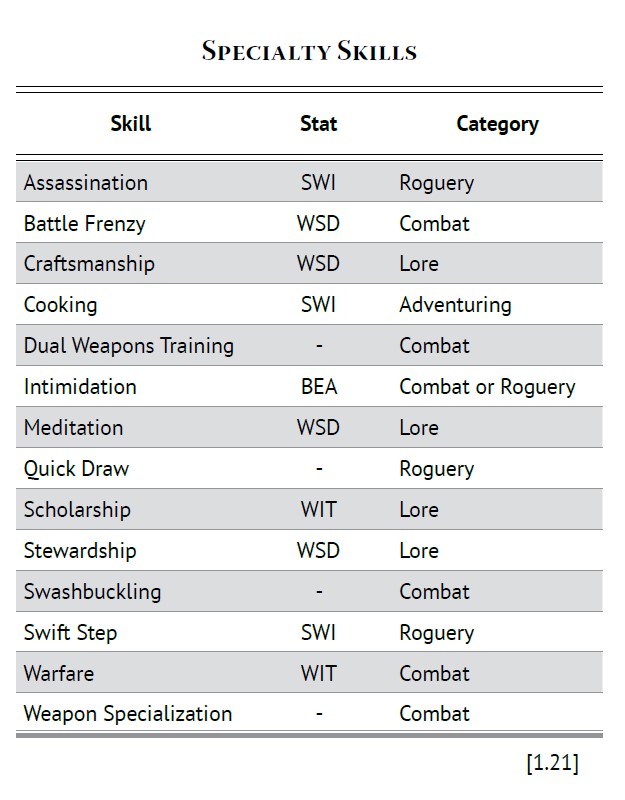
The skill list is tight, but it covers a lot of ground. There are five in most skill classes, and I can see uses for these on almost any adventure. There aren't narrow specializations under a category, such as acrobatics/tightrope. One thing the game does is it has optional specialty skills.

These optional skills are more accessible for non-magic-using classes to buy at cheaper rates of progression and for magic-using classes to buy at a more expensive cost. They offer a balance to high-level spellcasters with the rogue and martial classes. High-level mages can cast powerful magic, and high-level non-magic classes will have high levels of specializations.

And this list is just a sample; the game says you can make up your skills. Want a unique combat move, art skill, winemaking, rope tricks, dancing, bartender, seduction, juggling, camouflage, farming, wine-making, or another skill type? Get GM approval and add it to your sheet. I like this model of skill lists, a core list of skills the game supports, an optional list to get you started, and leaving the rest open to whatever your group wants and what your game would be enhanced by.

This avoids the "complete-ism" problem that RMSS and GURPS have, where every skill in the universe needs to be written down and rules created for, even if your group has no use or interest for 90% of the skill list. This also allows players to use unique skills to customize their characters, such as the group's blacksmith (or even blacksmith specialty skills, such as blacksmith/horseshoes, and forcing everyone's character to have that as an entry on their character sheets).


Massive Skill Lists are So 1990s

When the desktop publishing revolution came around in the 1990s, game developers could write forever, and we got a lot of games with bloated skill, power, spell, and gear lists. One of the problems of classic games is dealing with this bloat, and I like it when modern clones and games take serious looks at the skill and spell lists and pare things down to "what is the most essential and fun" for the game. Does the game need a dozen mind-control spells or just one?

While I love options and lots of choices, there is a point when meaningful outshines more.

Tuesday, June 21, 2022

Against the Darkmaster: Revised Pre-Orders Open

https://www.vsdarkmaster.com/product/against-the-darkmaster-core-rules-book/

Looks like Against the Darkmaster is getting ready to release a revised core rulebook in Q3 2022 and they are taking pre-orders now. This one was impossible to get a physical book for the longest time and it is good seeing them finally back in print and preparing a new version of the game. This one was on my unicorn games list and it is nice to have a pre-order put in and a book coming.

NOTE: The PDF they give you on the book pre-order is version 1.3, while the one on Drive-Thru RPG is up to version 1.5.

This game is sort of a "Middle Earth Role Playing" clone, so it has its roots in a sort of Rolemaster style of experience. What I love about this is it takes the entire "Tolkien-like" genre of "the quest to defeat a big bad guy" and it randomizes the entire experience. You generate a random "Darkmaster" who is the big bad of the current story and then create characters from a standard pool of archetypes and ancestries, and you set out on your quest to defeat them.

In a sense, almost any fantasy book that follows the Tolkien model, such as Wheel of Time, Dragonlance, Wizard's First Rule, Shannara, Riftwar, Dragonlance, Legend of Zelda, Final Fantasy, or any other "zero to hero" sort of "rise up against darkness" story can be told. The world is a sandbox, your epic journey is the story, and you just set out and do heroic deeded until the final confrontation happens at the highest levels of the game.

I love this game makes the quest, villain, world, and what you need to do random and generic. It is almost like a sandbox game that can be started and replayed infinite times with a different story and characters but the same classic model of heroism and struggle holding the narrative together. Instead of a licensed IP, it focuses more on the genre and theme of the story being told and simulates that.

And the art and inspiration sources in the game are an amazing collection of resources and images. This is truly a top-notch product with a lot of effort and love put into it, and to see a revised edition coming is exciting.

The rules follow that simplified open-ended d100 roll standard and are not as complex as the games they took inspiration from. So if you liked MERP, Rolemaster, or HARP - you will feel at home here. This is one of those games that would replace my Rolemaster games and give me the same experience, along with following a more open and free model of game - so this one is a definite win for me.

This one I was waiting for for at least 2 years, and it is nice to see it coming this year hopefully in time for the holidays. If you were waiting because you could not get a book, now is the time to dive in.