Showing posts with label Numenera. Show all posts

Sunday, June 15, 2025

Off the Shelf: Numenera

In Numenera, characters explore the ruins of the past and discover wonders to help build a better future. - Numenera Destiny, page 4.

As I'm pulling out my Cypher books, I will bring Numenera out of storage and onto a shelf for a while. This is an extraordinary, speculative, almost "lost Earth" sort of setting, a billion years in the future, where the world (and universe) has suffered multiple civilizational collapses.

This is one of the best science fantasy settings out there, not necessarily a Dying Earth dystopia (but it can be), but more of a strange, nanotech, super-science, living world, nightmare, bio-goo, AI-infused, mutational, psionic, oddly technological, energy-manipulated, genetically engineered, dimensionally travelling, broken networked, lost stellar, future world filled with who-knows-what and what-the-heck-is-that everything and strange we-have-no-clues.

The setting can be post-apocalyptic, quasi-medieval, weird horror, or a hopeful new world. Or all of them at once. It's similar to Gamma World, but not exactly. Gamma World is more D&D in technological dungeons with gotcha technology that can kill you for no reason, plus robots and mutants. Additionally, the setting assumes you are rebuilding society, rather than accumulating personal power.

There is an open question: we are in the Ninth World, the previous destroyed eight times over, so what is the point? Considering this world may never be destroyed again, that is the hopeful outcome you will be a part of. If not, you have a hundred million years to figure that out.

Numenera is more of a massive setting with any flavor you want. Start small, initially, with just a town and some ruins, and gauge your interests and those of your players. Figure out the ruins, the local bad guys, some locals, maybe some points of interest, a few places down the road or coast, and the stories you want to tell. Start with more minor, personal conflicts, and then gradually grow your scope.

Give the players a few memorable and worthy places and NPCs! You could create a town and place a holographic cabaret at its center, making it a popular spot for both travelers and locals. This place has been here since the city's inception, and no one knows how or why it works; it simply seems to function continuously. After you get player interest, draw them in with a few mysteries and unexplained messages that the holographs begin to give the players, sending them on quests around the area. Perhaps it will stop one day, and the characters will need to fix it or replace the power source. Let them make it their own. If they love the place, send them on quests to repair, upgrade, or improve it.

In these post-apocalyptic settings and games, there is often "no reason to care" about a harsh world with no hope. Numenera gives you plenty of tools and reasons "out of thin air" to get players to care and hook them in. Use them. Combine fantasy and unexplained technology. Give them a mental cry for help. Have monsters form out of goo. Let them discover an android trying to paint a painting with no brushes, paint, or canvas, and not realizing there is nothing there to work with. What happens when the characters give the android something to paint with? Can they talk to it? Will it respond if it finishes a real painting?

This is a better game than Gamma World, as it offers an extraordinary experience. It fills that "mutants and mayhem" itch, while presenting a system of rules where anything can be created by the referee, since the underlying Cypher System is capable of inventing almost any challenge or monster out of thin air. We don't need "product identity" since we can create it ourselves.

Gamma World tends to be either "primitive villagers in a high-tech nightmare dungeon" or "a medieval world with mutants and plant people visiting the ruins." There typically isn't a "bigger picture," and the game trends towards the D&D "increase my personal power over all else." Gamma World is also very loot-oriented. Once you get that 6d6 laser rifle and a stock of power cells, a set of good power armor, and a few energy grenades, you are set to start fighting warbots.

This is also the point at which many campaigns typically end. Back in the day, we were kids, and we did not have many more stories than "get loot, get power." Numenera is a longer-term campaign, more focused on narrative, worldbuilding, exploration, and story than treasure and personal power. These days, I am far more interested in story than mechanics.

That personal power thing is also D&D's Achilles' Heel, especially the newer versions of the game. If you are not interested in that "character build," then you are likely not interested in 5E at all.

If your imagination fails you, the game features three amazing bestiaries, plus a few dozen additional creatures in the core book. There is no lack of interesting, strange, "we have never seen that before" foes in this game. And you could reskin and mod all these, too, or pull monsters in from the Cypher System or the Strange games (and those two bestiaries). Five monster books? Go to town.

Numenera is a fantastic game, with one of the best science fantasy settings ever devised for creating your own stories, ruins, monsters, peoples, and places. It goes beyond your typical "mutants and mayhem" style of dungeon-first ruin crawls, and it world builds and gives you a vast space to create stories within. The game can be too imaginative for some, and I wish more people would play and appreciate this one.

What brought this game back to my mind was Daggerheart and the "you create your own world" starting point. Where that game falls short is that you are still in a fantasy system, and your concepts, magic, spells, and powers are all "sort of D&D-ish." You don't get to play with lasers, robots, technology, teleporters, bio-monsters, power first weapons, or any cool science fiction devices and technology. You don't have hover bikes, submersibles, high-tech wetsuits, jet-skis, hover-boots, concealment cloaks, space ships, hover platforms, mutants, cyborgs, androids, or AI computers with nano-bots.

You are still stuck in that D&D fantasy world.

Numenera gives you all that and more.

Wednesday, October 25, 2023

Cypher: The Better 5E

If 5E existed for a million years, I am betting Cypher System is what it would end up as.

This is a game I never thought I would understand since the layers of abstraction felt so utterly alien to me that I would not figure out how to create a character. I packed the book away and felt like the purchase was a waste of money. Then, I pulled it out and made an honest effort to determine what was happening.

People hyping this game up as a game they could not live without was what made me put the work in. Best thing since sliced bread! I never understood what they were talking about. Character creation was a mystery. The system seemed far too abstract to have meaning at the table. Everything from monsters, weapons, and powers seemed overly abstract.

And then it clicked.

Cypher simulates the 5E table-play loop perfectly. People sit around the table, managing resource pools, improving characters at milestones, trying to keep their player characters alive, finding treasures, solving puzzles, dealing with challenges, and rolling a d20.

Everything superfluous or distracts from that loop was tossed out. All the d20 scaffolding and cruft are gone, and many of the 'fake invented terms' were tossed out to keep the core gameplay loop streamlined and focused on the fun parts only.

Challenge Rating? Hit dice? Hit points? Difficulty Class? Saving throws? Proficiency bonus? Advantage? Modifiers? Lists of dozens of chained conditions? Action economies? The d4, d8, and d12? Multiclassing? One-level dips? Spell level? Inspiration? Bastions? Average party level? Flat-footed? Attack of opportunity?

Blah. Blah. Blah.

Fake, invented lingo meant to distract you. Most of it is worthless transitory values meant for exposed system math. It is like you asking me what the price of a cereal box is and me answering, "X equals 5.99!" Many of these terms were invented for 10% edge cases and then enshrined as the game's language - and then, they decided to load more rules onto the term. By default, games should be written in natural language, and special terms should be saved for things without easy replacement.

Forget the false lingo of D&D and Pathfinder and free your mind. Of course, you are replacing that lingo with Cypher's lingo, but the lingo on this side is more logically consistent and less rooted in a wargame-y, arbitrary past. You are also not dealing with 50 years of cruft and trying to keep things familiar yet modern.

You want to sit around a table and roll a d20 with friends.

Cypher gets you there in a single book with a core mechanic. The character creation and customization are on par or better than 5E. With one of the genre books supplying focused options and a few more customizations, you have a better and more complete game than a shelf full of 5E books draining your wallet dry. And Cypher is a generic game, so it really does everything.

Challenges are generic, as monsters can be just a level challenge, and that's it. The deeper you go here, the better it gets. Altering individual values for deviations from the norm is how you make monsters unique. A goblin may be a "level 1" challenge but does 2 points of damage. They may deal more surprise damage and set traps like a level 5 creature. Using the 'team up' (swarm) rules from Numenera/Strange, you can put them in four-goblin groups and have them attack as two levels higher (with a +2 damage bonus). With ingenuity and customization, monsters become deadly fast.

The resource pools are amazing. If you want depth, use a realistic wounds module and track that damage separately from the effort spent. When playing solo, watching those resource pools run dry and knowing what will happen when you lose one or two makes the tension rise. Finding a safe resting spot becomes critical for survival, and I am not talking about some closet in a dungeon somewhere.

You start cherishing and burning those XP to survive with player intrusions and rerolls.

And those start running low, and you get really worried.

Oh, and the players and referee share in narrative control. When those pools of resources run low, your characters are in danger of failing or dying. You are burning XP to shift the narrative in your favor, and you will feel the tension and excitement rising far more than listening to the door of room K23 and spending an hour fighting six goblins (and short-resting the consequences off). The more the referee awards XP, the more fluid the narrative becomes, and all sorts of amazing things can happen.

Cyphers themselves toss monkey wrenches in every situation. They are flat-out unique toys that encourage emergent behavior and roleplaying, often offering alternate solutions to problems other than 'blast them with a spell' or 'kill them all with weapons.' 5E is so limited in emergent gameplay, and the characters are almost internally focused on personal power that they become blind to alternate solutions to problems. We have murder hobos in 5E because that is what the game encourages and rewards.

Want a more fantasy-focused experience? Play the sister game Numenera; you have a world far better than anything 5E can dream of. Numenera does a science fantasy and extra-planar setting far better than the tired 5E 'great wheel' setting, and it does it with a sense of mystery and wonder - and is entirely unpredictable in terms of opponents and challenges. This setting is on par with Dungeon Crawl Classics in terms of 'I do not know what I am looking at' in terms of monsters and threats. Numenera beats the tar out of 5E's 'happy planes' and 'fantasy multiverse' offerings, where you must buy the earlier edition books to run the setting.

Numenera can be played on a wide range of flavors and feelings. You could play this as straight fantasy and have an almost Forgotten Realms feeling to the world, with ancient science making infrequent and mysterious appearances. You can play this as a better Gamma World than Gamma World. You can play this as a Heavy Metal science fantasy experience. You could play this as a sci-fi game and world. This can be played more like Rifts. This could be a horror world. A world with mechs. Thundarr the Barbarian works nicely here. A cyberpunk setting. There is a little bit of Minecraft in here. There is a space game hidden in here.

The range of flavors and ways this can be played boggles my mind. What GURPS is to universal rule sets, Numenera is to science fantasy settings - it does it all.

Combine this with The Strange? You can have characters from TV, movies, and fiction running around in your universe causing trouble - and those universes bleeding into others and taking them over to an infinite degree. These can be rebooted to be used again fresh. You can use the system to play characters inside one of those realities and have it break free from the limitations of that recursion.

You can even play characters from fiction, TV, anime, and movies. They can escape their world like something out of Last Action Hero and find themselves fighting for their lives in another movie or fictional universe. Want to have the characters from One Piece fighting Jason Vorhees at Camp Crystal Lake? Want to be a Mulder and Scully X Files agent stuck in the middle of that fight? The Strange does that.

I feel bad for the 5E players stuck in dungeons, railroad adventures, and those planes that reinforce stereotypes and Western religious paradigms. What would a place of ultimate evil look like if you were banned from using Hell, demons, and the Abyss? Who would live there? These players will never know how fantastic, frightening, unique, and alien the universe can be. They will be forever stuck worshipping the Keep on the Borderlands and thinking the Tomb of Horrors is the ultimate deathtrap dungeon.

I love those adventures but give them a rest.

Do something new.

Try something else.

If I sell all my 5E books, I would not miss them with this trio of games replacing that core gameplay experience. The character builds are better, the gameplay loop is better, the resource management is a revolution of thinking, and the shared control of the narrative allows the players to help shape the story.

Cypher is the ultimate sitting around a table and rolling a d20 with friends game.

Tuesday, March 14, 2023

Road War: It's Numenera

One of my stranger thoughts about my "Road War" campaign is, "This is also Numenera." I am not basing the game on a real-world version; all my locations and maps are made up. This is a "Road Warrior" world, but in that sort of strange, generic, desert-ruin, Hollywood-movie-style landscape of "this could be anywhere, but nowhere" setting.

This is a strange sub-plane of Numenera somewhere or even a part of the world where nano-technology has adopted a post-apoc road-war reality. It is modern-day, but it isn't. There are fantastical monsters alongside muscle cars, rocket launchers, and machine guns. None of the weapons are "modern-day," but they are like that.

Or this world would fit in as a  "recursion" in The Strange. This would make sense if you wanted this world as a "standalone" experience. I could go either way and easily "flavor" an area of Numenera if I wanted to.

Suppose you look at the world of Numenera being like an entire planet under the control of rogue nano-machines and massive underground AIs of past civilizations. In that case, you get a "Westworld" feeling, but instead of a company running the show, something else is. An AI, an alien intelligence, a computer that ran an automotive theme park, or the "God of the Road?" Who knows? A massive automotive factory could be lost underneath a desert, cranking out muscle cars, and many machines and AIs aligning their world-view on competing versions of the apocalypse based on 1980s action movies. And since this is a billion years on, those get twisted, and there were probably a few hundred thousand "1980s" style eras (of different alien cultures) the machines can pull a reality from.

And the Numenera rulebook says you can play the game from strict high fantasy to sci-fi. Post-apocalyptic and horror are in there too. Nothing in the book says that you can't play the game as a Road Warrior-style game. And since you can paint the game with any feeling, like calling lost tech magic and glaives "fighters," I can easily flavor the entire Road War area as a post-apoc 1980s movie.

One of the enormous problems I had with previous iterations of this world I played with Car Wars to Pathfinder 1e was linking it to Earth. I had to deal with geography, roads, maps, governments, history, cultures, borders, and the possible lack of the above. Things change, why, and how? Is this group still around? What about this border? What about the military? The Internet? Satellites? Technology? Air travel?

With my Road War world in its own self-contained "hex crawl" sort of place, I can play a more local-focused game and not worry about the big-picture details. I just have one map of one valley; the rest of the continent and world feel free. The cultures? Your typical post-apoc mix with a Southwestern style, and then go as wild as you want. Why? No idea; that is the media and information the local underground AI pumps out. Other sources, even alien sources, mix in there, but you can easily have a "themed" area of this world.

I don't want to worry about "what happened to the real world?" I don't have to write history. And I don't have centuries of geopolitics breathing down my neck. The world is that magical place of blacktop highways, deserts, fortress cities, strange ruins, ghost towns, remote stations, abandoned sprawl, and lawless crime zones.

I am using the Cypher System since that feels like a better fit, but since Numenera is 100% compatible, anything from those books can drop in. Tech, cyphers, monsters, or artifacts? They all work or flavor them to fit in. Aliens or other species could show up, and no one blinks an eye. They are just "other landers," which is how things work.

Will I play the standard setting? Likely, yes. Is the Road War version of the setting fun? Oh, yes! Any of the AI-generated art fits for cars and scenery since those are so strange, they fit right in. Some are normal, and some are insane, but everything is fantastic.

The needs are simple. Food and resources. Oil, steel, fabric, glass, and rubber for the cars. Roads. Towns. And minimal technology in other areas. Yes to radio and vinyl, and no to TV and digital. No computers or internet. Wire-based analog rotary phones in small areas. Books. Telegraphs. Newspapers. Hand-carried mail and package delivery. Movies on large film reels. Film cameras. The feel of the 1950s without the slide into the 1970s. And if the technologies are not the same, the Numenera equivalents are "like those" since they align with the whole reality zone of the area.

Which is essential. The tech of the area matches the flavor and feeling. Cyphers are subtly adjusted to match 1950s tech or even 50s science-fiction devices. People get together to watch movie-like entertainment, and maybe these are found like cyphers that play a movie once, and that is it. So everyone has to be there to experience it together. Some watch, others write down, and maybe others draw the things they see. And others take it in, knowing this is the only time they can.

The radios are playing strange songs. Books, dances, concerts, and plays are popular.

Then there are the roads. On which survival depends. The wastelands are home to many lawless areas, and those forces of chaos descend on the fortress communities of those seeking to build, not destroy. The convoys keeping the good places fed and supplied need to get through. Air travel is not seen that often, if at all. And the world is simple in some ways and fantastical in others.

So it is Numenera. Or The Strange. Or is this a standalone Cypher world? But as Numenera, this flavor is as valid as the high fantasy or science fiction version. As the game says, it is all flavor. What matters is having fun.

Tuesday, February 21, 2023

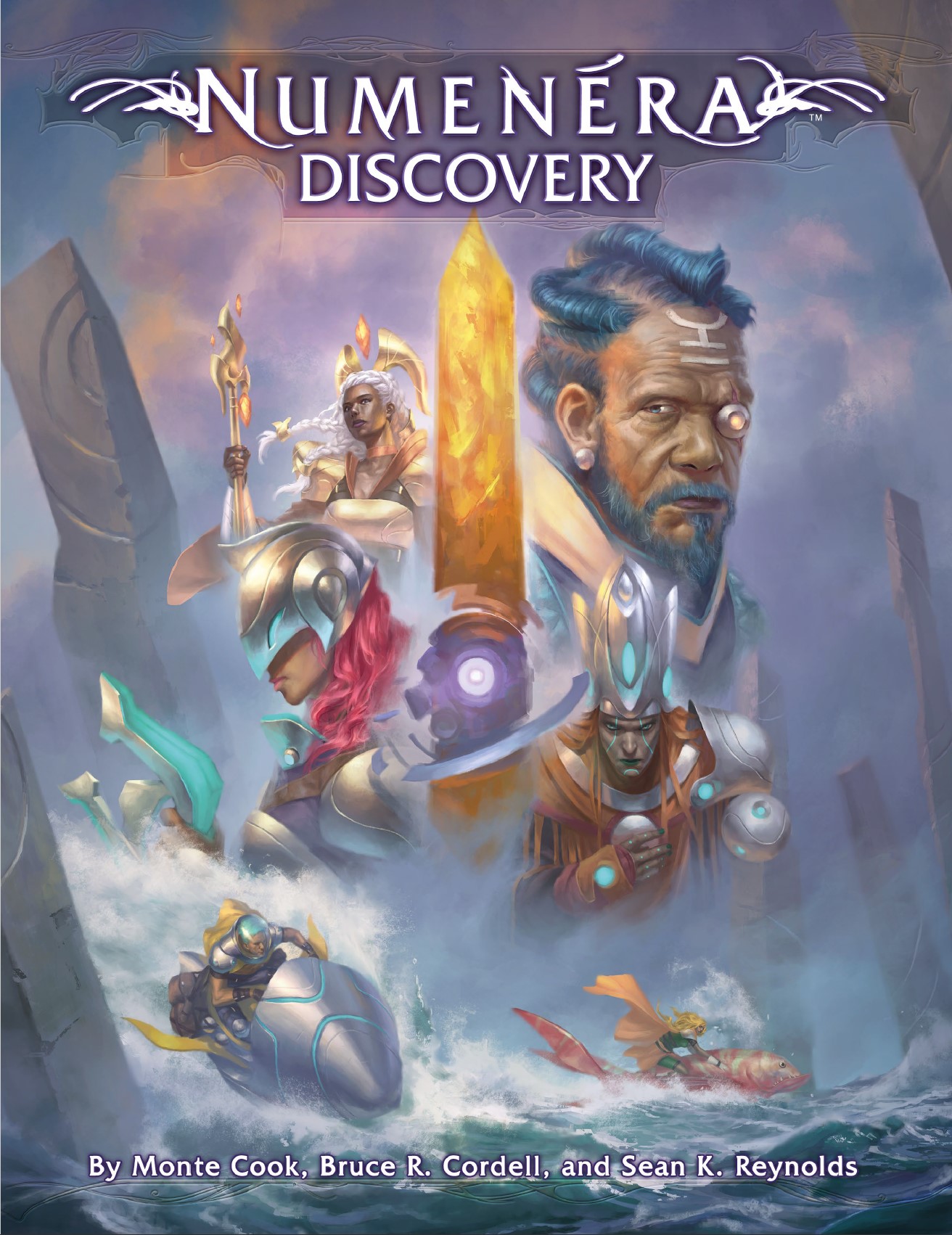
Mail Room: Numenera Discovery/Destiny

A new game is here, and I am looking this one over.

All I can say is wow, with one nails the science fantasy Appendix N feeling perfectly - but then, takes a step beyond. More soon.