Showing posts with label BX. Show all posts

Thursday, July 9, 2026

Design Room: Simplicity is Depth

There is a beauty to a simple, clean design that no amount of detail or crunch can improve. One can go on and on, providing tactical depth but adding nothing. At a point, you are taking away options just to give them back later, and the design becomes "rats in a maze," but the maze here is rules and paragraphs of subclass options. And with every new subclass added, you are taking those abilities away from those who thought they had them.

Oh, I thought as a druid, I was always a bit of a beastmaster. So you are telling me the new beastmaster subclass does that better? Oh, okay, I picked healing. I guess I am a little more inadequate these days. I just will never use my beastmater powers, since they will never be seen as good as the subclass that specializes in it.

In OSE? All druids are druids. If you want to do druid things, just make them up and ask the referee if what you are doing is druid enough. If it is a spell, well, then, it is automatically druid, and what you can do. You don't need subclasses "carving off" things you can't do with each new one added, either because you never knew you could do that and it was just taken away, or "someone else does it better now," and you have the specialization curse.

In the OSR, classes are how we have party specialization, not subclasses. I don't need rules to solve the non-problem that "all fighters are the same," since that's on me to solve. I will do that through my roleplaying, gear choices, social role, and stats. A party of four or five probably will solve the specialization problem through everyone picking a different class, or some using race-as-class to play an elf or a dwarf.

The game isn't giving me rules or subclass choices to make my elf different from other elves; that is on me. This is where my ability to play a character, roleplay, and craft a unique character comes into play. The player skill needed to do this is much higher than 5E.

5E solves the problem by cutting off parts of your class role, forbidding them from other builds, and making you a false specialist instead of a master of all. If I am the druid? I want to be the weather-caller, wild-shaper, druid of growth, beast-master, and harmony priest. I get that in OSE. Thematically, that is much easier for me as a role-player and much better for me to play my class role. I can call myself a "specialist" in one area, but there aren't any rules for that; it is just my choice.

I am likely the party's only druid, so I get to do it all.

Easy. Simple. Clean. Flexible.

We saw the "lie of specialization" begin to seep into the game with AD&D 2nd Edition and the kitbash design introduced in the compendiums. The game began to accumulate the debt of inferior game designers, and it diverged from the original clean, flexible simplicity it captured. 5E enshrines the lie of specialization and writes it into the structure of the game.

Without specialization, my druid is free to embrace all the tropes of being a druid, and I am freer to craft the character I want to play. Nothing is telling me "I can't do that since some other subclass is better than me at it."

D&D doesn't need specialization.

Class choice more than covers it.

D&D is better without specialization.

Tuesday, July 7, 2026

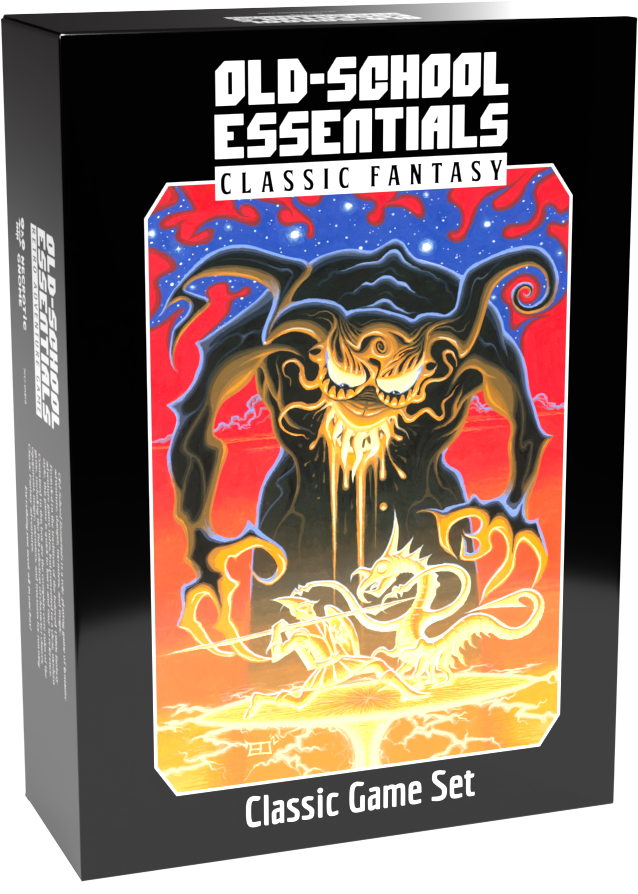
Mail Room: Old School Essentials Boxed Sets

Get these before you possibly can't.

I got the two boxed sets for the OSR version of Old School Essentials, and my first reaction was, "I like the all-in-one books better; having all these small books makes the game harder to play."

And then I saw the end pages in each book, each set different, and each set insanely useful, helping you learn the game's structure and gameplay. You can hand the characters' book to the players and have them just exist in that world, with no distractions or knowledge of what lies ahead. You can keep them to just Classic, and keep the advanced Characters book to the side, not introducing those options again until later.

The magic book sits apart from the characters and remains a mystery.

The adventures book is the referee's guide with all the rules in one place.

The monsters and treasure books are separate, each a reference guide that can be opened and consulted.

And the advanced books isolate and encapsulate the advanced options, still there if you want to use them, but also split off so they remain even more mysterious and special. Yes, you will have two monster books, treasure books, character books, and magic books - but they are divided on purpose.

One reflects the basic set, and the other reflects an expert set.

And the single adventures book is the master key that unlocks them all.

But those end pages are what make the magic happen, as each set is tailored to the most important tables of the book they bracket. Reading these, you will understand the gameplay and structure of the entire book, all the most important parts, and things to remember, all here in clearly laid out tables, beautifully concise and clear.

These feel like the classic 8-bit RPGs.

Simple. Direct. Clean. Limited yet boundless. Inspiring.

And starting with just the basics gives you a new appreciation for this retro classic.

This is even better than the original BX guides, as legendary as they are; these boxed sets are just amazing and special.

So simple.

But so infinite in the smallest form.

Wednesday, June 10, 2026

BX vs. Castles & Crusades

If there is one universal rule in the hobby, it is that Castles & Crusades beats every other game. C&C is easier than BX, requires less reference during play, and it is a modern set of rules that is backward compatible with any classic adventure you throw at it. The entire game plays from an index card. The characters have depth and a curated collection of modern abilities. The multi-classing in C&C makes nearly infinite combinations of characters to play.

If you want a modern game that does not feel like "walking away from 5E," then Castles & Crusades will make an excellent home for you. The game is still very old-school in its playstyle, resource management, danger, and feel, but very modern in its gameplay mechanics, with a dice roll for any situation that arises.

I still love Old School Essentials! There is a "toy factor" to these books that can't be denied, and I mean that in the best way. For a game this small, compact, and easy to use, having it be so expansive, infinite, and amazingly playable is a masterstroke. If you ever remember the magic of bringing home an NES game cartridge and having the feeling that "an entire world exists in this tiny object," then you understand the true power of Old School Essentials.

The Latin phrase for that is "microcosmus in parvo," and it fits perfectly when holding a copy of Old School Essentials. The universe is reflected in the smallest thing.

When I hold the OSE books, I am holding the universe in my hands, two tiny books, and infinite worlds and possibilities. With C&C, I am back to the "arcane tome" feeling of AD&D, where the books are big, serious, weighty, and scholarly, and arcane guides on how the world works. While the C&C books are each singularly amazing and a masterclass in game design, the OSE books have a "power in the tiny" that is undeniable.

Using the optional tertiary ability score rules in the CKG makes the game feel more modern and gives your character a lot of customization options. I am a super fan of those rules, and they broke the game wide open for me, so I don't feel my characters are making too drastic a trade-off between primary and secondary scores. Now, I get a smooth progression between my primary (12), secondary (15), and tertiary (18) ability scores.

I used to feel my human "survival cleric" lacked in DEX, having her primaries set to CON, CHR, and WIS. With STR and DEX as secondaries (15), and INT as her tertiary (18), I do not feel she is being punished as hard when she wants to balance along a ledge and force open doors.

Chef's kiss.

Seriously, the optional rules in the CKG turn C&C into about five different-feeling games and fix a few of the game's strange-feeling parts (when coming from the OSR), especially when compared to modern rule sets. You will find the game you want in C&C, and it can be a direct superheroic-fantasy replacement of 5E if you want it to be.

With BX, my survival cleric is just a cleric. I hope she has a high STR or DEX score, and that will do the same thing, but the SIEGE Engine invisibly handles the game's "skill system" without requiring one. In C&C, marking an ability score as "primary" tells us, "If this game had a skill system, I spent a lot of skill points in this ability score area." The SIEGE Engine forever fixes D&D 3.5E's massive, bloated, overdone, and cumbersome skill system by designating a few ability scores as primaries, secondaries, and, optionally, teritiaries.

Like Swords & Wizardry's single save number, the SIEGE Engine as a whole is a genius piece of game design. Rarely do we get game mechanics this good that simplify our lives and solve entire overdesigned systems with a simple, clean, and clear rule.

BX is the simpler game, with a more straightforward gameplay loop. If you have the BX gameplay loop down pat and want a modern set of rules? Want characters with something more to them than a few abilities?  Want that 1E feeling without all the complexity? Play C&C.

If you want the classic, tight, almost board-game-like gameplay loop? Play BX. Easier choices, more iconic selections, a game not overconfused by dozens of races and class choices? The rock-solid, core choices and options that make the game a classic? BX all the way, preferably the classic rules. Once you start adding "stuff" to the game, you water it down, confuse the choices, introduce classes that were never a part of the core experience, and you lose something.

You lose the game under a mass of optional stuff that ends up distracting everyone from what was there. It comes off like adding optional expansion boards to Monopoly or Axis & Allies, and all of a sudden, that core, solid, tight game experience becomes muddled, slow, heavy, distracted, and confused.

The original game is lost.

People who knew the original can see the beauty through the chaff, but any modern player will see a weaker version of what they already have in 5E and similar games. If you want modern classes and roles like those in 5E, but you don't want everyone to feel they're lacking powers or iconic class abilities, C&C will be a better fit.

There is an argument that if you play BX, you should play without all the distractions and enjoy the game as it was played back in the day.

Sure, Advanced Fantasy is the more popular game and has the most "stuff" - but an abundance of choices doesn't make a good game. Some can't play without the bard, druid, or ranger, and I am one of those, too. For me, those classes in C&C feel much better and keep other games out of the equation. I am more than happy with the C&C designs, and they fit my vision of what the modern classes should look, feel, and play like.

The BX versions of these classes are weaker and are slow to "come online" with signature powers. In lower-level play, the feeling between playing a fighter and a paladin will not feel like much in BX, where in C&C, those two will feel and play vastly different.

Your class identities are much better represented and feel in C&C than in BX, especially for expansion classes, which in the original game took quite a while to begin to feel and play differently. C&C also lets you houserule in "class skills": if a ranger should know how to do something, you make a SIEGE Engine check on the closest ability score, and do "the thing" on a success.

C&C makes adjudicating "class skills" a part of the system by default. In BX, you will rely on the referee "pass or fail" allowing it, and most of the time, if a ranger knows how to do something, they will just be able to do it (or make an ability score roll for it), and that will be it. C&C starts with the modern notion of the "skill check" and lets the SIEGE Engine drive it all simply and in a unified manner.

But do you prefer a more modern set of rules with ways to handle any situation that comes up? Rules mods that fill up an entire book? Characters with new abilities that unlock as you level? Then, C&C will be better for you. C&C does everything BX does, but with a modern rules framework that stays out of the way and handles much of the heavy lifting for you.

For me?

Castles & Crusades easily replaces 5E for me, as a game that "does anything and everything." This is my 16-bit Genesis console that "brings home the arcade."

OSE is my "game on the go" and daily driver for everything else, being cross-compatible with so many things (and even C&C) that the investment is great for every game I buy. This is my 8-bit NES or Gameboy, the tiny thing I hold in my hand that does so much.

Microcosmus in parvo.

Saturday, June 6, 2026

BX Cures Burnout?

There is a truth to BX being a cure for gamemaster burnout. In BX, the procedures for running a dungeon are very clear. You have a set dungeon turn, the referee tracks time and rolls for wandering monsters, the players track resources and interact with the environment, and the referee tells them what is around the next corner. Encounters are dynamic and fluid, with no preset script to read from, just a few ground rules about who they are, what is happening, and what the consequences could be.

But there is a structure here that creates the experience.

Modern gaming, like 5E or Daggerheart? We just jumped from the real sport of Greco-Roman wrestling to the WWE. Prescripted railroad adventures. Encounters with the story and outcome are prewritten. The dungeon has a story; the characters have multi-page backstories; and everyone and everything is telling a story.

We have moved from D&D being an unpredictable sandbox game to D&D becoming scripted professional wrestling. This is the single largest difference between classic BX D&D and modern D&D 5E.

Modern D&D replaces the BX sandbox simulation engine with a prewritten story you need to buy, read, and spend hours preparing to run. There is more money in fluff-filled hardcovers, after all.

And there is no game structure in modern gaming, just the prescripted flow of a story. Imagine playing baseball without any concept of innings, outs, or a set procedure of play. Imagine playing football without a strict timekeeping system or a division into quarters and halves. The teams get on the field, and just play the game until a preset outcome is determined, and the fans walk away happy since "everyone wins."

If you ran a game like that, you would get burned out since nothing really means anything.

Read the script, phone it in, turn off your brain; you are running a modern storytelling game.

And this sort of model is assumed for all modern games, where the rules exist to support an extensive story overlay required to even play the game. Pick up most games designed today, and you will see an overemphasis on story and very little emphasis on structure.

That gameplay loop and dungeon turn structure are the "sandbox engine" of BX.

And it is there to save a referee 90% of the work needed to run a game.

For the most part, BX runs itself.

Put a modern referee in BX, and wait a minute? What is all this structure? You mean, parts of the game that I had to write stories for and account for in each encounter automatically run themselves? And it is easier than hours of prep for each game, you just "hop in and play" and "the system takes care of the rest."

What is this game?

The game is BX, and the structures the designers built all the way back in the 1970s automatically eliminate the need for endless story writing before the game, and they allow any group to hop into a "dungeon environment" and have the story "dynamically generate." The same with wilderness adventures, there is a structure there, too.

Even if a referee had zero prep time, like homework was due and they had to go to band practice, that game could still be played. All the referee needed to do was "follow the procedure," and the game mostly ran itself, allowing the referee almost infinite room to be creative on the fly within that framework. A game could be run with zero story and no prep, and run just fine.

And what inevitably happens is that these story games adopt their own structure for story gaming and narrative flow, and that structure returns. Cypher System and its extensive narrative flow-control tools, and Daggerheart with its pools and dicing system, are examples of the structure coming back to "help referees," so you are not really getting away from structure; it has been renamed and moved to another part of the game (and likely less effective at running dungeons than the BX system).

The narrative dice in Star Wars and Genesys are another way to shift the structure to the dice for generic storytelling and are a touch fairer than other narrative gaming tools, since they are dice-based rather than at the referee's whim or tied to spending pools, as in Cypher or Daggerheart. Interpretation of the pool is still needed, but at least I am not feeling like I am "screwing my players" as I am in Cypher by triggering an Intrusion, or in Daggerheart by dropping fear on players. Those systems are more adversarial, whereas in Star Wars/Genesys I can point to the dice, shrug, and say, "bad luck."

My job as a narrative referee is a lot easier if I feel like I am not fighting my players. BX referees are a different thing entirely, and they enforce the game's structure at an event, with clear procedural rules. I am slowly shifting back to the narrative dice system of Genesys/Star Wars rather than systems like Cypher and Daggerheart, as they work better for solo play and clearly tell a story of what happens without referee intervention or bias.

As a referee, the more structure I have, the easier my job becomes.

The less of my own bias I introduce into the game, the easier my life is.

Structure cures burnout.

The elimination of bias and adversarial play makes the game more fun and engaging for the referee. These "screw the players" narrative trigger systems are ultimately fake tension, meant to be overcome anyway, and feel like throwing sand in the gears to create artificial tension and resistance to a predetermined story outcome.

With a sandbox system or narrative dice, the outcomes are not predetermined. Even the referee does not know what will happen. The next wandering monster check could kill the party. Rolling despair could mean a fatal wound, and that is the end of your character in one bad roll. There is no script. Your lives are at the mercy of uncaring, mathematical systems that have no care for your life or well-being, and you fight to minimize the impact of the cold, hard math of the system.

The story is how you deal with these impersonal, absolute, cold, hard systems during the game, together as a team. The story is never prewritten as a script before the play begins, cutting out all player input, and is doomed to be ignored anyway.

If you are burned out, tired of writing endless stories your players end up ignoring, and think roleplaying is "story gaming," give BX a try. If you are more of a story gamer, try Genesys and break free of the need to constantly oppose the players.

Let other systems do the work; instead of the game relying on you to constantly write reams of stories that will never get seen, read, or appreciated. Discover how great the game is without the need for all those scripts and massive, story-based railroads. Imagination happens during the game as a shared experience, not in hours of story prep toiling alone before it!

Immerse yourself in the structure.

Let the dice free you.

And discover the power of shared imagination.

Tuesday, June 2, 2026

BX Makes You Immune to Bad 5E Advice

If you follow the dungeon turn, everything will work, the universe shall keep its logical order, resources will tick down naturally, wandering monster rolls shall be made, and you will not need to endlessly listen to bad YouTube advice for 5E. The more of these 5E "advice" videos from YouTube creators that I watch, the less I want to play:

  • How to Roleplay
  • How to Write a Backstory
  • Speeding Up Combat
  • Don't Use Alignment to Roleplay
  • Quick Dungeon Prep in Under 4 Hours

Just looking at the titles makes me want to poke D&D with a 10-foot pole and set the trap off from a distance. Some of them mention mechanics removed from 5.5E and present themselves as current topics. All of them are a terrible waste of time that makes me dislike 5E more than I should. They make 5E sound like the worst game ever written, since it seems like so much help is needed to play it correctly.

Terrible advice videos spread negativity and confusion for the game.

I now block, unsub, or steer far away from these videos in my suggestions.

D&D YouTube is infamous for spreading negativity and confusion for views. The vast majority of people hate-watch the negative coverage of the Wizards, just like the majority of Star Wars viewers hate-watch to see the franchise crash and burn. I stay away from most of the negativity since it is addictive like booze; you can get drunk on hate, and you need to abstain from it just to have a clear head and enjoy life again.

All of it hurts D&D, even the older editions. And the confusion and horrible advice drive people from the hobby.

How do you play the game?

By playing the game.

Back in the day, roleplaying was optional! You were not forced to, nor did you have to, come up with a backstory, declare a character goal and motivation, or layer a weak narrative inspiration-dicing system on top of the game. Due to the inspiration system, you are now forced to roleplay to gain a mechanical advantage in combat.

In BX, you do not need to engage with roleplaying to play the game, and many did not even start gaming with backstories or psychological profiles. The game gives you no benefit from roleplaying.

If you just wanted to play "dwarf," you picked "dwarf" and played "dwarf."

That was your "playing piece," like the shoe or dog in Monopoly.

If "dwarf" survived, maybe you gave him a name. Maybe you gave him some background. It was not required, nor did it give you a mechanical benefit. We usually figured it out by level 3, sometimes 5. Until then, it was just "dwarf."

In fact, that "feature" let us get new people into the game more easily, since it reduced the pain of losing a character and the number of decisions needed before play began.

Want to play with us? Want to play an "elf"? Sure!

You did not need to think about roleplay to play BX D&D.

You just "played."

And prep? The modules were typically 16 pages long, shorter than a single high-level character sheet, and you could read them during lunch break. This 6-hour fallacy for session prep is alien and not D&D. Most games needed no prep. Flub a room description or miss something? Most of the time, it didn't matter, and we put whatever was missed in the next room. The dungeons were meant to be expanded, so you could always make a new room and put it in there.

I get the feeling mixing D&D with a narrative game was a mistake. Writing "roleplay rules" into the game complicates play, creates a barrier for new players, and makes the game less accessible. Giving mechanical advantage to an out-of-game roleplaying reward cheapens storytelling and investment. Are you really playing your paladin as chivalrous, or are you just trying to gain inspiration for a combat benefit?

BX was a clean, simple, and straightforward game.

Let the narrative games be narrative games.

Mixing the game with a storytelling system was a misstep, and it ended up hurting our ability to tell stories with the game, since it linked mechanical benefits to something done naturally and for no benefit.

Monday, June 1, 2026

OSR Buyer's Guide Page Updated

https://sbrpg20.blogspot.com/p/osr-buyers-guide.html

I updated the OSR Buyers Guide page to cover BX, and here are my best suggestions for getting started with various editions in the hobby. Today, information, links, and discussions of BX are laid out, with my picks for the best in the genre, both in inspirational material and rock-solid books for play.

Gone are the discussions of alternate editions and versions (Labyrinth Lord, Dragonslayer, etc.), and a page will likely be added later to discuss them. Times change, and those need to be updated.

Sunday, May 31, 2026

BX and Star Wars

The original Edge of the Empire game was released in 2012, and it is still an amazing experience. This is one of the most lore-dense games I have encountered in this universe, and it continues the tradition of the roleplaying community carrying the Star Wars fandom and keeping the torch lit when hope seems lost and the light is dimming.

I get that this seems like a modern game, but it really feels like something from the late 1980s that carries into the 1990s. Technically, the West End Games' Star Wars system is the 1980's version of the game, but this is what we have today, and it works well enough to take me back.

If we can have Classic Pizza Hut back in 2026, we can have Classic Star Wars, too.

The same thing applies to Old School Essentials; this is my 1980s throwback game. While yes, we have the original BX books in PoD these days, there is no guarantee those will be around forever, and OSE is the path forward. The original BX books are the better game for learning to play, but Basic Fantasy also does a wonderful job teaching the game. For me, OSE is a fast-playing, more-optioned, easier-to-use, streamlined set of rules that disappears into the background and lets me focus on the dungeon turn, the story, and being the referee.

Keep your BX books close for inspiration and for that positive karma. For me, OSE is BX D&D, the game that brought it back to the mainstream and became the de facto standard for creators and adventure writers. There is no way you can publish for BX anymore except through the OSE license, and that is getting free of the OGL next year. The BX books are teaching games only until the rules are released under a Creative Commons license. If Wizards could put out as much as possible under the CC, for every edition, that would be a huge gift to gaming and go a long way to winning me back.

Given the sad state of both 5E and Star Wars, I am ready to go back to the 1980s and forget today, and relive those times. Yes, that is not possible without d6 Star Wars (you can still get the d6 Space system in PoD), but the Edge Studio games are fine and in print rotation. I am supporting this game while it is still out there, and I hope it continues.

Do I hope Disney can turn it around? Yes! Wishing for failure is just evil. I want good Star Wars again. Until I can get it, I will go back to the last, best Star Wars we had. There is an argument for Rogue One, Andor, Mando Seasons 1 & 2, and The Force Awakens being glimmers of light in the darkness - so the current state of things is not a total loss. We have fallen off, post-Pandemic, and we need a turnaround.

TFA had potential. It could have gone so many places. Even that seems like something that could have started off rough but gotten better over time. If I ever play in the sequel universe, it will be with TFA as the starting point, and nothing that comes afterward will count.

Poe would be a hero, assembling a team of Resistance fighters under Leia's guidance.

Finn would be a Jedi and lead the new Jedi Order through Luke.

Ben Solo would need to find redemption through sacrifice, just like Vader, through Han.

And Rey would fall to the dark side, betraying them all, and becoming the new Emperor.

Look at that poster, that is the story it tells me. Where the characters are, the lightsabers they are holding, Rey crossing the red saber towards the darkness, and Finn holding the blue. Subliminally, this is the story we were promised but never given.

The game lets me tell that story, fulfill the dreams I had of that place in my universe, and finish the trilogy in my head the right way. Yes, it is fan fiction, but it is better than what we got. One of the most beautiful things about gaming is being able to finish one story and begin another. And to take the huge box of action figures and vehicles, this big box of toys, and play pretend.

TFA, as a starting point, could be salvaged.

The Edge of the Empire and sister games are GOOD Star Wars games, full of nostalgia and memories, written by people who love the EU and the source material. I hope these continue and are even expanded upon. I want PDFs and VTT support!

But I know this may not happen, so I will hold onto my library tight.

It is really all I have, unless someone makes a "clone game" of BX Star Wars in a like universe. There is White Star, and that is getting a new edition from those who brought us OSRIC 3.0, which is great news. I need more drop-in replacements for some of the "SW-like" items and to make parallel, BX-based play in this universe easier.

There is room in the BX and OSR communities to make a parallel science-fantasy game that delivers a Star Wars-type experience well while leaving the door open for us to write our own stories. This is likely one of the next steps to take in the hobby, just to keep the stories alive if the licensed game were ever to fall.

Until then, I will be back here in the 1980s, enjoying myself, with classic BX and the EU books and games. I will keep an eye on the new stuff and hope it shows promise, but I know where I will be happy.

Here.

Thursday, May 28, 2026

Fighting for Classic Star Wars

So many have given up on Star Wars that it feels hopeless. We are like Luke, sans hand, clinging onto a central shaft antenna, learning Vader is our father, and giving up all hope.

I know the feeling; this is the same feeling I got with 5E. There are some things I like about it; it is still D&D, after all, but I really can't agree with most of it. It is not that "I can't stand it" that is hyperbole; if "new Star Wars" is on, I may watch some of it, but I won't go out of my way to keep up on it or watch the newer movies again. Same with D&D 5E, I can play it, and it isn't terrible, it is just so clunky, the character sheets are massive, and I have better.

I just don't really care for the new Star Wars stuff.

Like, I do not care for the new D&D stuff. And that's okay.

But I am not going to throw out my great memories of either.

Legends Star Wars fans are sort of where the OSR was during the 3.5E days. Why do we need you luddites? What is this OSR thing? You people are insane for holding onto the past, clinging to outdated lore and stories, and looking like you worship clunky, worthless, old, and outdated material. 3.5E works well enough as an "old school" game if you want it! You just have to flavor it, and things are fine. Why aren't you using modern rulesets?

These days? The pure genius of BX is slowly dawning upon people. How the game was about mapping the unknown, the brilliance of group initiative, and the careful tracking of time and resources. The sheer magnificence of BX reveals itself in play, creating engagement, tension, and a fear of the unknown, and delivering compelling gameplay.

BX is rapidly replacing D&D 5E as people's game of choice these days. This is what the cool kids play. This is where the fun is. You won't get burned out or tired playing BX; you will have fun.

If all you enjoy is the Legends stories and universe, you will have fun.

You can dream here again.

This is the OSR fight. We know "real D&D exists," and we can hold it in our hands. We can play it. We love it for what it is, and the experiences it brings to our tables. The game is classic, the memories golden, and sharing the experience is unifying and creates bonds with others.

We may see the old stuff recycled into the new, but that does not tarnish or change our memories of it. We know what an AD&D beholder used to do; this wasn't a video game monster, destined to be a challenge and eventually defeated, no, the beholder was a permanent character-killer, disintegration-ray-firing, TPK machine. The beholder cut character egos down to size.

And we know real Star Wars exists; it is just so hard to stay focused, since what we are being given today is so poor in quality that we want to dismiss it all. The constant nostalgia farming and endless bringing back of the "greatest hits" diminishes our memories of the past; it is almost a reverse nostalgia, where the more they bring up the past, the less we want to see of it.

But I like classic Star Wars like I like classic D&D, and I will fight for it. Star Wars represented something magical, a call from the stars to be better, to reflect upon our sins, and to feel goosebumps at the sight of brave heroes overcoming all odds to stop evil and save the day. To hear the music, and cheer when good triumphs over evil, or feel despair when evil delivers a deathblow to the forces of good.

This is as much the story of tragedy as it is of heroes.

These are the stories of adventure series from the dawn of cinema.

In D&D 5E, it feels like you will never die, and level 20 is a sure thing. There is a boredom of inevitability with the system, a certainty that sakes me to say "so what" to the entire character progression system. I don't really care about 5E characters since I never feel any real threats to them.

In a BX game, characters die. In Star Wars, characters die. Given the nature of Star Wars, it is a bit harder to die than in BX, as you have a few heroic mechanics to save yourself, but those can and will run out if you are stupid and careless. Or just plain unlucky.

But, just like in BX, a character's death is not the end of the game. It is the beginning of a new character's story. In 5E, you have this immortality clause, which means if you do die, it is quite likely the end of the game, and you won't really want to create a new character of that level again, just due to all of the character sheet complexity and build choices.

What hurts is that it is hard to be a Star Wars fan right now. In the OSR, indie games and new content are constantly coming out. Even if D&D is taken off the shelves and never sold again, we still have enough like it to get by.

With Star Wars, we have one game and one source of new media. The game is worth your support, and I feel that playing it and loving the classic universe sends a message. What makes it hard is the constant negativity streaming in from the new projects, and you get despondent and feel hopeless, like "Star Wars is garbage."

Well, my memories aren't garbage. The games I played with my brother aren't either, nor are the characters we played in this universe. How I felt back then isn't either. How I looked forward to the movies and the excitement I felt while in line for the original releases of each film is not garbage.

And yes, I saw each of the first three movies in the theater in the first week of release.

Those weren't just good times, they were pure magic.

They ignited a passion in me for art, storytelling, and technology like nothing else could. Part of me feels that the forces seeking to diminish Star Wars know its power, and that this is an attack on our future as a people and species. I love space and technology. I love art and music. I love great storytelling. I love lasers and spaceships.

But we are in an age of the trite and mediocre. Corporate storytelling. Nostalgia farming. Live services and subscription models that force us to accept the lowest common denominator. It is easy to give up hope. The new movies are not on the level of what we had, and the television shows are mostly forgettable. It makes me feel that we can't bottle magic anymore.

But there is a way.

And for me, it is through gaming and the Legacy books and movies. I can capture that magic as much as I want, as often as I want, and all at my gaming table with a character sheet and a set of dice. I just need to imagine and block out all the negativity in my head so I can enjoy those good times.

Like a Jedi in training, I block out the negative emotions and calm myself, channeling only the good times that once were. With my mind clear, I can create thrilling tales and stories again. The universe can come alive. The dreams and emotions return. The dead feeling I had is gone. The hope shines brightly.

Dreams are worth fighting for.

Monday, May 25, 2026

Is OSE Dropping BX?

https://necroticgnome.com/blogs/news/ose-2026-update-faq

I see some handwringing over OSE's move to a unified, standardized edition based around the Advanced rules. If what Castles & Crusades did with their amazing "de-OGL-ing" of their game, I would not worry one bit, and removing some of the "iconic terms" that some find so endearing (beholder to eye of terror, as given in the above link) is nothing but a nuisance, since call it what you want.

A few name changes to "owned IP" are not going to kill BX, but will make it stronger, able to stand on its own for the first time, and enable creators to use the iconic monsters and magic items in their adventures with a brand-new, not-tied-to-Wizards creative license. This is the birth of Open BX.

C&C did it just fine; I am not worried.

Breaking free of Wizards is exactly what the game needs in this moment.

Troll Lord Games did an incredible, exciting job of removing the OGL.

And the OGL is not BX. It should never be, since the OGL can be taken away from us someday. I am not letting them take BX from us as an extension of that. It is probably a moot threat, but I have no trust in companies with billions of dollars to throw around at a whim, and what they may do with that to kill competition. The little guys need to do everything possible to protect themselves and, by extension, our hobby and the investments we've made in our games.

Getting rid of the OGL is worth it at almost any cost.

A few name changes, or having the game under permanent threat because of "the feels?"

Who cares?

BX is greater than D&D. BX is greater than a few names we used to call things. BX is more than an old set of terms and spell names. The community of BX creators comes first. And 98% of the terms are already in the CC 5.1 document, so not much will need to change, anyway.

BX is a way of life.

The game will still beat with the heart of BX, and there is no need to go running back to dead-license versions and reprints from Wizards just to have a few names printed in your books. You are turning your back on a larger community of creators who need the support of passionate fans to run back into that cave of Wizards and the versions of the game that can never have new content created for them.

My old books work fine; they are not going away.

But creating new content is what this move is all about. They can't go forward with new starter sets, demonic grimoires, adventures, and expansions under the OGL. We will get more new stuff once the license is finally cleaned up and the game stands on its own. The new products will be possible because of the new license, and the game's future will be secure. We already have so much more in OSE than we did in the original books, with new classes, races, and ideas in an amazing game! Why would I go back?

If we want BX to live on its own, apart from the OGL and Wizards, we should embrace the new version and this new vision of the game. This is still 100% BX, but it is now Open BX. If the "old books" can't be expanded upon or adventures written for, then we will go crawling back to the dead-end versions of the game, and the game will eventually die.

An open-source and open-license version of any system will be superior to a proprietary one.

We need to move on. A few things here or there are nothing compared to having an open system.

This is the version of the game that will move forward as the old system slowly dies, goes out of print again, and is pulled by the parent company for whatever reason they come up with on a meeting room whiteboard. I want a game that is protected from "someone's stupid idea" for increasing profits.

Sure, for a few moments, playing with the original books will take me back to the 1980s. But nostalgia is a form of depression, and it is also selfish to support a version of the game that creators cannot write for. The BX community comes first, as this is the Open BX version of the game that will live forever.

OSE isn't dropping BX.

They are making it permanent.

A few changes are needed, but we will come out of this with a better game.

Saturday, May 16, 2026

Games Without Number

Right there on the same shelf as my Old School Essentials games sits my collection of ...Without Number games. There are some of the most amazing games in my library, easily complementing OSE games with fantasy, science fiction, cyberpunk, and post-apocalyptic gameplay. Yes, there is another fantasy game in here, and it is worthy and BX compatible.

If a game ever fails me, these will do them all, and keep me in my beloved BX framework. The best thing about these games is that they are all BX-compatible, so I am not wasting library space keeping these or my OSE books out on the same shelf. I am gravitating towards games that work together and support each other, rather than the new "system of the week" pushed on crowdfunding sites, or the mess that 5E became.

Worlds Without Number is an interesting fantasy game. It reminds me a little of Numenera, a post-civilization fall into a feudal world where the old world is forgotten, and the advancements of that age are lost to the sands of time. This can be played more like straight traditional fantasy, too, with your typical elves, dwarves, halflings, and other fantasy races and monsters pulled directly from OSE. Either way you go, and even using this as your world-building book for OSE, you can't go wrong.

The magic system seems very strange at first, and almost like it doesn't do as much as a Vancian BX system, but it actually does more and operates on a higher power level. It is a very strange system, but once you wrap your head around it, you find it gives a magic-using character a lot of power and flexibility that a bog-standard BX wizard just does not have. Plus, you will gain world-breaking spells of power if you find them. The magic system here is very different, feels more materially satisfying, and offers greater tactical flexibility than BX, despite seeming far less in-depth.

The system itself is BX, but nothing like BX in feeling. It feels really good, strange enough to transport me to another time and place, yet familiar enough to run fast and stay out of the way. It is (and is not) your typical race-and-class system and feels fresh and amazing at the same time. If anything, the characters feel fully realized, like characters from a novel, and there are clear specializations at play here.

Shadowrun? Cyberpunk? Why do I need them? I got Cities Without Number right here, drop in some OSE races, and I have a Shadowrun-like world ready to go. Better yet, I get Tieflings, Dragonborn, Ratlings, Drow, and all my OSE favorites, along with OSE magic - and full OSE monster lists. It is honestly a better experience that plays on all my favorites, and allows for a true fantasy world inside a modern sheen of chrome and oppressive mega-corps.

The d20 System tried to do "D&D Shadowrun" with Urban Arcana. The pairing of OSE and Cities Without Number does it better since the races, monsters, magic items, and spells of BX all port directly in. This is a trivial conversion, and who cares if it does not make any sense? Some wizard somewhere blew a wish spell big time, and we ended up with a fantasy world put on top of Earth.

Or, you could say "this is not Earth" and randomly generate a modern world hex by hex, saying "this is a fantasy modern world waking up," and they uncover the "fog" and start discovering new cities, ruins, lands, and places in the world as the New Era awakens. There is a dragon over there, orcs over here, a ruined subhere there, a megacity over here, and whatever you want.

Now, I love GURPS Space.

But Star Frontiers, Space Opera, Traveler, Star Trek, Starfinder, and many other games can be done as well, and in the comfort-food framework of BX with Stars Without Number. Again, I can do a Starfinder or Dragonstar science-fantasy game easily with the OSE races and magic. It is easy, I get a full monster list to use as-is or reskin, and I can have a laser-basilisk if I want. A robo-dragon. A mutant ogre-kin. A metal-eating chrome-slime. The OSE monsters reskin so well, and even the spells can be converted to "space force" powers if you want. There are OSE psionic books, too, and you are free to do whatever you want here.

Why do I need Traveller 5E, again? This works, has no issues working alongside a BX game, and SWN does not need an online VTT character sheet to be playable. SWN does a great Traveller, and in fact, the star generation methods here are more tag and adventure-focused, and work out better for space exploration and discovering new adventures on worlds.

And I wrote a conversion article about 5 years ago where I renamed everything to fit different ideas, and it still works well...

SBRPG: Empires & Federations (Without Number)

You can play any variant of science fiction with SWN, and just swap the names of things, and you are good to go. A rock-solid BX engine, compatibility, and ease of play with any sci-fi genre? Drop in BX classes and monsters at-will? This is a solid, great game, and you are not getting fleeced every few years for a new crowdfunding sci-fi game.

And the ships and weapons of SWN are reskinned easily, too, and I could name the weapons one thing and have Star Wars, and another thing and have Star Trek. A procedural space hex-crawl BX "Star Federation" adventures style game? Where did I hear about that before? 

I had the Starfleet Voyages game in 1982 (my Sister bought it for her birthday, and we played it with her), and I miss it. I really miss those BX-Trek adventures; they were so silly and stupid, beaming down to a colony, hearing about trouble in the space mines, and exploring them with phasers and encountering Klingons like they were Orcs in a room, stealing space gems.

We were kids, dumb, and had the time of our lives with this one. We even ported in BX monsters to live on planets, like a planet with space giants attacking colonists. That is when you break out the big phaser rifles and photon grenades. BX-like systems, back then, could do anything. SFV was slightly different, but similar enough to feel like BX.

I can do BX-Trek directly with Stars Without Number, and the classes, powers, rules, ships, and universe generation are all right here. I just have to add Klingons as Orcs, Romulans as Dark Elves, and Vulcans as the Elf race, and we are nearly all set. It was such a rip-off of the obvious franchise, but we loved it; it was pure kitsch, with an innocence and wonder that few other games could capture.

SWN does this, Star Wars, Star Trek, Traveller, Battlestar Galactica, Buck Rogers, Firefly, Star Frontiers, Alien, Space Opera, Starship Troopers, and everything else you can imagine perfectly well. I hope this gets a new edition someday with the updated rules found in Cities and Ashes.

Ashes Without Number is the new game, a massive post-apoc toolkit good for any post-apoc game, doing the game itself, or meshing with any BX rules. This game is the perfect companion to Gamma World, Rifts, The Walking Dead, Aftermath, Mutant Crawl Classics, Mutant Epoch, Car Wars, or any other post-apoc game you have in mind. The rules work well, too, again, mixable with BX if you want drow, goblins, and elves running around the wastelands. Play it on its own or with other games; this is a toolkit that will give you decades of fun.

Ashes can be used alongside Cities pretty closely, with Cities providing the system for urban environments, and Ashes filling in the wastelands between massive fortress cities. Most Car Wars games will work this way, with the places between fortified towns savage wastelands, while inside the walls is a more urban, almost Cyberpunk level of control and politics.

And again, I can reuse all my BX monsters directly in this game, reskin them as mutant beasts, give them laser eyes and radiation blasts, launchable quills, electified tentacles, or sonic attacks, and they are terrifying beasts of the wasteland. Why do I need to buy post-apoc bestiaries again? My imagination and a good source of BX monsters do far more, bonus points if I have a mutation table handy. Oh, wait, the game has that, too.

If you are planning a BX library to be your be-all end-all games you will support, the ...Without Number games are must-haves that support every other game on your shelf.

Friday, May 15, 2026

The Case for OSRIC Over Swords & Wizardry

Swords & Wizardry still has a lot of high-end combos and exploits that turn the upper-level game into a thrash-fest, where you can use a buff-focused caster on a monk to deal death and insane amounts of damage. This unhinged high-level game is familiar to those of us who enjoy Dungeon Crawl Classics, and that is a feature of 1970s gaming - not a flaw or oversight. The game was designed to have insane power combos at high level, and that is what it is.

This is also a feature of 70s gaming: if you reached a high level, all bets were off. DCC does this so well and encapsulates the feeling of the time; you go from hero to insane god of power. S&W has that swingy, unhinged play at higher levels, and it is meant to be a houserule, ban exploits, and serve as a "house system" for a group that likes to hack and add to the rules.

At lower levels, this is like "enhanced, houseruled BX" and it plays identically. There are flavor differences here in some of the classes, with slightly more abilities and power than a standard BX character. Some of these abilities are coming to OSE (fighter multi-attacks per round vs. 1 HD or less creatures, assassin backstab) in the next version, so S&W does get a lot right and sets the BX standard in many areas. The fighter is the standout class for me, and it feels much more satisfying to play than the OSE version, without needing to houserule or wait for next year's revision.

And, S&W is cross-compatible with any OSE race. OSE tends to set higher racial level limits, so that is more of a bonus than a drawback. I will play S&W and use the OSE races as-is, and it is a great-feeling combo, and I can have my dragonborn, tieflings, and all the nu-fantasy classics right there in a comfortable game with the OG classes as they were in the 1970s.

AC, hp, HD, hit-modifiers? The same across OSE and S&W. There is one saving throw number in S&W, which I still feel is genius, and lets that number be used for any saving throw effect. I am not trying to decide if a save is a wand or a spell. It is a save. Some classes get bonuses to specific areas. If a new effect comes along, such as a save versus entanglement, mental attack, parasites, life leech, or confusion, it is just the save number. We are done here.

In OSRIC, the high-level game is far better balanced and sane, and the game holds together much better without dipping into exploits or unintended consequences. The high-end game holds together, and it is not as wild or swingy. It is intended to be played "as-is" and not hacked or homebrewed. This is the OG 1980s convention-play official rules, and you don't really deviate from the book.

By the time we get to the 1980s, balance is important, and those groups grew tired of the high-level swingyness. The game lost something, that slapstick, freewheeling, punch. The rules needed standardization for convention play. We needed "one way to play" so we could all play together.

OSRIC is the perfect game for capturing a moment in time when gaming was at its best. Sorry, Stranger Things, nobody played 5E in the 1980s, and Wizards of the Coast and its Magic: The Gathering would bankrupt TSR ten years later. I was there when the hobby stores reduced the D&D and RPG space for MTG tables, and a hobby shop owner told me, "Nobody plays D&D anymore here."

If you want to play high-level AD&D adventures without having to houserule cheese combos out of the game, OSRIC will do a fine job. If you play DCC and love the cheese combos, and love seeing a monk slap a dragon around like he was Bruce Lee, play S&W. At lower levels, though, S&W works exactly like BX and does not feel unbalanced.

OSRIC will hold together at higher levels much cleaner, at the cost of increased complexity, more record keeping, and slower play. OSRIC also has the higher base hit-die values than BX, which I see as a negative. I don't like fighters having a d10 hit die since it inflates hit points and slows combat. Sure, you are more survivable as a result, but the more constrained and tighter hit dice of BX make the game more deadly, and fast-playing, and higher-level characters do not have as many hit points.

1E started the "bag of hit points" slog that got worse in every edition past this, and even AD&D 2E started to give monsters hundreds of hit points as a result of the tougher characters in AD&D. Combat got very slow by the time 2E rolled around, and people left for GURPS.

By the time we got to 4E, monsters had 1,400 hit points, and Wizards had completely lost their minds.

BX has the best hit dice and keeps the classic d4 thief and magic user that we have all come to love and fear. S&W shares that philosophy. ORSIC starts the hit point slog, and complexity and slower play increase as a result. More hit points do not equal a better game. In fact, constraining hit points makes the game better, since each point matters.

Also, death is an issue. In OSE, it is death at 0 hp. In OSRIC, it is bleeding out and death at -10 hp (OSE will get this in the revision). In S&W, it can be either death at 0 hp or death at a "negative level hp" with bleeding out. S&W feels the best to me, and gives me either option. Death is heavily houseruled, though, but it is worth mentioning.

That said, who plays games past level 14? I think maybe 3-5% of the gaming population plays games at this level. For 95% of everyone else, just picking up Old School Essentials will be fine for games that last way past the time when most campaigns wrap up and end. Level 14 is an epic power level in BX.

If you are playing that long and appreciate the pedantic depth that 1E brings, start and stick with OSRIC. If you couldn't care less about table modifiers, weapon speeds, and other 1E minutiae, stick with OSE. If you want the 1E feeling without the 1E rules and want things to stick closer to houseruled BX, play S&W.

I doubt you will ever see some of the exploits and cheese in S&W since very few play that high. You could play OSRIC, OSE, and S&W and barely see a difference up to level 14. There is a lot made about nothing here, and houseruling and banning silly combos is expected in S&W. Most do what we did, let it happen once, laugh, and then ban it as a cheese move. There is a magic in being the first to find these, and then the gods catch up to your tomfoolery and ban the silly combo.

Zeus would be sitting up on Mount Olympus, shaking his head and telling the epic heroes to "cut it out."

This is sort of the relationship between the players and the referee in these games, too.

The game and the rules were a fluid dialogue and free-form train of thought. They were less of a set of rules and more of a discussion of fantasy fulfillment within a loose framework.

As a side note, S&W uses the magic resistance mechanic from 1E, and S&W's monsters are closer to 1E in compatibility. Any OSRIC or 1E bestiary is easily a S&W resource. Also, with S&W, you get classic demons and devils out of the box, whereas in OSE, they come in a book being delivered next year. From the previews, the demons and devils in OSE will be their own thing, interesting designs that seem fun to play and have unique threats and mechanics. If you want to stick with the classic infernal monsters, S&W and OSRIC will be your best bet.

I like S&W since the classes bring more to the table than OSE, and the expanded classes feel great and play well. If I want a bard, I can have a bard. There are two bards, too! The bard is a storyteller druid, while the troubador is a performer illusionist. We also have necromancers and warlocks. The expanded classes rock and are a lot of fun. In OSE, the bard is more of a druid-style and feels more basic and straightforward.

That said, there is nothing wrong with simplicity. Where S&W classes have that oomph, the OSE classes are iconic and feel perfectly balanced. They are a touch on the simple side, and being a former 5E player, S&W's diverse assortment of class abilities appeals more to me (C&C is the same way for me).

Coming from BX, the straightforward and iconic OSE appeals to me greatly. 

Coming from 5E and DCC, the allure of S&W with its custom class abilities is irresistible.

Having grown up in the 1980s, there is nothing wrong with OSRIC or sticking to the tried-and-true.