Showing posts with label horror. Show all posts

Thursday, May 25, 2023

Grimdark and Pop Culture Jokes


When I try and find a great grimdark RPG, I stay away from the sophomoric ones that constantly riff on pop culture. Only a few are purist grimdark fantasy horrors, like Zweihander or Shadow of the Demon Lord. Still, many of the d20 OSR ones just get too silly, full of pop-culture jokes, and it feels like the writers fear the material and need to sugar-coat it in silly jokes and pop-culture references.

I don't want riffs on movies or anime. Dated political jokes. Star Trek references. Willy Wonka. Disco music. Spaceships. Those have their place in gonzo settings, but I don't want them in my grimdark. And gonzo-style themes are the trend most d20 grimdark games take, toss in the anime influence in there, and suddenly we are playing 5E.

My problem with anime-style games is they encourage too much player protection and emotional investment, which counter the goals of pure horror. People get upset when "terrible things happen" to their anime characters because it triggers an emotional response on the level that hurting innocents would have.

Anime characters look too much like cute animals or children to be taken seriously in horror roleplaying. Yes, there are great horror animes, but they are very disturbing to many for that exact reason. You play anime-style games, and that "make the game too easy" player protection follows shortly after. I don't know what it is; perhaps the type of players the game attracts?

And the JRPG tropes of the supersized weapons and 'rule of cool' art are an extension of the anime tropes. Suppose a barbarian is wielding a sword more sizable than himself. In that case, you have already stepped away from reality on a level that anything horrible that happens really can't be taken seriously. I will just hit it with my room-sized sword! My lightning bolt can crack a castle tower in half! I am too cool to be afraid of anything!

You are superheroes now. That much player power is incompatible with horror. I don't know; some unwritten code about anime and the rule of cool games equates that look and style now with player protection and excessive character empowerment. It adds complexity, and those generous "player attractive" design goals are incompatible with horror games.

I like horror games where the characters are grim and gritty and have that initial disposable feeling. You watch a movie like Event Horizon, and you meet the crew. When you first see them, they are average nobodies; who cares? And then you start to care when you get to know them and see their struggles and fears. They make you laugh, and you learn things about them. And then you invest, and the loss of one means something. It begins to hurt.

Gonzo is a different genre. Gonzo is crazy, like Gamma World. Gonzo can get silly because the whole genre is admittedly unrealistic. Gonzo-style horror is difficult to do well; only games like Dungeon Crawl Classics pull it off - mostly with lots and lots of the unknown.

But even in gonzo-style games, I like to limit my pop-culture references. Gonzo-style means that feeling of venturing into the unknown. Having evil versions of the Muppets running around a dungeon may sound hilarious, but I find those gags silly at first and groan-inducing the next time. That sort of thing is more satire, and if a game says satire and starts there, then I am comfortable (since I know what I am buying into).

In a game like classic Paranoia, sure thing, bring on the pop-culture reference and insanity, and that game is a classic mix of grimdark, satire, and gonzo themes. I expect that there. But suppose a game starts with a severe tone and says horror, and the adventures and world go into total Paranoia satire. In that case, there is a disconnect where the game's "adventure culture" takes off in one direction, and something is missing in the original book.

I hate sounding like a spoil-sport, but I am choosy about games with pop culture and silliness. If the game embraces the genre, like Paranoia, I am all in! If a game wants to be grimdark, and I get Star Trek cameos, I feel like I have been misled. Yes, what goes in a game is ultimately up to me, but consistency in theme and feeling is very nice.

Tuesday, February 1, 2022

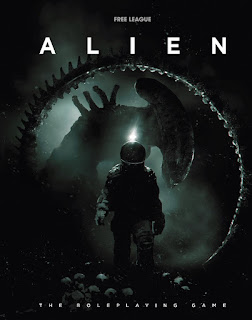
Mail Room: Alien RPG Starter Set

This is a very cool starter set. You get plenty of dice, cards, counters, some beautiful maps and deck plans, and a starter rulebook and adventure. You do not get the full Xenomorph as the adventure's monster, but once you consider the broader Alien-Prometheus sort of background the Xenomorphs should only be a small part of the equation here and all sorts of monsters should be able to mutate and morph from this alien DNA and the monster they do give makes sense.

"Alien DNA mutates humans and/or creates new creatures" - that is my game's tag line. This generic "alien DNA" doesn't even have to be "Xeno/Prometheus DNA" either - there could be many strains from different sources, and it honestly just a reason to infect anything and create a creepy bio-monster out of it.

You should feel free to create any monster given this background, from huge crawling brains with tentacles, a spider eyeball, anything from The Thing movies (a huge influence on my ideas as well), a snake with a human head, a mutant hellhound with tentacles, intelligent vines with human blood, monster crabs, icky triped grabbers, giant boring beetles, monster worms, or anything that creeps you out. I like "expanding the monster list" for this to the "DIY monsters" that the games like Lamentation of the Flame Princess or Dungeon Crawl Classics use.

You make your own monsters. They are unique and not like any other. They are not in a tired old bestiary. You do not know what they can do or their powers, attacks, defenses, or weaknesses. Every time you have an adventure, this is both the first time anyone encounters the beast and the last time anyone will.

If a monster is in a bestiary, it is not a monster anymore.

These have to come from your imagination, fears, and inside your mind.

This is very much an "Expanded Universe" view of the Alien universe, and I feel one that suites a role-playing horror game a lot better than just having week after week of Xenomorphs. I am not even as tied to the time or the technology, if I wanted to run a few one-shots in different times with different technology levels that would be cool as well. The system is pretty rules-light and you could create pretty easy stats for new gear and weapons quickly (or reskin the existing items).

This is one I am really excited about, and more soon!

Monday, January 31, 2022

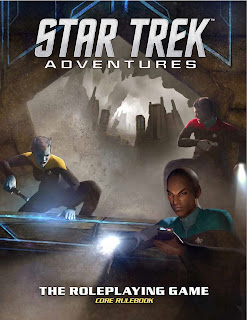
Star Trek Adventures: Horror

What I would really love to do with this game is mod this into a horror game. I know, what???

If you go back to TOS, there were horror scenarios in that series with monsters in mines, colonists dying for unknown reasons, salt-monsters, lava-monsters, and all sorts of creepy-crawly monsters and alien life forms shambling about. The scanners (ship and hand) could not always tell us everything, we had to crawl around in caves and mine shafts, and stay in colonies and have the woman's scream in the next room. Even the transporters did not solve every problem.

By the time we got to The Next Generation we mostly forget about horror. The "unknown" became really theoretical and we were modulating shields and phase capacitors to solve "big science" problems (but always with a personal cost, so it wasn't so theoretical it did not have an impact). And if I did a horror mod to this game, it would be in the TNG era.

I just like the concept of taking a society that thinks it knows everything, has perfect scanners and a science established that can play with space and time, a theory and conceptual framework for everything, and knocking it down a few rungs of the ladder.


You Don't Know Everything

Don't be so sure of that "science" of yours.

The results of scans? Likely wrong as the evil "Hellraiser force" manipulates the results to get you to send crewmembers to their deaths. Transporters? They can be unreliable and whatever this evil force is controlling the galaxy can transport your away team into a hellish trap, chained up on a wall, into a deathtrap, or never to be seen from again. Weapons? Not always effective against the things which lurk about.

Yes, I know, crews would be playing it safe by taking the shuttle most of the time. But there is a risk and a cost to using technology. Even a scan by the ship's sensors could get this "feedback loop" and cause the science console to explode with an overload, and possibly kill the crewmember doing the scan. You have to be prepared for the worst, and every decision to use technology should have a chance for a terrible cost (perhaps on a critical failure roll death is certain, no matter what you are doing).

Your starship? Not always a safe place as the hallway lights blink on and off as the force probes and searches for life to torment, things escape from the lab, crewmembers mutate into bloodthirsty monsters, and accidents do happen. Some of your crew let their baser desires control their minds and turn evil on you. Perhaps one wakes up with totally black eyes and tries to kill everyone. Strange mutations happen in crewmembers and are not always understood, and perhaps they are benign, or perhaps they will drive the crewmember mad. Maybe the crewmember will grow into a room-sized monster. Maybe they will grow devil-like horns and be fine. Or perhaps, "fine." And other members of the crew whisper about this "freak" and mistrust spreads.

Every thing you were certain of becomes an unknown.

You can't trust your ship, science, technology, weapons, or even your crew.


Just Add Alien


Free League's Alien RPG has a lot of great tables for stress, injures, panic, and wounds I may wish to borrow from. I love the concept of an ever-increasing stress pool that leads to panic. I would not do Xenomorphs, but the rules for a lot of the conceptual fear and horror mechanics (if I choose to use fear mechanics), would fit right in here perfectly.


The Dark Universe

This would be a parallel universe sort of experiment, sort of The Dark Universe sort of thing where TNG at the end of the run splinters off into a universe which becomes overrun by evil power, the Federation begins to shrink and decline as planets fall into madness, and the over-arcing meta-plot is to solve problems here and there to keep the ever-encroaching madness and insanity at bay.

There would be "safer" hub worlds where things felt normal, but the edges of the frontier would be lost to madness. There may be sadistic raider ships flying about in a Mad-Max style of orgy of violence and piracy out there, so there would be a few fun "straight combat" options for missions and breaks in the horror. A lot of the missions would be going to a colony world to solve a problem that would force the world more into the darkness, like miners uncovering a strange idol that causes madness, creatures on a space station, or other classic monster and horror-style adventures.

Since you can't always be under threat, the hub worlds would be relatively safe, and provide that needed contrast between "the normal world" and the terrors of the periphery. If everything is horror, then there is no tension. There needs to be safe harbors and normal life.

And then you are sent out into the darkness.

If you succeed (often at great cost), that remote colony is safe for a while. The threat level goes down. And your ship is sent to the next flashpoint where the evil tries to dig its claws into the innocent minds of the world. The cost would be high as your ship would be constantly losing crew and having them replaced, and perhaps your ship itself would be lost in the fight, but to serve in this Federation is to defend the peaceful worlds from this cosmic horror, at any cost.

Perhaps you survive long enough to make it home.

Perhaps you earn the chance to retire and your mind cannot take it anymore.

Perhaps you are chosen to train the next recruits for their first mission into the darkness.

It is a fatalistic and noble game where the ship and its crew know they are fighting a losing battle against the impossible, with their very lives and sanity at risk, but to win another battle against evil and push the madness back a few parsecs makes every sacrifice mean something.

Or perhaps not. This is horror, after all.

Monday, January 24, 2022

Explaining the OSR and Horror Gaming

My sister and I should start a podcast because when we get started discussing things it always breaks down into laughter. We talk a lot about gaming, history, current events, and I try to explain different things I have learned over my years playing pen-and-paper games.

Today I was trying to explain why horror games are better done without artificial concepts like insanity rolls, fear checks, bravery checks, or any sort of other rules layer that sits between you and what goes bump in the night.

So you head towards the abandoned farmstead in the dark forest on the hill. The Mayor sent you and your companions here to find out why the families of this area fled their homes and never returned. The clouds hang low in the overcast sky.

And around the farmstead you see arcane symbols, sacrilegious icons, and pentagrams  weaved from branches and twigs hanging from trees.

Also hanging from the trees are the carcasses of dozens of dead animals.

Then I told her, "Okay make a fear check, and suffer 1d10 sanity loss! Remember at zero you lose your character forever."

I paused, and she said okay, and then I said, "Did that pull you out of the moment?"

And she saw what I was talking about. The fear should be in the mind of the player, the person experiencing this scene through their character there, and not filtered through a layer of rules where what the player fears the most is losing control of their character through a rule that says they have to.


Fear Mechanics

A lot of games do the fear and sanity mechanics, Alien, Call of Cthulhu, and many more. Other games have fear mechanics added in optional systems, like GURPS, Pathfinder, and others. This isn't to say these games are inferior, but that I prefer the OSR (Old School Revolution) method of creating fear in the mind of the player.

This is the way I like to play, and I feel removing that game mechanic layer lets you tell better stories. Admittedly, it is hard to tell good horror, and finding players that understand how this all works is very tough too. Not many groups and players do it this way, and the more mass-market manner of handling fear and insanity through mechanics is needed to help newer players through how they should act.

There are times I like to settle back and play games with fear mechanics too, when I want that sort of "playing the rules" feeling of working within that rules limitation - more like a game, less like a story. The Alien RPG does a great job with this sort of "rules based fear" and is very enjoyable to play as a board game, but I am not feeling the same sort of fear as I do in an OSR horror game.

It isn't easy telling a good horror story, and in some rules systems death is so hard the players barely ever feel fear. Fear becomes a mechanical process that tells a player, "you lose control of your character" and that is what the player ends up fearing.

Not the strange sounds of labored breathing shaking the floorboards. Not the dark basement where the sounds become stronger. And not the space between the floorboards a human head on a tentacle jumps from and attacks. And again, in some games, the players know the encounter needs to be balanced and they will win regardless, so roll initiative.

The mechanics of the system, and the fear mechanics themselves, remove the player from the story.

Players fear the rules more than they do what is happening in the moment, and that isn't horror.


Advanced Mechanics?

She mentioned, what if the fear score could be gamed so that it improves and you become less and less afraid over repeated encounters? We switched to a fear of spiders for this one, and while "leveling up" a "fear of spiders" disadvantage seems like a fun mechanical answer to the problem, I said this is better done through roleplaying. A player-character is afraid of spiders. They refuse to help the party fight a giant spider. The player is awarded bonus XP at the end of the session for playing in-character, even putting others or themselves at a huge disadvantage.

We don't need rules for that on the player side or the referee side. They get in the way, and this is best left for players to work through and roleplay. This is the fun of shared storytelling and letting players handle this instead of mechanics is more freedom and empowerment for players in their stories.

It was an interesting discussion with her, since we are all so trained to "gamify" everything these days. What do you do to make something fin? Make rules for it! She made a lot of good points on creating a fun system, and her ideas on "buying down" a disadvantage and having that give you special abilities are very cool.

She is a budding gamer designer herself, which makes me endlessly happy.


The OSR as a Theory

But we were talking about two different things. She was trying to come up with rules to make fear mechanics work, I was trying to say we don't need any rules at all. It took a while to communicate the OSR theory of removing rules and only keeping what is needed, and focusing on the roleplaying as the primary driver of interaction and rulings.

In hindsight, I should have introduced her to the OSR theory before the discussion. I do feel this is one of the things we forget when speaking about OSR games to newer players, as a lot of new players to OSR games feel they have to "find the rule for X" when a situation comes up.

In the OSR, a lot of the game is left to the interactions between the referee and players. Want to search for a secret door? Tell me where you are searching and how - no roll needed. In a more modern game, the new player would be asking, "What are the rules for searching and what skill do I need to roll?"

A lot of phone and computer games "train" players to expect a rule, and the OSR concept of "you don't need them" seems alien at first. This is how we started playing these games, and this concept is one of the core principles of OSR games.


We Roleplay It

In the OSR, the player elects to take a fear or phobia as a personality quirk, and roleplays it whenever it comes up. If they roleplay it well and it adds to the story, the referee rewards their roleplaying at the end of the session. If some day they overcome their fear by finally defeating a village-eating spider, give them an XP bonus for conquering that fear and it doesn't come up again. That arc and story is over. Players are free to have new phobias or personality quirks, and the referee rewards good play with XP, treasure, or other rewards.

Same with fear. Everyone is free to come up what their characters do when that head on a tentacle bursts from the floorboards. If a player has their character flee the house screaming because that is what the character would do, putting everyone at a disadvantage, that is great roleplaying. That isn't "hurting the party" in any way, which is what the some gamist gamers would likely say.

This person ruined the combat encounter.

They caused a TPK.

This person sucks as a player.

No, they don't suck. If this is a horror game, having your character act like a character in a horror movie is fair game. It is expected. If a player makes that choice, I would support them. Maybe they end up helping the party in the end when they run outside. Maybe they will be the last one left. Maybe they will hear the sloshing in the well where the heart of the tentacle lies, and get an opportunity to attack the most vulnerable part of the monster - and save the day.

Maybe they will run outside and get mauled off-screen by the werewolf in the woods and never be seen again.

This is horror, after all.


Reverse Rules Interference

What is more important is the story and what the players experience. Yes, there is a loss of control. The character who ran outside? Within a horror game it is perfectly fine for the referee to not tell the player the werewolf killed their character and leave everyone wondering, "What happened to him or her?" It happened so fast even the player controlling the character never knew.

They may find the body later.

They may never.

They likely won't be told how it happened either and are left to figure that out for themselves.

This is different than a more normal game in that the horror genre needs these feelings of fear and uncertainty. Everyone knows what they are signing up for and getting into here, or at least I hope they do. it is harder to do horror with a set of rules that explicitly lays out what the players can and can't do, and what the referee is and is not allowed to do. You get these situations where a horror situation, like the above, comes up, and the player will start arguing rules to say why that did not just happen.

"But I should have gotten a search or sense roll!"

Again, the rules are inserting themselves into the story and getting in the way of the experience, this time from the player's side and using them to invalidate the story and referee's rulings. As a board game, yes, this is fairness built into the rules and what a lot of players expect these days.

As horror and OSR? Ruling everything feels out of place and it distracts from the experience, which is the most important part of the game. Remember, an OSR referee is a neutral party and not playing against anyone. This isn't gotcha, but one person has to be in charge of the game's "secret information" and ruling what happens when player X does Y.

With no rules between X and Y to disrupt that cause and effect.