Monday, January 31, 2022

Star Trek Adventures: Horror

What I would really love to do with this game is mod this into a horror game. I know, what???

If you go back to TOS, there were horror scenarios in that series with monsters in mines, colonists dying for unknown reasons, salt-monsters, lava-monsters, and all sorts of creepy-crawly monsters and alien life forms shambling about. The scanners (ship and hand) could not always tell us everything, we had to crawl around in caves and mine shafts, and stay in colonies and have the woman's scream in the next room. Even the transporters did not solve every problem.

By the time we got to The Next Generation we mostly forget about horror. The "unknown" became really theoretical and we were modulating shields and phase capacitors to solve "big science" problems (but always with a personal cost, so it wasn't so theoretical it did not have an impact). And if I did a horror mod to this game, it would be in the TNG era.

I just like the concept of taking a society that thinks it knows everything, has perfect scanners and a science established that can play with space and time, a theory and conceptual framework for everything, and knocking it down a few rungs of the ladder.


You Don't Know Everything

Don't be so sure of that "science" of yours.

The results of scans? Likely wrong as the evil "Hellraiser force" manipulates the results to get you to send crewmembers to their deaths. Transporters? They can be unreliable and whatever this evil force is controlling the galaxy can transport your away team into a hellish trap, chained up on a wall, into a deathtrap, or never to be seen from again. Weapons? Not always effective against the things which lurk about.

Yes, I know, crews would be playing it safe by taking the shuttle most of the time. But there is a risk and a cost to using technology. Even a scan by the ship's sensors could get this "feedback loop" and cause the science console to explode with an overload, and possibly kill the crewmember doing the scan. You have to be prepared for the worst, and every decision to use technology should have a chance for a terrible cost (perhaps on a critical failure roll death is certain, no matter what you are doing).

Your starship? Not always a safe place as the hallway lights blink on and off as the force probes and searches for life to torment, things escape from the lab, crewmembers mutate into bloodthirsty monsters, and accidents do happen. Some of your crew let their baser desires control their minds and turn evil on you. Perhaps one wakes up with totally black eyes and tries to kill everyone. Strange mutations happen in crewmembers and are not always understood, and perhaps they are benign, or perhaps they will drive the crewmember mad. Maybe the crewmember will grow into a room-sized monster. Maybe they will grow devil-like horns and be fine. Or perhaps, "fine." And other members of the crew whisper about this "freak" and mistrust spreads.

Every thing you were certain of becomes an unknown.

You can't trust your ship, science, technology, weapons, or even your crew.


Just Add Alien
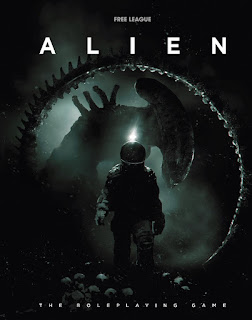

Free League's Alien RPG has a lot of great tables for stress, injures, panic, and wounds I may wish to borrow from. I love the concept of an ever-increasing stress pool that leads to panic. I would not do Xenomorphs, but the rules for a lot of the conceptual fear and horror mechanics (if I choose to use fear mechanics), would fit right in here perfectly.


The Dark Universe

This would be a parallel universe sort of experiment, sort of The Dark Universe sort of thing where TNG at the end of the run splinters off into a universe which becomes overrun by evil power, the Federation begins to shrink and decline as planets fall into madness, and the over-arcing meta-plot is to solve problems here and there to keep the ever-encroaching madness and insanity at bay.

There would be "safer" hub worlds where things felt normal, but the edges of the frontier would be lost to madness. There may be sadistic raider ships flying about in a Mad-Max style of orgy of violence and piracy out there, so there would be a few fun "straight combat" options for missions and breaks in the horror. A lot of the missions would be going to a colony world to solve a problem that would force the world more into the darkness, like miners uncovering a strange idol that causes madness, creatures on a space station, or other classic monster and horror-style adventures.

Since you can't always be under threat, the hub worlds would be relatively safe, and provide that needed contrast between "the normal world" and the terrors of the periphery. If everything is horror, then there is no tension. There needs to be safe harbors and normal life.

And then you are sent out into the darkness.

If you succeed (often at great cost), that remote colony is safe for a while. The threat level goes down. And your ship is sent to the next flashpoint where the evil tries to dig its claws into the innocent minds of the world. The cost would be high as your ship would be constantly losing crew and having them replaced, and perhaps your ship itself would be lost in the fight, but to serve in this Federation is to defend the peaceful worlds from this cosmic horror, at any cost.

Perhaps you survive long enough to make it home.

Perhaps you earn the chance to retire and your mind cannot take it anymore.

Perhaps you are chosen to train the next recruits for their first mission into the darkness.

It is a fatalistic and noble game where the ship and its crew know they are fighting a losing battle against the impossible, with their very lives and sanity at risk, but to win another battle against evil and push the madness back a few parsecs makes every sacrifice mean something.

Or perhaps not. This is horror, after all.

Sunday, January 30, 2022

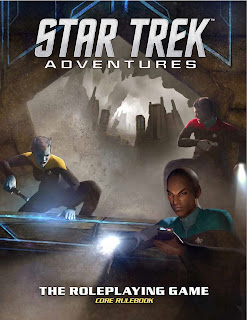
Mail Room: Star Trek Adventrures

I got this one on a whim, I like the options to play original TV series adventures and we will see how this goes. This is a 2d20 system game, and I think it is a "roll low" system - which should be interesting.

Star Wars has the action, but for me Star Trek always nailed the problem-solving and party-based play stronger. You are typically on a "mission" so you get that Paranoia-style objective and setup, and you are not as freelancing or reacting to a galactic war. It is easier to setup goals and objectives, and players typically need to use a little restraint when approaching problems in order to live up to the examples Starfleet wants them to be.

The game can have encounters, combat, and action, and from what I see in the PDF it looks like that action-style of play is supported and this is not completely cerebral play. So if you want shootouts and hand-to-hand, you can have it.

The game is set in the "Next Generation" timeline, but there looks to be support for the original series era. The modern film era is not present here, and there doesn't look to be any of the newer TV series either. So this is just "classic and next generation" style play, and admittedly those feel like the best eras with the greatest support and fandom. I would love to see an "original series" book that focuses more on that era, but I bet I could pick up a book on Amazon and have all the information I need to convert things in.

Overall and interesting looking game and I hope it works out.

Saturday, January 29, 2022

B/X Collection = My NES

One thing I love about my B/X game collection is the entire shelf feels like a classic NES system with tons of games waiting to be played. I have so many fantasy options, modern, sci-fi, horror, kingdom building, high adventure, pulp, gangsters, spies, and my choices are endless.

I want generic B/X? I got that. I want stripped down simple B/X? I got that. I want a more modern feeling game? Got that too. Kingdom building, hex crawls, horror, post-apocalypse, or gonzo fantasy? Got those. Games more Middle Ages than Renaissance that get me into reading history? Yep! More games come out, and I have more options every month. Everything sort of works together too, and the speed and ease of play mean I can jump right in.

I am not flipping through hundreds of pages of rules to look up the rules for hiding and stealth, referenced in two chapters hundreds of pages apart (which I saw on one Youtube video of a playthrough of a newer game, and I felt pained watching). I like systems that stop the rules at a certain point and say, "You come up with the right ruling, we trust you."

Where a generic system, such as GURPS or Champions, does all of the above as well, they do not do it as easily and as fun, and you still have the heavy rules framework. Yes, you do have the argument of having to "relearn a new game when you want to switch genres" but with B/X there is not really that much to re-learn, other than a few minor differences between games.

I have lost some interest in the current flagships in tabletop gaming, such as 5E. I did want to get in on 5E, but life got in the way and I never got a chance to play early. Right now it feels late to jump in with a new edition/revision coming, and I would rather focus on the games I know and grew up with. Now is not the right time for me, and props to everyone having fun with the current edition.

No system wars or belligerent advocacy here, I would rather be playing and writing.

I have a few other options too that aren't necessarily B/X, such as FrontierSpace or Covert Ops (d00 System from DWD is my Genesis), and a few other retroclones of other systems, such as Zweihander or Cepheus System, and a few high quality options from companies like Free League (TG-16), and those are my "other consoles" that have a few good games on them as well. Some of the games for my NES-like collection have built-in "expander packs" that enhance the game within the old-school framework with a modern feeling without needing a new console or platform, such as Castles & Crusades.

My B/X games remain the most compelling part of my game library, and it is such a vibrant, diverse, and imaginative community to be a part of and support.

Star Frontiers & FrontierSpace

One of the hardest things I did recently was shelve all my old nostalgia games. I got to a point where I had a very nice collection of OSR games, plus a few new ones I wanted to try, but my legacy collection of games kept sitting there and silently demanding attention.

I love them, my brother and I played them for years, and those will always be a special part of my life.

But there is a point where I felt they were holding me back from having new experiences. Also, buying reprints of them and being in fan groups for them felt like that was holding me back from trying and enjoying the new stuff. I still am in those groups (and I do have a lot to add), but I want to make time to explore new games and join new communities.

And while I like having POD reprints of the classics, sometimes having them means they demand attention and they take time away from indie creators trying to get attention and coverage. While I love my classic games, I love the excitement and new ideas that this generation of publishers and creators are bringing to the hobby. Instead of giving money to a billion dollar corporation for a POD legacy game they no longer really support, I would rather give that money and attention to those fans and creators working in a basement somewhere to create new and fun experiences.

I realized I can't always be looking behind me, and that was holding me back from discovering games that I may love. Any game - even newer ones - can become an obsession like this too and prevent you from exploring and finding yourself.

I love you old games, but with limited time and attention I would rather give that to people out there trying to build something new and cool. So with that in mind, I wanted to collect some of my thoughts on nostalgia games and the systems I am using today that replace them.


FrontierSpace

What could ever replace Star Frontiers for me? The classic game my brother and I played for a good amount of our lives, kept us excited about science fiction, and was a great "other universe" from the tentpole franchises of Star Wars and Star Trek. One I am looking at now is the excellent FrontierSpace game from DWD Studios. This is a classic d100 style game with an excellent action economy and support for ability scores and skills over 100%. 


Star Frontiers Unarmed Combat

The hand-to-hand game seems light-years better than Star Frontiers, which limits unarmed damage to the few points of your Punching Score, no damage dice, and has you hoping for a 01-02 roll or "ends in zero" roll for a knockout result in melee. Or getting someone in a hold with martial arts skill while others beat him for a few points of damage per hit.

I tried replaying the Volturnus modules with the original rules and the first "escape the starship" scenario fell flat because of the unarmed damage and combat rules. They game felt and played "wrong" to me, like there was something missing. This wasn't an OSR "then make it up" moment, the rules laid out options and none of them felt really great or worked well.


FrontierSpace Unarmed Combat

In FrontierSpace base unarmed damage is 1d5+melee damage bonus, and those with the warrior skill (basically melee combat) can buy a skill benefit and do 1d10+damage bonus. You can multi-attack too as much as you want as long as you can stomach the cumulating -20% extra action penalties (which also apply to defense).

The unarmed skill also has a great assortment of abilities and bonuses when fighting in melee (purchasable with development points, DP). They can gain improved dodging against being unarmed versus armed opponents, multiple attackers, and dodging ranged attacks. They can get a massive bonus when using two-handed weapons or dual-wielding, and even can conceal melee weapons. 

All of these bonuses can be bought with improvement points as the character gains experience, so their skills improve in unique and interesting ways. If my player wanted to create a new skill benefit, maybe one based on a feat, power, or special ability from another game (for example, bonus sneak attack damage or blocking missile weapon attacks with a laser sword), that could be written up, balanced, and dropped alongside one of the existing ones they give you and purchasable as you gain DP.

There is a lot of customizability here, and with benefits existing for every skill, the system is incredibly flexible and adaptable to anything you could want or add to it. The melee game in particular feels a lot better than the original game this was inspired by.

In our legacy Star Frontiers campaign one of my brother's main characters was a melee fighter and Star Law Ranger. This set of rules would have made my brother very happy and his character a lot more fearsome than the Star Frontiers version. In our legacy campaign we ended up switching rules a few times to get that feeling, and the base game never really did a good job at making his character feel powerful. Here, he could customize his Star Law Ranger into being one of the most fearsome melee fighters in the galaxy and have the special abilities to back it up.

This is one of the advantages to playing a more modern set of rules written by fans of the original, you get so many of these "play improvements" that make the entire experience a lot more satisfying and interesting than the original game. You get a high degree of character customization. This game feels like a next-generation Star Frontiers to me.


The Setting

I love the original Star Frontiers setting, and I know I would port the original setting races into any universe I play with these rules. The original Star Frontiers setting said "the original races came together here" so there are a few questions hanging out here. Did they gather anywhere else? Where did they come from? Are there any others out there?

So there is enough latitude to create your own map and universe without playing on the original Frontier map. You could add new races and have them intermingle with the existing ones. You could also have a mysterious race of worms show up and find this area of space and salvage a lot of the original lore and conflict without sacrificing too much.

The included setting in FrontierSpace is workable, I like the fact there are are different governments to deal with and to have interacting with each other. One thing the original Star Frontiers setting lacked were different areas of space controlled by different factions, things felt very much a uni-faction with one Star Trek style Federation (UPF) running everything.

I suppose if pressed, I would do a more grand sweeping space opera style setting, with ways to return to the original home-worlds of the major races (via slow travel space arks), some home-world factions involved, and more main-map factions and areas of space. Maybe make some of the new races native to this "crossroads" area of space, and put an over-arcing metaplot in place. Something like the crossroads is an area of dense and heavy metals and natural resources, the only place like it in thousands of light-years of low-density space, and the resources extracted from here are critical to the home areas of space of the major races.

Without these raw materials the home worlds will stagnate and exploration will eventually grind to a halt within 100 years. Every so often a new mammoth space ark shows up from the home-worlds after a journey lasting hundreds of years, new factions are introduced, population for a new planet is awoken, and the space ark is loaded up with raw materials for the trip home that will take hundreds of years.

With this campaign setup you could drop the original Frontier setting in there as a home-world faction and area of space that is supplying colonists to this area of space and have that nostalgia hit while keeping things in the newer campaign setting fresh.


Technology

The technology level is different, the ships are a bit more advanced with antigravity and speedier travel, but since the timeline could be advanced or reworked, that isn't too much of a problem. Again, if this is a campaign set after the Frontier timeline and that area of space has been depleted of resources and we are playing 500 years in the future this all works.

Star Frontiers works best when it is "D&D in space" with a mix of modern-style RP, hexcrawls, dungeon adventures, and space combat added on as a fun, almost cinematic, battle where everyone gets to take part. You put too much advanced technology in there, all-seeing scanners, teleporters, real-time instant interstellar communication, and you lose a lot of the adventure elements the game depends on to be "D&D in space."

This is the same problem "too much divination and teleportation" magic that D&D has, and it applies to sci-fi as well. If character have no need to leave their starship, can scan a planet and instantly find the crashed and stolen satellite, and lock onto it and beam it up to the ship there is no need to get out of the ship at all. You have to start inventing reasons why "the scanners and transporters" don't work, or why "instant communication back home doesn't work here."

For good "pulp adventure sci-fi" there has to be work, travel, and going down there to see what is happening. You can't shortcut player investigation and face-to-face interaction with a button on a console.

With super-tech, you end up doing more work finding reasons to limit the unlimited than you do in crafting fun adventures. It gets tiring after a while, which is why everything needs a cost and limitations - magic and technology - in order to have that classic adventure experience.

To be honest, Pathfinder 1e with unlimited first and third party expansion-books ended up this way for us too, you can literally be a mage and solve every problem in the world with a near zero-cost spell. You didn't even need other character classes beyond a cleric for heals and resurrections.


Starships & More

To keep things simple I will probably use the FrontierSpace ships. I had ideas of mixing in Traveller ships, but that feels like too much of a jumbled mix of rules and ideas to work practically. If I go with the assumption this is a 500 years after Star Frontiers setting the only thing I need to keep are the Frontier races that I would like in my game, and possibly use the others in FrontierSpace as expansion material.

It is one of those things, if I am moving on to a new rules system, keep things as much as possible in it and give it a chance before changing everything. The few things I want to keep, some of the legacy lore, can be added easily. I don't need everything from the original rules except the races and the original setting still being somewhere "out there in the stars."

I still would love to do a Traveller-style campaign with these rules, but I may have other ideas for Traveller I want to explore. For now, keeping what I loved about the original Star Frontiers and upgrading to a new set of rules seems like the best fit for this game.

This game really is a better fit for Star Frontiers than the original, at least for me. This is one of those few non-B/X games that is on my "best games" shelf and I look forward to diving in.

Wednesday, January 26, 2022

First Look: Amazing Adventures

Here is a fun one I am looking at, the Siege Engine (Castles & Crusades) pulp 1920s-1950s game Amazing Adventures. I like Castles & Crusades so this interested me as a sort of "also" game that went along with those rules.

I also like the pulp genre a lot, from the original TSR Gangbusters, B/X Gangbusters, Mercenaries Spies & Private Eyes, and other games that do the era justice. This one was interesting as a B/X style of gangster game but using the C&C rules, so I picked it up to read.


A Fading Era?

I always get this feeling that interest in the pulp era is fading year after year. We get farther and farther away from the time, and the relevance of this era seems to wane to a modern audience. I hope not, since there is a lot of great and amazing stories to tell in the pulp era, and a lot of our adventure fiction is based on this genre as the genesis of the heroes and action for what we even see in movies today.

As time goes by this era becomes more and more fantasy-like, with the strange level of technology seeming far removed from the present day. No cell phones or computers? No direct dial long distance? No television (towards the end of the era but still, mostly radio)? No jet aircraft? Ocean liners for cross sea travel? No interstate highways? Strange rules for law enforcement where a county or state line could stop pursuit? A world that was still mostly distant and unknown?

This was a different world.


Strangely Rules Heavy

From my first read through I found more rules and a larger book that I would have expected. A lot of these are classes, options, and magic - but the game still felt substantial and complete compared to other games in the genre. I wanted a few more weapons and vehicles, regardless, for a book this size and this much depth in the rules. There seems to be more weight here around characters, powers, and builds than lots of "stuff" but it does not feel like an issue that is a deal breaker. I have a lot of reference material, so I don't see the lack of gear and vehicles as a drawback, just a "want more" thing that could easily be fixed by myself or "gear and gadgets" book.


Gangsters, Serials, Sci-Fi, or Cthulhu

The game has the tools needed to do a lot of genres from horror, gangsters, crime fighting, action serials, treasure hunting, to campy sci-fi action. I like the options here and the game feels like a complete playset to do a lot with. One one hand, it isn't as focused as other games are. On another, this game is a sandbox playset with many uses.


Looks Like Fun

I want to get my Castles & Crusades game running pretty soon here, but I like options like this to explore and have fun with. More soon as I read through this and get more of this read.

Monday, January 24, 2022

Explaining the OSR and Horror Gaming

My sister and I should start a podcast because when we get started discussing things it always breaks down into laughter. We talk a lot about gaming, history, current events, and I try to explain different things I have learned over my years playing pen-and-paper games.

Today I was trying to explain why horror games are better done without artificial concepts like insanity rolls, fear checks, bravery checks, or any sort of other rules layer that sits between you and what goes bump in the night.

So you head towards the abandoned farmstead in the dark forest on the hill. The Mayor sent you and your companions here to find out why the families of this area fled their homes and never returned. The clouds hang low in the overcast sky.

And around the farmstead you see arcane symbols, sacrilegious icons, and pentagrams  weaved from branches and twigs hanging from trees.

Also hanging from the trees are the carcasses of dozens of dead animals.

Then I told her, "Okay make a fear check, and suffer 1d10 sanity loss! Remember at zero you lose your character forever."

I paused, and she said okay, and then I said, "Did that pull you out of the moment?"

And she saw what I was talking about. The fear should be in the mind of the player, the person experiencing this scene through their character there, and not filtered through a layer of rules where what the player fears the most is losing control of their character through a rule that says they have to.


Fear Mechanics

A lot of games do the fear and sanity mechanics, Alien, Call of Cthulhu, and many more. Other games have fear mechanics added in optional systems, like GURPS, Pathfinder, and others. This isn't to say these games are inferior, but that I prefer the OSR (Old School Revolution) method of creating fear in the mind of the player.

This is the way I like to play, and I feel removing that game mechanic layer lets you tell better stories. Admittedly, it is hard to tell good horror, and finding players that understand how this all works is very tough too. Not many groups and players do it this way, and the more mass-market manner of handling fear and insanity through mechanics is needed to help newer players through how they should act.

There are times I like to settle back and play games with fear mechanics too, when I want that sort of "playing the rules" feeling of working within that rules limitation - more like a game, less like a story. The Alien RPG does a great job with this sort of "rules based fear" and is very enjoyable to play as a board game, but I am not feeling the same sort of fear as I do in an OSR horror game.

It isn't easy telling a good horror story, and in some rules systems death is so hard the players barely ever feel fear. Fear becomes a mechanical process that tells a player, "you lose control of your character" and that is what the player ends up fearing.

Not the strange sounds of labored breathing shaking the floorboards. Not the dark basement where the sounds become stronger. And not the space between the floorboards a human head on a tentacle jumps from and attacks. And again, in some games, the players know the encounter needs to be balanced and they will win regardless, so roll initiative.

The mechanics of the system, and the fear mechanics themselves, remove the player from the story.

Players fear the rules more than they do what is happening in the moment, and that isn't horror.


Advanced Mechanics?

She mentioned, what if the fear score could be gamed so that it improves and you become less and less afraid over repeated encounters? We switched to a fear of spiders for this one, and while "leveling up" a "fear of spiders" disadvantage seems like a fun mechanical answer to the problem, I said this is better done through roleplaying. A player-character is afraid of spiders. They refuse to help the party fight a giant spider. The player is awarded bonus XP at the end of the session for playing in-character, even putting others or themselves at a huge disadvantage.

We don't need rules for that on the player side or the referee side. They get in the way, and this is best left for players to work through and roleplay. This is the fun of shared storytelling and letting players handle this instead of mechanics is more freedom and empowerment for players in their stories.

It was an interesting discussion with her, since we are all so trained to "gamify" everything these days. What do you do to make something fin? Make rules for it! She made a lot of good points on creating a fun system, and her ideas on "buying down" a disadvantage and having that give you special abilities are very cool.

She is a budding gamer designer herself, which makes me endlessly happy.


The OSR as a Theory

But we were talking about two different things. She was trying to come up with rules to make fear mechanics work, I was trying to say we don't need any rules at all. It took a while to communicate the OSR theory of removing rules and only keeping what is needed, and focusing on the roleplaying as the primary driver of interaction and rulings.

In hindsight, I should have introduced her to the OSR theory before the discussion. I do feel this is one of the things we forget when speaking about OSR games to newer players, as a lot of new players to OSR games feel they have to "find the rule for X" when a situation comes up.

In the OSR, a lot of the game is left to the interactions between the referee and players. Want to search for a secret door? Tell me where you are searching and how - no roll needed. In a more modern game, the new player would be asking, "What are the rules for searching and what skill do I need to roll?"

A lot of phone and computer games "train" players to expect a rule, and the OSR concept of "you don't need them" seems alien at first. This is how we started playing these games, and this concept is one of the core principles of OSR games.


We Roleplay It

In the OSR, the player elects to take a fear or phobia as a personality quirk, and roleplays it whenever it comes up. If they roleplay it well and it adds to the story, the referee rewards their roleplaying at the end of the session. If some day they overcome their fear by finally defeating a village-eating spider, give them an XP bonus for conquering that fear and it doesn't come up again. That arc and story is over. Players are free to have new phobias or personality quirks, and the referee rewards good play with XP, treasure, or other rewards.

Same with fear. Everyone is free to come up what their characters do when that head on a tentacle bursts from the floorboards. If a player has their character flee the house screaming because that is what the character would do, putting everyone at a disadvantage, that is great roleplaying. That isn't "hurting the party" in any way, which is what the some gamist gamers would likely say.

This person ruined the combat encounter.

They caused a TPK.

This person sucks as a player.

No, they don't suck. If this is a horror game, having your character act like a character in a horror movie is fair game. It is expected. If a player makes that choice, I would support them. Maybe they end up helping the party in the end when they run outside. Maybe they will be the last one left. Maybe they will hear the sloshing in the well where the heart of the tentacle lies, and get an opportunity to attack the most vulnerable part of the monster - and save the day.

Maybe they will run outside and get mauled off-screen by the werewolf in the woods and never be seen again.

This is horror, after all.


Reverse Rules Interference

What is more important is the story and what the players experience. Yes, there is a loss of control. The character who ran outside? Within a horror game it is perfectly fine for the referee to not tell the player the werewolf killed their character and leave everyone wondering, "What happened to him or her?" It happened so fast even the player controlling the character never knew.

They may find the body later.

They may never.

They likely won't be told how it happened either and are left to figure that out for themselves.

This is different than a more normal game in that the horror genre needs these feelings of fear and uncertainty. Everyone knows what they are signing up for and getting into here, or at least I hope they do. it is harder to do horror with a set of rules that explicitly lays out what the players can and can't do, and what the referee is and is not allowed to do. You get these situations where a horror situation, like the above, comes up, and the player will start arguing rules to say why that did not just happen.

"But I should have gotten a search or sense roll!"

Again, the rules are inserting themselves into the story and getting in the way of the experience, this time from the player's side and using them to invalidate the story and referee's rulings. As a board game, yes, this is fairness built into the rules and what a lot of players expect these days.

As horror and OSR? Ruling everything feels out of place and it distracts from the experience, which is the most important part of the game. Remember, an OSR referee is a neutral party and not playing against anyone. This isn't gotcha, but one person has to be in charge of the game's "secret information" and ruling what happens when player X does Y.

With no rules between X and Y to disrupt that cause and effect.

Saturday, January 22, 2022

Lamentations, the 17th Century, and Fantasy Worldbuilding

Shout out to RaRa-Rasputin and his Youtube channel. Go subscribe and support his work. He had a great interview with James Raggi, the author of Lamentations of the Flame Princess, has this wonderful discussion about why he set his game in the 17th Century. Around the 15-minute mark we get this:

When people play medieval fantasy, they are not playing like medieval. There's so many modern assumptions still in there, and the 17th Century is when those things are starting to exist, so they make sense as far as how people play anyway.

This is a fascinating quote, and there are many in here, and one about Middle Ages settings that make me feel that a true Middle Age game is so far away from our "modern" experience that it would almost seem like playing in a sci-fi setting than anything we associate with traditional "medieval fantasy" as we know it in tabletop gaming.

You take the concept of serfs and peasants, and how they belonged to the land, could not leave or move to a new town, and were more considered property of the local lord. That isn't anything we know in traditional fantasy gaming, it is borderline controversial to even mention these days, and framed as science-fiction we are more ready to accept this as a concept. Seriously, if you did a big-budget sci-fi movie where evil Earth corporations enslaved an alien race and used them for labor, that would be something you could mentally frame and accept easier than accepting the fact we used to do this to each other on this planet.

This one statement sends me down the rabbit hole of reading history. An ACKS game, played right in a true Middle Ages setting, is not at all like a Lamentations game in the 17th Century. ACKS would feel like playing sci-fi, and I dare say the farther back you go, the more sci-fi things become.

The modern experience is a very small window in time. It is the one we are the most familiar with, and it is the framing we use to look at other people and other times with.


Modern Fantasy

When you consider the "modern fantasy" generic world, and this world is this almost "all ages sort of generic Tolkien meets MMO" world. It is built off safe fantasy art, sterilized by corporate sensitivity reviewers, double checked so it won't anger Twitter or the stockholders, and it becomes this self-sustaining force that permeates every fantasy game.

Generic fantasy has become this manner of speaking, dress, world building, and a look and style that I feel is  decidedly like a "modern world dress up" with some fantasy architecture thrown in there. Harry Potter is the great example of modern-relatable characters, very modern in outlook and manners, living in a fantasy world. All of the TV tropes in Xena and Hercules, those direct-to-video fantasy movies, animation, and those sort of modern people in fancy dress living in a world with fantasy replacements for modern conveniences.

I feel this world mixed with a set of rules even enforces a manner of acting, such as someone who behaves like they are playing a set of rules instead of playing a character in a real world. The world takes on this manner of acting, and people in the world act like they are playing one version of a fantasy game instead of acting like real people in a realistic world.

D&D 4th Edition felt like it had this problem in an acute manner. It did not feel like a real world, at least not to us, it felt like the world of a video game MMO following a specific set of rules. There was this layer of the artificial put on top of everything, how people in the world behaved, the governments, wars, conflicts, exploration, rural life, city life, and every other facet of that reality. The fact the planes are integrated into the world and a part of normal life. The gods are real and "end bosses" for the world.


My Fantasy, My Perspective

With the current edition of D&D we have a huge Magic the Gathering influence, and this high-technology magic feeling where magic can do anything for zero cost. For fans, it is great to see those worlds come alive. But it does bring in a culture, sort of nebulous reality that can be anything to anyone, and it changes the fantasy reality to a "be anything and do anything" sort of world with multiple dimensions, modern influences, and a lot of - I don't want to say baggage - but assumptions that can mean anything to anyone is the better word. It does feel more nebulous and that "the world exists from my perspective" is a modern thing and also a powerful force of marketing the game.

I feel modern fantasy is evolving from the "generic MMO fantasy setting" to more of the world is "your perception of fantasy, and every perception is valid" sort of experience. There is also this feeling of empowerment delivered with the game, almost like a Power Rangers sort of thing, but tailored for a mass audience. Because I play a powerful wizard in game I somehow have more power in the real world sort of sales pitch.

They blur fantasy with reality, which in previous editions of the game was a no-no because of the effect it had on some people's perception of reality.

Also, the zero-cost magic thing is also troubling to me, as our current world is dealing with resource shortages, pollution, worker suffrage, and great imbalances of trade from this "infinite consumerism" mentality. Infinite magic is the Amazon.com one-click anything goes mentality, and I can see why big companies don't want you questioning it. More on this later, but infinite magic I feel enables the "my reality, my fantasy" experience these companies are shipping today.


Fantasy Conveniences

I need my cell phone. I need my mass transit. I need my freedom of speech, freedom of association, and other human rights. I need my airline travel. I need my Internet. I need my speedy travel. I need my public education, schools, and universities. I need my on-call law enforcement with detectives and judicial resolution. I need my familiar governmental authorities and government programs. I need my modern outlook and assumptions. I don't want people of different heritages fighting or coming into conflict. The world must be cosmopolitan with dragon-folk, demon-bloods, and other fantastic races walking around without any differences, bad blood, mistreatment, or suspicion.

Very few of these things are in the historical record. They get Harry Pottered into a lot of these settings. The farther you go back, the more alien the world becomes in all of these regards.

The modernization of modern fantasy RPGs is this commercial force in making a product more acceptable to a mass audience. Some call it a Disney-ification of rules systems once they go mainstream, and you see that in some of the newer movie and series reboots as well.

I feel when companies add these fantasy conveniences where they create "magic parallel technology" for what are things we are used to in the modern world, something is lost. We aren't immersing ourselves in a unique world or time anymore. We don't have to be curious and figure things out. We don't have to learn the lands, peoples, and cultures. We have our traditional Western and current-day assumptions and biases preloaded into the setting and everything feels comfortable. The setting is pre-colonized with our biases and we don't need to learn to adjust to a different time and place.

We are still stuck in the modern world, the one just around us in our daily life, and never escaping it.


The OSR = Room to Explore

I feel this is why I am gravitating more towards the OSR. There is room for experiences outside of that generic fantasy core that has been overdone and I feel become a stereotype of the Western and Internet-centric experience.

How can we ever learn to understand and respect other cultures if we are constantly transposing our own reality onto everything we experience?

The OSR has a lot of room to explore, grow, and find niches that spur me to read history and understand a time outside my own. Also, to understand things from a non-Western perspective. ACKS got me deeply enthralled with the Middle Ages experience of faith, lordship, the pitiful worker experience, and the entire forging kingdoms through blood and conquest. Are there bad-controversial things in the game by today's standards such as forced-servitude? Yes. But as a player, I am free to fight them and correct that wrong, if I choose. The game doesn't erase things it doesn't want me to see.

Lamentations of the Flame Princess got me deeply into horror fiction and also the parallel horror of colonialism. Are there bad-controversial things this game? Yes, it is a horror game. But we need the terrible in here so we can confront our own fears and feelings about how Western society (and to be honest, a lot of non-Western societies) was built off the backs and blood of others. The game does not hide that truth that is integral to the horror experience.

ACKS and Lamentations have me buying and reading history. My real-world life and experience are growing, and I am educating myself as a life-long learner. Modern fantasy feels like a frozen TV dinner in comparison. It doesn't nourish me mentally, challenge me to rethink what I am told on the Internet, and give me that depth of knowledge that makes me an interesting person.

Lion & Dragon can also be mentioned here, but I am still reading that game and it looks like a fun one.

Are there less-heavy options in the OSR? We got Old School Essentials, Labyrinth Lord, Basic Fantasy, and Castles & Crusades that can fill the need. They can easily do "modern fantasy" if that is your thing, or they can do a lot of other things. The games aren't really written to enforce one world or style of play. If I want a game that doesn't challenge assumptions and delivers the modern feeling, they are all here.

We have Dungeon Crawl Classics out here too for a more Heavy Metal fantasy experience of gonzo anything goes play. And there are many others, from a Conan-style game to sci-fi, hexcrawls, gangsters, and many other options.

But most importantly, I have that choice, and I can play these grim and gritty and with any assumption I want. And I am not having modernity forced on my game because the rules include it as a requirement to make the game comfortable to a mainstream audience.

Also, the room I am finding to explore in the OSR is not only in the games I have to read and enjoy, but the room inside myself I have to grow as a person in my experience and knowledge.