Monday, October 9, 2023

Flex Tale Solo Adventuring Toolkit

Today, we look at the phone-book-sized solo play system!

Someone who buys this could be instantly put off by solo play of any sort. This book is bigger than most of the games it supports in page count (613 pages). Compared to Mythic and other solo-play systems, this is not rules-light.

But it is.

The book is divided into sections that each cover a topic, and most of the pages are filled with charts for each option. The random-dungeon generation section is only 43 pages long, and it covers five different game systems, giving you CRs, damages, and DCs for:

  • Pathfinder 1e
  • 5E
  • Pathfinder 2E
  • OSR Games
  • Dungeon Crawl Classics

Using this for games like Castles & Crusades, GURPS, Mutant Crawl Classics, or your favorite would be simple. Just understand the difference between a hard, moderate, and easy check in your game, and you can easily translate the tables. This isn't limited to any genre, so you could create anything from sci-fi, and modern, to fantasy adventures with the system.

This is easily the most complete and comprehensive random dungeon system out there and can create an amazing variety of rooms, traps, encounters, and treasures. The rooms are more generic, so it is up to you to make one a 20x20 and another a 40x40 with a corner removed, so there is room for a little artistic freedom. The system is concerned with the master grid and what is in each 'cell' instead of trying to draw a pretty map. That is your job.

If you ignore the rest of the book, this solid random dungeon creation system can provide hours of fun. This is honestly how I approach this book, and at this point, this is all I am using it for. There are plenty of other chapters here, including:

  • Quick Start (with the random dungeon generator)
  • How to Solo Play
  • Play Techniques and Variants
  • PC Roles
  • Solo Quests
  • Balance and Rules Adjustments
  • Rewards and Penalties
  • Generators and Tools
  • Encounter Tables
  • ...Appendixes

The Solo Quests chapter is enormous, with over 150 pages of quest templates and charts for creating the 'flowchart style' adventures common to other games. A great system is hidden here for 'generic and specific clues' that can be used as counters to fill quest objectives. If you need 3 clues to find where the bandits ran off to with the princess, there are systems to generate and place those clues in the environments you explore - and even on the enemies you defeat. Some clues you can collect, and you won't know what quest they are for, and they have a chance to become relevant later when you pick up a new quest. It is really a smart and innovative syste.

This is the sort of book where you aren't supposed to use it all, but it has it all in case you need it.

I am taking this one part at a time, starting with the most valuable pieces and ignoring the rest until I read and discover them. The quick start rules are excellent and are probably where 90% of the book's buyers should start - and leave the rest of the book for later. My reviews will probably come in as I discover new parts of this book, but that is okay since I doubt anyone would (or should) use every table on every page of this book.

Supporting so many games is a plus, and it doesn't use much space to get the job done. You won't find conversions between systems here, but guidelines to get you started. The hardest part about using this book is creating a way to deal with how much you have at your fingertips.

This is recommended if you lean more towards 'random generation' and less 'off the cuff' style of solo play.

Saturday, October 7, 2023

Phasing them Out

https://www.dexerto.com/magic-the-gathering/wizards-potentially-removing-mtg-creature-types-like-druid-for-religious-reasons-2318609/

There is a report that Wizards are considering phasing out witches, druids, and shamans from Magic the Gathering. More Wall Street censorship feels like it is coming to D&D. This year has been horrible enough trying to ignore what they did with the OGL, and I can't support this.

I will be phasing them, and sadly, 5E, out of my gaming life.

Old School Armory

This is one of the best OSR equipment lists and resources out there. This quickly drops into any OSR (or generic system) game and gives you an instant gear list with prices and weights.

You get gear sets and packages, so you can pick a pre-created gear loadout and get playing!

There is a discussion of encumbrance rules and an alternate system that uses slots. Are you playing an old-school game that doesn't have an encumbrance system, like Dungeon Crawl Classics, and want to add it to the game? This is your book, and since it only covers gear, it becomes an expanded gear book for the game that fits right in perfectly - with much more to buy and choose from.

You also get primitive gunpowder weapons, in case your DCC game is more Renaissance. A side note, the Crawl! issue #8 has a more DCC treatment of the subject, with some nice critical and fumble tables for firearms specifically in DCC, along with an expanded selection. There is nothing stopping you from using those tables with this expanded list of guns though (2 gunpowder-era guns in Crawl! #8, and 14 here plus bombs and cannons).

One of my highest recommendations, especially for using DCC to simulate old-school play, hauling treasure out of dungeons, and for players who love spending and shopping.

Thursday, October 5, 2023

Barista Roleplay


The colossal irony in D&D pushing "Barista Roleplay" as social D&D roleplay is that so many other games do this much better. In GURPS, I can have a barista skill and specialize in making coffee foam art. I could do baking, specializing in artisan pastries, or even gluten-free cooking. The social skills are outstanding, and the personality quirks, advantages, and disadvantages put D&D to shame regarding roleplay support in character creation.

If I wanted to do a fantasy barista campaign where we entered cooking competitions, pleased demanding customers with specific tastes, hunted for rare ingredients, and did 'light adventure' on the side - D&D would be my absolute last game of choice to do this with.

I don't have a problem with Barista roleplay. My games have been full of strange, noncombat, skill-focused challenges. The problem I have is pretending that D&D supports this play style.

D&D, and any leveled system, assumes a bloodthirsty power curve that ever increases power, ramping up combat power with every level, and it does absolutely nothing in supporting barista roleplay. The game forces combat on you like an MMO and keeps ratcheting up the power level of fights to 'keep death and violence interesting.'

In GURPS, you can play a "level one" game where combat power never increases and spend 500 to 1000 points on characters, making them the world's best baristas and god-like coffee shop owners. All my spells can be coffee-shop-focused. I don't have to spend one point buying any killing power.

My 500-point GURPS fantasy baristas will school level-20 D&D baristas like Gordon Ramsey of 20 cups of coffee. Want a castable fantasy scroll written on your coffee foam? Good luck with that; all you know how to do is fight the gods.

In this coffee shop, we are the gods.

I get what they were trying to do in those social adventures where characters played college students and baristas; the design team was trying to make non-combat adventure alternatives for the game. This is a laudable goal, but D&D is entirely unsuited for that type of play.

We quit D&D in the late 1980s because it was "just a game about killing and looting things."

It hasn't really changed.

We got bored with it then.

And One D&D is doubling down on the concept.

Note 'skill support' is not roleplay; you can roleplay anything you want and pretend the game has skills and systems to cover these situations - and that is another thing the Wizards design team does: uses roleplay to cover up the fact the game has very little for rules support for non-combat activities. This is why they made 'tool proficiencies' - to cover up for the fact the game doesn't have a comprehensive skill system, so one character could take 'coffee machine' and another could take 'mop and bucket.'

But tool proficiencies aren't GURPS skills; they are one-time +2 toggles. You can't specialize. You can never improve. There is no way to have a 22-minus skill in 'milk foam art' where you can take a -8 penalty for trying to recreate the roof of the Sistine Chapel on milk foam and impress a harsh gnome art critic who hates your shop and was forced to come in because it was raining.

You could use specialty art history skills to remember fine details that make the piece perfect. You could do a cooking artistry skill roll to prepare the saucer with the ideal display of biscotti and artful white-chocolate garnish. Your manager could make all the deals for food and ingredients fair-trade that supports local farmers - there are skills for that in GURPS, and you could always specialize them.

D&D? The module says it is fair trade! We didn't work out the deal, but, umm...

There is a world of difference between 'a module says' and 'characters actually doing it in the game.'

Level-based games would force you to go out into dungeons to kill things to get better at your coffee shop job. In GURPS, you can head into the field and help your fair-trade farmers with the fire beetle infestation problem, but you don't have to, nor will the game force you. Deal with it another way: head to the local university, find an entomologist and lure the beetles away to a new habitat with the food they like. Yes, we have a complete set of science skills in this game.

Or use social skills and convince other adventurers to help out. Or use magic. With hundreds of skills and types of spells, there are infinite ways of dealing with a fire beetle problem other than grabbing a sharp piece of steel and stabbing things in a cave.

In D&D, you would need an 80-dollar Kickstarter book that precisely wrote rules for that coffee shop roleplay and gave you directions. If it was ever made in the first place. GURPS supports this super-specialized style of play out of the box; you don't need to wait around for or buy other books. This book would still suffer from the 'forced combat leveling' that plagues D&D. 

Still, D&D is built off the consumerist model, so the game's design teaches you creativity is purchased and only allowed if you exchange money.

And One D&D isn't making non-violent adventure support any better, as the rules fixes are squarely focused on death and combat. The MMO-power curve. The leveling experience. Whenever Wizards tries to diversify the play experience with non-combat adventures and fun diversions, they only highlight how terrible their game is at supporting that style of play. You can roleplay anything and pretend the game supports it, yes.

A5E doesn't pretend they have rules for exploration and design support for social activities - the game has them.

But are the non-combat rules in One D&D really there?

Do the rules support creative and non-violent solutions?

Or do levels only exist to make your character a better killing machine?

Tuesday, October 3, 2023

Dungeon Crawl Classics: Still Amazing


I have a lot of favorite fantasy games, but the sheer range from crazy to terrifying with Dungeon Crawl Classics is unmatched here. Games like OSE and Shadowdark are great packages, C&C is a faithful 2.5E, and Shadow of the Demon Lord is fantastic.

But DCC does one of those things that I have only seen GURPS do: it reflects the personality of the person playing the game. I love it for many of the same reasons; plus, when you begin to realize that the random charts you bring to the game - and create for it - are just as much a reflection of your personality, the game takes on an entirely new light.

I want random Diablo-like magic items, including some complete 'WTF do I do with this?' creations built by a chart of chaos. I find a PDF that does that and add that to my game. I can have a chicken that can be used as a wand of fireballs now. Great! Can't do that in 5E!

I want custom corruption tables? Find them or write them! Random chaos effect? I got a fun book to get the ideas flowing. Custom traps? Find a devious book, or write them myself. Patrons? Make my own! Gods? The same thing, make some up and make them insane! Or serious. Or terrifying.

And the tables make interacting with all of this unpredictable. I can't tell you how many times I got excited by a game and then quit because I figured out what would happen, and the game felt limited and on-rails.

Cypher System uses the game's cyphers (random, one-shot magic items) to introduce the X factor into the game. DCC is a complete X factor, depending on what you are dealing with. Some people do not deal with that much randomness well, but I see it as exciting.

GURPS and fantasy settings go together well, but I lose that unpredictability I get in DCC. The characters are very mathematical and precise and get this well-defined feeling to them - but they feel like a "sim" character. I would pick GURPS over Shadowdark, Warhammer, or even Zweihander if I want that gritty realism. I would get the best 'bang for the buck' when designing that type of character.

GURPS only surprises me when I allow it. I build in my disadvantages and expect to operate in that envelope. Surprise and unpredictability are built into DCC's world, magic system, combat system, gear, and monsters. There is a 'campaign math' with GURPS where character designs control the chaos present in the world. I can put a lot of 'rando stuff' into GURPS, but DCC uses your wits and resources to prevent the 'rando' from killing you.

Big difference. Can I simulate a spear charge against a shield wall between bandits and royal guardsmen in the dark forest? GURPS all the way. Do I want to explore the 'mysterious tomb of the eye of ziggurat' full of 'rando death and treasure?' - DCC is my go-to game.

Plus, in GURPS, too much rando will make the point of some disadvantages pointless. External factor disadvantages, like enemies, will suffer since they will feel very 'pile on' after the sixth random chart event of a goblin ambush hits. Then, the character's enemies decide to pay a visit, and it all feels like a messy game of Skyrim with too many enemy mods, and you are hiding in the inn to avoid mass bloodshed. This is probably why Dungeon Fantasy removed all of these 'external disadvantages' and stuck to internal ones based on motivations.

In GURPS, if I did 'World Rando' like that, I would force everyone to buy 'Enemies: The World and Rules Hate You' and then just give it a 3d6 or less number. It's like an unlucky, but tag it to a number and roll when it matters. Leaving the dungeon with armfuls of gold? Yep, roll for the world hating you now, please.

The charts I add to DCC enhance the experience, and I can shape the world using them to suit my tastes. This can happen in GURPS, but DCC is built on that model - everything great in the game has a random chart attached. And the game allows you to override the charts or use your own.

Do I want 1980s Satanic Panic themes in my game? Make some charts. Do I want '1990s extreme comic book themes' like Spawn, Heavy Metal, or Lady Death? Do I want a 'deathtrap dungeon' sort of 'Tomb of Horrors' madness and insane traps and unfair fights in my game? More charts. Make some charts that reflect those themes. Or include them all. Or not. Your game!

Sometimes, I feel the prudes have chased all the fun out of 5E and Pathfinder, and it is time to move on. D&D is a Wall Street brand now, and Pathfinder feels like it wants to follow that model. How long will safety tools be allowed since they are a back door for mature concepts to enter the game that Wall Street wants complete ownership of?

Don't laugh.

Someone on the board will ask why they are in the game, and they will get removed because of what they imply could happen. They will be pushed to the website, then the memory hole.

And I am a pro-safety tool gamer for those who find them useful. To each their own.

The range that DCC can capture, from silly to terrifying, to old-school tribute, and much more, is like a singer with an impressive dynamic range, and every time they sing, you hear something new. GURPS also does this for me, but not in the randomness - every time I design a character, I discover something new and incredible. The player characters I 'sculpt' in GURPS grab me, and I want to play using them. I use the word sculpt because this is the best way to look at character creation in GURPS.

You aren't creating a character; you are designing a game that happens to also be a character.

DCC is like that but in play. You aren't playing a game; you are watching the world's systems create a game. The game simulates a world and allows you to include your ideas.

5E doesn't do that for me. I am buying books and praying they aren't broken all to hell with game balance issues. I play A5E because the team that made it felt 5E was an incomplete mess.

GURPS? The balance is mine. If I mess it up, I know better next time.

DCC? Who cares? Put it all on the charts, and hope you roll well. It will balance out. Maybe in another life, but it will.

Some versions of B/X out there seek to control your ideas as tightly as 5E does. The designers can copy and paste and make a game that looks and plays like B/X, but when you begin getting into the game's philosophy, you realize the games were not meant to play outside of the tiny sandbox the designers intended. The designers come from the 5E mindset, where you should never leave the B/X cave, just like 5E teaches you to never leave the 5E cave.

B/X was never like that, not back in the day. It was a framework where your game started. It was never the endpoint and the last set of rules you needed. This is why the rules were never 100% well defined. Many things you hacked in and added. The rules were never supposed to be complete, and things like the Rules Cyclopedia were terrific - but full sets of rules also felt like the game was dead, and there was nothing else to be said. B/X was always best left to the primary and expert books and for the rest to be filled in by your imagination.

But both DCC and GURPS give me something very few other games do. It is a way to put my creativity into the game and have the things I create reflect me.

Monday, October 2, 2023

Backerkit: The Purple Planet, Tome of Adventure #4

https://goodman-games.com/blog/2023/10/02/prepare-for-adventures-on-the-purple-planet-and-beyond/

This is fantastic news, and I hope Earth lasts long enough for me to pledge!

I missed out on the original Purple Planet DCC physical module, and this collects them all - plus, it gives us a new adventure set in this world in a new hardcover.

We are also getting the next tome of adventure collecting modules #73-77, which are excellent collections.

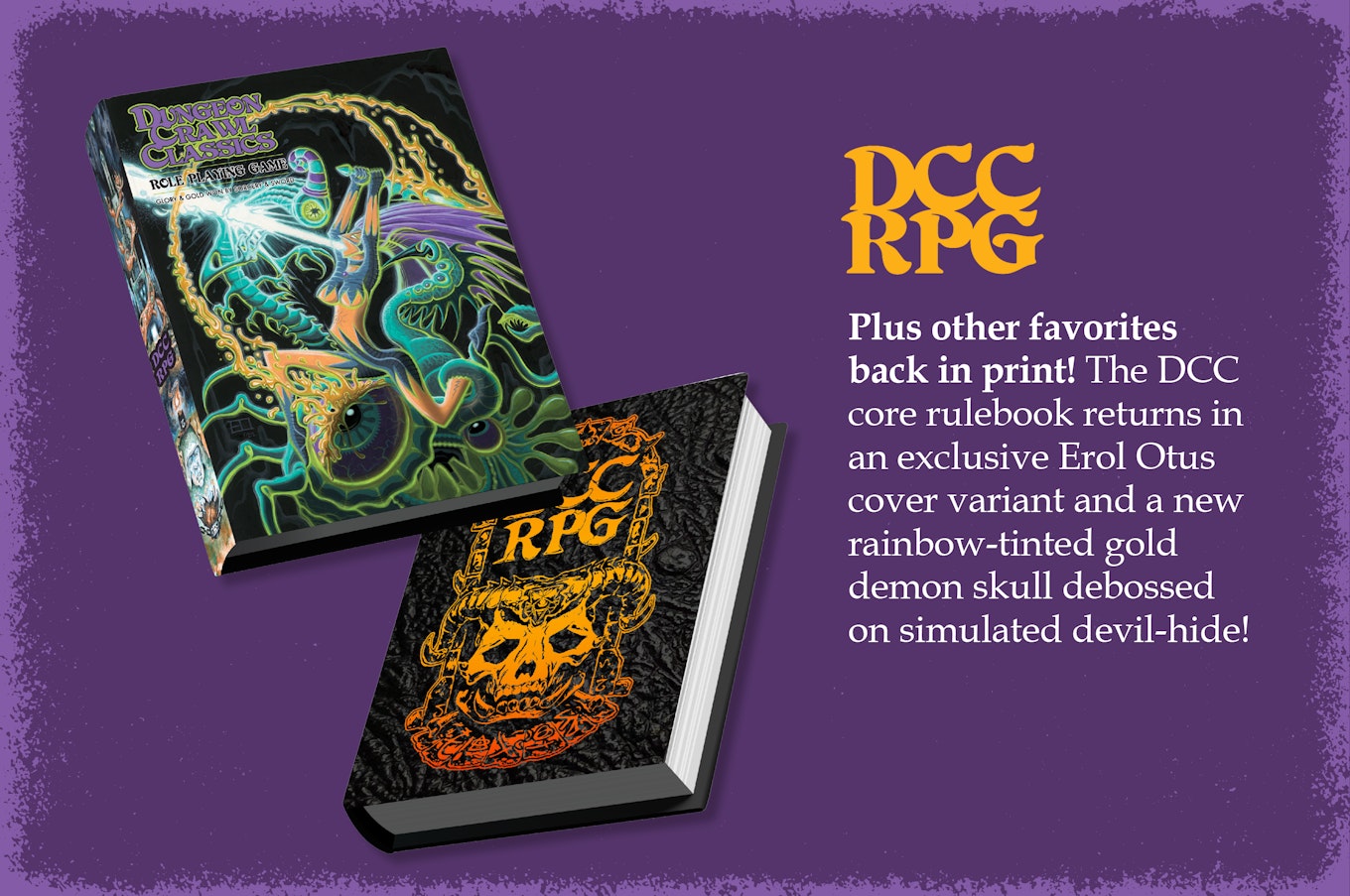
And we are getting variant covers of the rules, including an Errol Otus cover, which looks impressive. I want that book!

DCC is becoming my favorite OSR game, eclipsing the original B/X editions.

I am all in with this one when it drops. Plus more.

Sunday, October 1, 2023

One Million Magic Items

This is an excellent PDF to pick up for games like Dungeon Crawl Classics; since that game assumes magic items are supposed to be unique, and the game does not come with tables for anything other than swords, this PDF gives you a nice set of tables to generate Diablo-style items for DCC. Two notes:

This is for D&D 3.5 edition, so you must make a few adjustments to the items to work in DCC. These are trivial changes, and you can either swap ability scores, give a save bonus, or just make up a DCC-specific bonus if something does not work well. Some modifiers and damage resistances seem high (+10 competency bonus or +10 to skill checks), and the damage resistances of 10 to 30 points seem high, so you should halve those bonuses and resistances across the board, so YMMV.

I haven't played enough high-level DCC, so they may be okay. D&D 3.5 is close to DCC, but the modifiers are slightly lower across the board.

The number 42 in every table is omitted as an in-joke. Some reviewers pointed this out as a problem, but if I roll a 42, that means this is a DCC item, bonus, or ability that it modifies. So this in-joke gives me a DCC-specific result to give bonuses to luck or luck regeneration, spell burn, patron rolls, spell checks, dice chain results, or any other DCC-specific rule or numeric value. I can give a weapon a condition add or immunity. So, the 42 result on every chart is a highly-desired DIY DCC result, making the charts even better. A 42 on an item type? Roll on the level-zero character equipment chart and have a magic chicken that gives +1 STR and allows the holder to read and understand any language.

The Warrior's Chicken of Comprehension is born.

I like random items since they force players to determine how to use them and which character should benefit most. That chicken could go to a fighter., but the fumbles may be epic, with a missed axe swing cutting it in half. Or it could go to a more social character who doesn't need the STR but would use the language comprehension well. Or give it to a thief to listen in on enemies and then have the thing cluck at the wrong moment.

A final note: don't grow too attached to your magic items. In DCC, you should never get too attached to your gear; a magic weapon can fly out of your hand on a fumble and fly off a cliff, magic armor can be disintegrated by an acid attack, and a patron could flat-out ask for a great item as a repayment for a favor. A god could be appeased by sacrificing that great item, too, so they can be 'burned' for debt repayment.

A hungry troll could eat that chicken.

You will always find another piece of random junk later from these tables, so don't worry about it. I have had games where if you touched a magic item on a character, the player would quit the game. It felt like cutting off a character's limb to make 'all gear paid for' and was part of the reason we loved Paranoia so much.

It is all paid for.

Nothing the characters possess is sacred.

Everything is on the table.

And the replacements for all the junk you lose, burn for favor, and stupidly lose in fumbles are on these tables. Once everything is expendable in a tabletop game, the freedom you feel is like no other and worth experiencing.