Wednesday, January 31, 2024

Wizards Selling D&D to Tencent?

Current rumors are that Hasbro is shopping D&D around to potential buyers, and one of those is Tencent. I speculated this in an earlier article.

The Creative Commons SRD release may be the last we see of the D&D IP as a freely shareable resource. This was likely not a goodwill gesture but a life preserver tossed to the gaming community.

You are on your own now.

It is still possible to get involved with other communities if you are not on board with Open 5E by now. Open 5E may be the only way the 5E system survives. At this point, pick a game and buy-in. Support those communities earlier rather than later.

It is time to pick a side, choose, or walk away.

Even if this is just a fake story, D&D will be bought and sold by Wall Street to worse and worse companies, disappearing like your favorite movie gets sold to another streaming service as the parent company gets absorbed into the blob of 'content.'  Or the entire game gets locked behind a 'lifestyle brand' paywall and micro-transactioned to hell.

Honestly, it is only a matter of time.

I have zero confidence in things owned by Wall Street.

A5E Play Report: Part 4

This got pulled from a sell box recently. I never listened to this podcast, but I enjoy good campaign settings. This one is on the smaller side, with the main island being the size of the US West Coast. There are a couple other island mini-continents on the map (not explored), and the rest of the world is yours.

The map reminds me of a Final Fantasy game on the old NES 8-bit console. It is not huge; there is a lot of ocean. The first continent is the largest and divided by mountains; the others are strange islands, thin strips of land, and oddly shaped islands. It feels like islands in a broken world more than a complete world. Which is okay; I can fill the rest out myself.

Some of the art is great, there are good maps, and there is a lot of cartoony art for characters, which is okay. I am not too hot on the cartoon art, but at least it does not have that same-ish feeling that many books from the larger publishers have.

This isn't an epic setting but a solid, small sandbox setting.

But for me, it is still too small, not epic enough, and not anything wrong about this setting - but I have better, more epic settings that feel more like places rooted in history than a collection of places visited. I have old-school 5E worlds that are a tour-de-force of amazing adventures.

Midgard is my favorite for depth, history, maps, and a sense of the natural world. I am saving this one for Tales of the Valiant. It is simply amazing. We discovered this during our 4E years, and I almost switched our campaign here. Best of all, unlike any Wizards settings, it is supported with current releases and new books.

You snooze, you lose, Forgotten Realms. All you have is nostalgia, and the shine is wearing off year after year. Not supporting a setting "damages the brand," and I left the TSR worlds a while ago to explore new places.

And sadly, the creators of many of the lore of the Forgotten Realms aren't helping with movies and media. We will only realize it is too little or too late when we lose that generation of creators. Then again, Wizards tried to get into TV and movies, and they blew it. The larger market isn't interested in the stories of D&D, just the game culture, which is easily copied by others. Visually and dynamically, there isn't much difference between D&D, ToV, A5E, MCDM RPG, or any fantasy RPG these days. The roleplaying uni-culture is what it is, and the word D&D is like Kleenex or Q-Tip.

You have to ask yourself the actual value of a brand if the name can mean any game from any publisher.

Lost Lands is my Level Up A5E setting of choice. Old School with street cred, home of the best grandaddy mega-dungeon, and plenty of old-school adventures converted to 5E make this a fantastic experience with rules that tip the hat to old-school play - just like A5E.

And it is home to the above. This a 5E version of what I feel is one of the projects Gary Gygax left as his legacy, and this blows the 'oh so rando' Tomb of Horrors out of the water as a dungeon where you must pay attention, synthesize history, solve mysteries, read, understand, and care about the culture. If you go through this without caring, not thinking, trusting the detect magic spell, divination, and passive perception are getting you through this, your characters will die. If you treat the native culture like dirt or act like tourists, your characters will die. If try to do this in one run and avoid roleplaying and breaking for outside research, your characters will die. More on this later, but this is S-tier dungeon adventuring here.

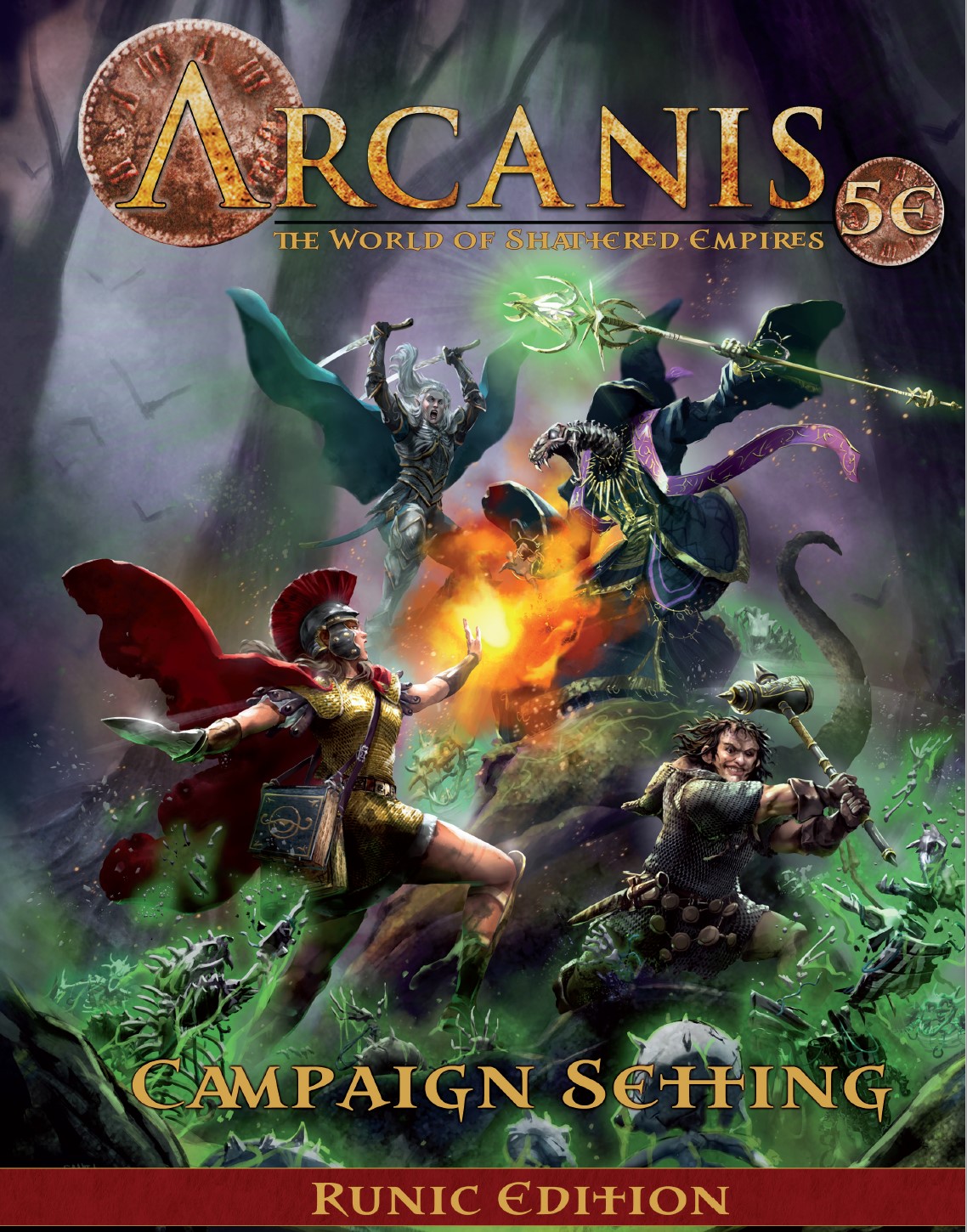
And, the other I am saving for Tales of the Valiant, the Arcanis Setting. A pseudo-fall of the Roman Empire mixed with magic and dark sorcery, and it feels epic and grand, with a deep sense of history.

Theria is a great little setting, but it does not give me what I want in a setting. I have too many other great ones I will barely explore. It is returning to my sell box, but not because I don't like it. It just pales in comparison to what I already have.

Tuesday, January 30, 2024

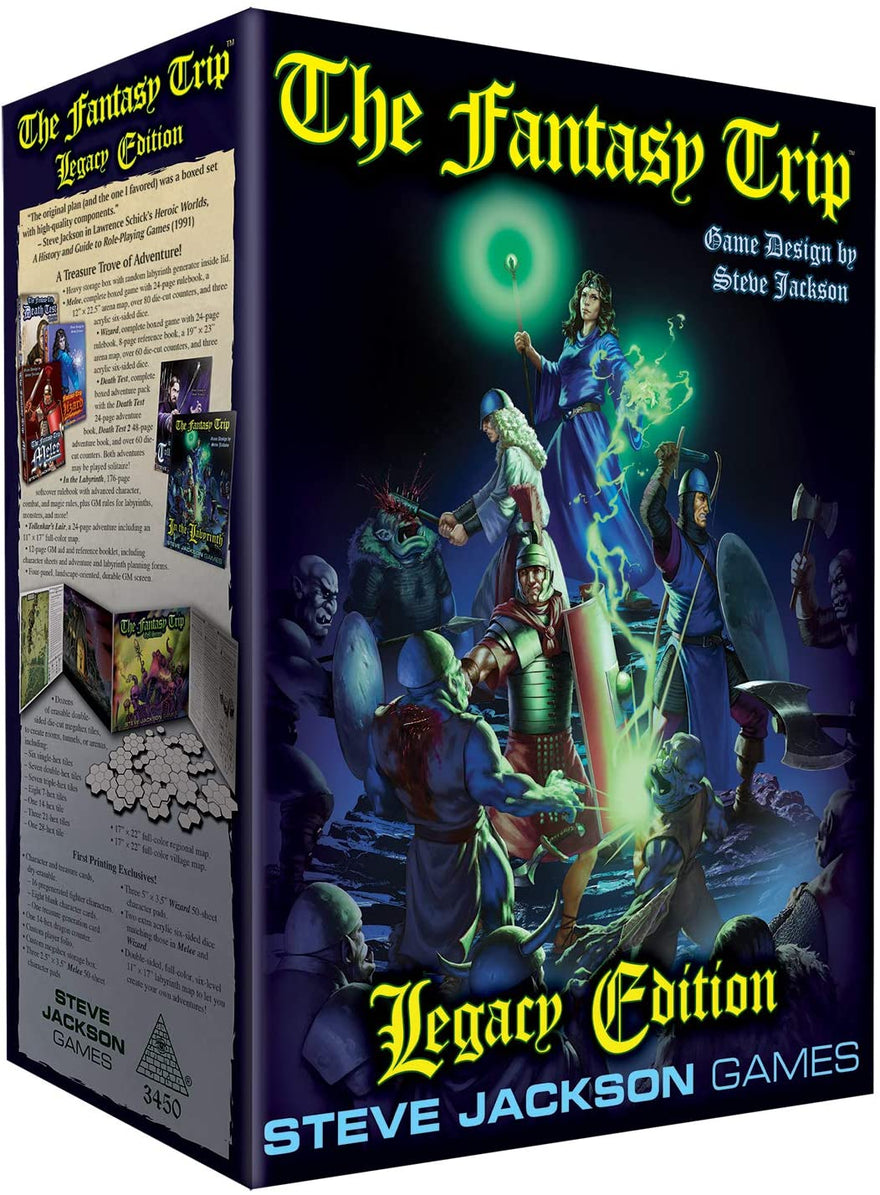
Ordered: The Fantasy Trip

I have always seen The Fantasy Trip as the Car Wars' answer to D&D. This is the game Steve Jackson lost control of and the one that made him create GURPS to replace it. Now he owns the rights again, and we are seeing a resurgence of popularity after this game's Kickstarter.

The game is 25 pounds in a huge box, with the "I Want it All" box at 35! You get a lot here for your money. I love these "big box, infinite play" games, and there is a magic to them I can't describe. It is like owning a treasure chest containing infinite fun.

As I hear, there are two archetypes, fighter and mage, and you customize them with talents in the advanced game. You can mix magic and fighting, but buying those abilities will cost you more XP. I don't mind a game with only two archetypes, as in recent years, the "specialism" of needing dozens of character classes to simulate every possible occupation has gotten tiresome.

I picked a "dockworker" as my character class! Oh yeah, I picked "cargo handler!" I want to be a "harbor master!" Me? A "salty dog" for sure! You get this strange mix of professions, positions of importance, slang terms, oranges that do not relate to apples, and nothing makes sense. Scurvy lad? Matey? Swabbie? Freebooter? Pirate? Corsair?

Game designers only embarrass themselves when given a thesaurus.

TFT focuses on two types of play, melee combat, and spellcasting, presenting tight tactical challenges. The tactical combat is better than D&D 4E, with every turn and move making a difference. Weapon and armor choice matter (and this is like subclassing when you mix talents in there). Party composition matters. Turn order matters.

This is also a game that solo plays well, as I am told. I have been looking for a light-roleplay, heavy skirmish, rules-light game. This game will fit my needs perfectly. It reminds me of the old Advanced Hero Quest games, with the WHFRP rules cut down for dungeon-skirmish play and a heavy focus on scenarios and building your figure's power through advancement.

When solo-figure gaming was popular in the 1990s as an AD&D alternative hobby, this was an excellent pastime. The DM laid out a dungeon with tiles, and the rules were clear and straightforward. There was no "theater of the mind" play, which also reminds me of what they tried with D&D 4E (but failed). You had a hero, a character card with simple abilities, and you went to the hobby shop to play a few 'dungeon skirmish' adventures and get rewards to use next time. The characters were simple, so validation and "loot tracking" could be done before play and kept as records. If my dwarf got a magic axe, that was added to my card, and the GM put that in their notes so I could use it next time.

4E tried to do this so hard by making every power, item, and magic item a card. The game tried merging with Magic: the Gathering - which was an exciting idea, but how they went about doing it was a dumpster fire. First of all, no cards. A 4E adventure should have come with cards for the treasures you find in there so you can hand them out to players. But, no! This is where your legacy holds you back, and another game steps in and does it better.

They tried to do that concept in Gamma World 4E, but by then, it was too late, and the 5E team was already trying to fix the mistakes of 4E by rushing back into the cave and banking on nostalgia hard. It was a smart move, but I already had 3.5E (and Pathfinder 1e) for that.

This is also a GURPS-like 3d6 system but without the GURPS. The complexity has been cleared out and eliminated. This is like a GURPS 5th Edition beta that removes all the fiddly parts and messy point builds and keeps the game's heart - the combat.

The relation to Dungeon Fantasy is strange, as this game is pure GURPS, and The Fantasy Trip is pre-GURPS. Dungeon Fantasy is what to play if you love GURPS and its infinite layers of detail and customization. The Fantasy Trip you play because you don't care for any of that and just want the tight tactical game. But even Dungeon Fantasy pares a lot of GURPS and focuses the engine on the fantasy gaming part.

I like DF, and my fantasy gaming is slowly moving back into this area because of the excellent solo play. The fewer heroes you have, the better the game gets. There is a point where a game is so easy and the characters so pigeonholed in a class role that you feel you have no options other than to grind XP and "level up how they want you to." With GURPS, 5-15 points in one place can change how a character plays and puts them in a new role.

SJG is succeeding in stripping down the excellent 3d6 and GURPS engines and focusing them on experiences. This is a winning formula.

You can get the Fantasy Trip: Melee in PDF for free right now - so the first melee-focused game is free to try yourself.

I am looking forward to this one.

Monday, January 29, 2024

Mail Room: Shadowdark

I got my Shadowdark books a while back and finally opened the box. Sometimes, I will hold off on opening something until I have the time to thoroughly enjoy it. A few thoughts...

The referee's screen isn't as helpful as I would have expected. I will probably know more in play, but there aren't many tables to reference during play. I am sure there is a reason for these tables to be on here, and I will know more when I sit down to play. I guess I am used to rules-dense screens with many tables and reference charts, but this isn't that type of game.

No roll under ability score; everything is DC, modified by ability score. Skills are "soft" there is no skill system. In downtime, you can learn a skill (nothing that crosses class abilities); with a DC 18 INT check and an instructor (and likely paying some money), you learn the skill and have an advantage on those checks. Also, backgrounds can be used as skills in those situations.

Lots of random tables. Almost too many. Are games turning into books of random tables?

This is a very rules-light game! This is lighter than most versions of B/X, and Old School Essentials is a deeper game. If you are coming in here looking for a full 5E replacement game, this won't be your thing. This does not replace Tales of the Valiant or Level Up Advanced 5E.

Simplified gear and encumbrance.

No index? The game isn't complex enough to need one, but I was looking for something a few times and had to flip through. The Internet was faster to find answers, honestly.

Random-level awards, like the original Gamma World or even Lion & Dragon. As long as they are all good, I am OK with this, and it produces interesting and unique progressions.

Lots of charts in here.

The book is small, but the type can be seen easily. My copy does not stay open and lay flat, so if I were playing this, I would order a spiral-bound printed copy from a commercial printing site and get this in 8.5x11" lay flat (personal use only, and using my paid-for PDF, of course). This would also blow up the font, which would be a good option if you are visually impaired.

Note, you DO NOT add ability score modifiers to damage rolls unless you are told to do so. The mostly compatible 5B rules set has monsters and treasures that work well with Shadowdark, but if you use the monsters here - ignore the static damage modifiers in the attacks. The bear in SD does 1d8 damage on an attack, while the bear in 5B does 1d8+4. Drop static damage modifiers for monsters converted this way; SD is deadly enough.

DEX and STR modifiers do apply to to-hit rolls.

The time-based light mechanics get a lot of heat, but I see them as okay. This is closer to a board or mini-game where the unique mechanics add tension and flavor. The levels are capped at 10, so this game is excellent for one-shots, short, and mid-length campaigns.

Excellent referee's advice. This book says more in a few pages than the 5E D&D DMG does in an entire book. This is due to the tight focus of the game.

The GM always tries to find ways to put the light source out.

Money is tight! The random treasure tables and adventures keep a tight reign on cash, and this feels like money is progression as you can buy better gear. I get a "Heroquest" feeling from this game; every coin matters, and player skill is essential.

No short rests.

I like this game; it feels very "small" concisely, which is very attractive. I am a fan of minimalist designs, and to take 5E and turn it into a rules-light dungeon game with unique time-based light mechanics and a hefty penalty for stumbling around in the fark effectively simulates an old-school dungeon romp without a lot of math, tedious bookkeeping, and character preparation.

Spellcasting rolls.

This game also requires a minimalist mindset, especially when modding or bringing in 3rd party content. It is so easy to port in a heavy, complicated system that takes over the game, muddles progression, introduces too many variables to track or bogs down the game in ways the designer never intended. The designer here likely wrote on a whiteboard "what I like about OSR games" and "what I don't like." Why do we need to mod all that stuff back in? Especially if it bogs down the game.

Danger levels of areas mean something.

When you put yourself in the mindset for this game, you are focused on the environment, story, and what is in the next room. There is a tight focus here, and things outside that focus have been eliminated or simplified to the point where the rules are left to the game master. I don't need a book with 1,000 pieces of gear for this game, weights down to 0.1 pounds, and an old-school encumbrance system.

The less you have, the better.

This game is about the minimal guidelines to recreate a particular old-school experience. The empty calorie crust of D&D was cut off, leaving us with the best parts.

Saturday, January 27, 2024

Tales of Argosa Public Playtest

FREE Playtest PDF: 

https://preview.drivethrurpg.com/en/product/465681/tales-of-argosa-public-playtest

Kickstarter Link (Feb 2024):

https://www.kickstarter.com/projects/lowfantasygaming/tales-of-argosa

Wow, this one took me by surprise. The Low Fantasy Gaming team is rewriting LFG into Tales of Argosa and rebuilding the concept around a Shadowdark-like experience with a unique art style, presentation, and gritty theme.

How is this different from Shadowdark? LFG was always closer to a 5E-like experience than OSR, though it takes a lot of inspiration from the OSR. This is more Warhammer FRPG and Conan than old-school D&D, and there is cinematic flare here, where Shadowdark is more square-by-square grim-and-gritty. ToA also pulls in ideas from Dungeon Crawl Classics, like dangerous magic, and revamps the martial-caster power divide.

They also may go Creative Commons with this version, breaking away from the OGL and standing on their own. More games need to do this, embrace that Shadowdark energy, express their creativity, and go their own way from B/X, the OSR, and D&D - and make something more than someone else's stuff.

It is great seeing this team spread their wings and fly, taking inspiration from Shadowdark, but keeping most of what made Low Fantasy Gaming fantastic. There are tons of minor, mechanical tweaks in here to refine the experience from the first version and to pare down the cheese and exploits.

And the Kickstarter is next month.

This is another I am all in on.

A5E Play Report, Part 3

Ah, the Nerrath campaign, the D&D 4E "default setting" that felt like more of an example of a starting area that every player wanted to see fleshed out as an entire game world. This was part of 4E's "rebel nature," and people loved this since it wasn't Greyhawk, the Realms, Dark Sun, or anything else we have seen before. The game had a lot of things we never saw before, such as elevating tieflings, dragonkin, and eladrin as core rulebook races. The world was new, the planar cosmology was new, some of the gods were new, and the world's model felt more interesting than we had in 20 years of 3 and 3.5E.

Then, 5E comes along and quietly rolls back many of the changes. Back in the cave with you! I get why; 4E's design was horribly broken, and everyone in this uni-class acted and worked exactly the same. The entire experience was MMO-ized. It felt like a card game in book form. High-level play was a disaster. The game needed a reset and back-to-basics to survive.

But we loved this little place like it was home. We built a world around it that was our own.

When we tried to create 5E characters to fill this world back in 2014, when 5E came out, the characters felt lacking. Something was missing. We never replaced 4E with 5E and put the game aside as "meh" compared to other things we were interested in.

Ten years later, I designed some of my NPCs from our game using the A5E rules, and what a difference a solid core design makes. A5E tightly links your character to the world unless you choose a more nomadic background and happen to wander into this area. Otherwise, if you say I am in a trades guild, the game asks you, "What guild? Who do you know? What connection do you have?" In every case, you must answer specific questions about the world that tie your character to it.

We had a character, a female tiefling town guard from Winterhaven, and in 4E she was what she was - tiefling fighter. In A5E, she had this background where she still had some of the responsibilities of that background in the sandbox. She could get called upon to serve if the town were in danger. The guards could ask her to investigate mysterious caravan attacks on the north road. If a killer were on the loose in Winterhaven, she could be asked to bring her friends in to solve the mystery. And if she did enough for the town, she could have skilled retainers, a 4-person squad, assigned to her permanently. This is great if the party were on a long trip and needed a small group of trusted, trained guards to guard their camp, look after their treasure, and watch over them while they rest.

She went from bland to fabulous.

I don't get that in D&D or 5E.

I get all this for every background in A5E by default.

One of the problems many adventures have is the "wandering adventurer" mentality. They are written from the standpoint of "you wander into town," and it feels like such a tired cliche. I love my sandbox settings and a system that forces me to say this person came from that place and knows these people. You can tweak this relationship to your liking, so if you want to be more of an outcast - that is your choice. But you will still have to say who threw you out and why.

I could run a fantastic Nerrath campaign with A5E. The one I wished we could have run. Nobles could have been linked to Eladrin families looking to restore their manors in the Moon Hills. Traders would have contacts in every town. Guards would be linked to actual towns and NPCs. Members of different guilds would have NPCs and guild houses to visit and deal with. Entertainers could make names for themselves and earn a living in different towns. Clerics could perform religious ceremonies at temples in exchange for room and board.

As the PCs level, the importance of their groups and circles grows. The cleric is brought to a council of faith for a larger area. The guild invites the player to a regional meeting to discuss significant issues. The guard becomes an officer and is sent to the local monarch to represent the area in significant security issues.

The PCs would still be adventurers and free to go where they wish, but having a world to fall back on helps. This world can also be a source of adventure hooks and opportunities. The PCs are part of the world, and the world is a part of the PC's experience.

My adventures are mostly "you wander into town," which limits my options. Most 5E adventures are written like this so they can "drop-in" anywhere. Even if I use these, I would like to establish a "home area" and "why the PCs are here together."

I would do that work before I ran the adventure; even though they could be a hundred miles away from home, the questions of "where do they come from" and "why are they there?" must be answered.

Starting with a more robust sandbox helps like some of the classic OSR mega-dungeons converted to 5E that come with starting towns. These have NPCs you can use during character creation, where you can point to someone and say, "I worked for him, or she was my guild master." That makes for a great game; you are tied into the setting, and your motivations are clear and personal.

D&D suffers from a plague of "the adventurer class" like they were a caste middle class between peasants and royalty. They assume these people have no connections to the world and just exist as a wandering group of thrill seekers. This feels like the people who go to Burning Man and other festivals, one after the other, and you wonder if these people have real jobs and real lives.

And every adventure is written for them. "The wandering band of adventurers stumbles upon..." is now equivalent to "it was a dark and stormy night." It is a lazy cliche, tired, and invites the players to care less about the world and adventure since another one will be waiting for them just down the road a little.

I love the concept of a system that forces a tighter connection to the game world. You could house rule in "I am a wandering X," but that should be the outlier, not the norm.

Thursday, January 25, 2024

A5E Play Report, Part 2

Do you know how some 5E players feel about B/X characters compared to 5E characters?

"They are way too simple! I got nothing to work with here!"

This is how I feel about 5E characters compared to A5E characters.

I went through all the characters I built for my A5E game and designed them in Hero Lab for straight 5E, and time after time, all the fun stuff was missing. The 5E characters were flat and uninteresting. Parts of the rules dealing with resting, navigation, survival, environmental hazards, and social encounters were flat-out missing.

The DMG would say, "Make it up yourself!"

I don't have to; the A5E game gives me all this plus more.

Do you know how GURPS players fall in love with the detail level of their characters? Where is every skill, disadvantage, advantage, and other particular facets of the player character mapped out in intricate detail? While A5E does not go as far as to-the-point GURPS, I can say having 9-12 special abilities (a mix of combat, social, and exploration) for my 5E characters makes all the difference in the world between a flat, combat-only, generic race-plus-class-plus-subclass build.

A5E is 5E with a semi-GURPS level of customization, all done through background choices.

In A5E, I can swap out these specials for anything I can imagine when I start to homebrew and custom-hack my characters. Like swapping the cosmopolitan option's "discreetly armed" feature for "expertise die for getting into royal events." Or anything else, wine tasting, area knowledge, criminal gangs, or any other area of knowledge where an expertise dice will make a character shine above everyone else.

One of my characters in A5E is a sailor berserker who gets angry like Popeye and kicks butt with his giant boarding axe. In 5E, generic barbarian. In A5E, this guy can talk him and his friends onto a ship voyage for free (you may have to do a little work), hire a ship crew (or cargo handlers) for half price, know ship captains and ships, talk salty language to intimidate people, and get information from the local sailors by drinking hard and telling fish stories.

Sorry, D&D, you are boring. Your game gives me nothing to work with. Your advice is, "The DM makes it all up!" or, "The player's backstory gives you ideas!" I have played for 40 years, and none of that would have immediately come to mind. It helps to have a little inspiration and guidance.

He also has an AC of 15 without armor because of his toughness and cool tattoos, and he moves at a base speed of 35' per round. He does a d12 + 2 slashing damage a turn.

In A5E, this guy is fantastic.

Parts of him directly work with the game's unique pillars-of-play systems. He can learn fighting styles at level 2 and have unique attacks and defenses linked to a stamina-like resource.

He is like a freaking Danny Trejo Popeye.

His ability to socialize his way into any waterborne adventure gives me ideas for adventures for this group. If I were doing a game based around ocean travel, this is the guy I would want in my party. Even on land, this guy kicks butt. And he only gets better as he levels.

A lot of the complexity is never seen in A5E and melts away; it plays like 5E. When you need it, it is there. The options and extra systems are only in the places where the original game has a void.

I don't need D&D anymore.

I have this.