Saturday, February 3, 2024

Nostalgia is a Form of Depression


A random video came up on my YouTube, and the statement "nostalgia is a form of depression" hit me like a brick to the face.

Let that sink in.

Especially in regards to gaming. Your purchases. How companies market to you. How you feel about roleplaying games. Classic gaming. Modules. The OSR.

Is what you feel is "good" based on nostalgia?

This is something that goes to the core of my feelings. Some older games did things better - mechanically. Most older games were trash. Today's games forget the past or go in a direction I disagree with. They pander to power gaming to create lifestyle brands, make it impossible to die, and encourage you to self-insert "you as your character" - when we were told repeatedly in the 80s and 90s that was NOT to be done. The DM is supposed to "cheat for the players" to "tell a good story," which removes any feeling of danger or challenge.

At a point, D&D will become the "who cares" shared-story game.

But a lot of this feels rooted in marketing to a form of depression. The want for a past that never existed. People laud the 1980s, but we had AIDS with no cure, plus the constant threat of nuclear war. Rampant starvation. Wars in Central America for defense contractor profit, with secret police disappearing scores. The drug crisis and neighborhoods being controlled by violent gangs. The Satanic Panic. Megachurches with television empires. Zero rights and respect for LGBTQ, and they could not even be talked about - or were jokes.

There were good things back then, too. The music. The flashy culture. MTV. Miami Vice. Comedy. Movies. Gaming. Nintendo. Fashion and the notion of glamour. Aerobics. Rock music. Rap. Not owning a cell phone. AD&D and its competitors. Car Wars. Battletech. Paranoia. Wargaming. Atari. Original Star Wars. The SNL cast movies. Up until the Challenger disaster, the 80s were fantastic.

We can still love these things, but I get the feeling letting them control our thoughts and feelings is a form of depression where we care so much about the past that it prevents us from seeing the future.

Are you letting companies use your depression to take advantage of you?

Open that wallet; Wall Street is calling.

The past will make everything all right.

Kickstarter: Harnworld

It is the last 36 hours of the Kickstarter for the Republic of Tharda Kickstarter for Harnworld, and you can get all five previous hardcover books (including the world overview), plus this one in a package deal (26 of them left).

Don't let the beautiful classic art dissuade you; this is a setting that is very much as great-looking and "real" as any other - this is just the art style of the period and can be played with anything from 5E to GURPS. Even FATE or Pathfinder 2.

The best way I can describe this is a setting written like the history of a Crusader Kings game. You get histories, articles, descriptions, battles, accounts, and all sorts of other information about an area, the current status of what is happening today - and you start from there. The borders and rulers are always in flux, with kings and their followers being forced into exile, cities being conquered, fighting orders in eternal war, strange magical things happening, and you get a complete picture of a land and you pick a plot hook (of which there are almost infinite in the articles), and you go.

Is your character one of the lost children of a deposed ruler? Is your character an exile from their land? Does your character practice the forbidden magic of a strange sect? You read the history, find a place to insert yourself that is compelling and would make a great story, and you tell it.

It isn't dry; here is a map, here is a population, here is the name of a ruler, and here is a few landmarks sort of setting, like most fantasy settings today. The setting doesn't start with a novel or videogame, and sort of goes 'la de da' with the details. The setting starts as a history first. People. Factions. Events. Places exist because of things that happened before. Sometimes the unthinkable happens, and the world adjusts.

Also of note, the Harnworld Starter Set is on sale now for 9.99 on DriveThru:

https://preview.drivethrurpg.com/en/product/234400/harnworld-starter-kit-bundle

The setting defaults to humans, but there are others present (elves, dwarves, and others), and honestly, you can make this setting as diverse as you desire with dragonborn and tieflings.

The ability to 'drill down' into an area of the map and see what's going on there makes this unlike many of the other settings I own. A lot will just start with a feeling, or even just art, and expect you to take it from there.

I backed this and look forward to a small library of books I can lose myself in, and possibly tell stories in with the games I love.

Friday, February 2, 2024

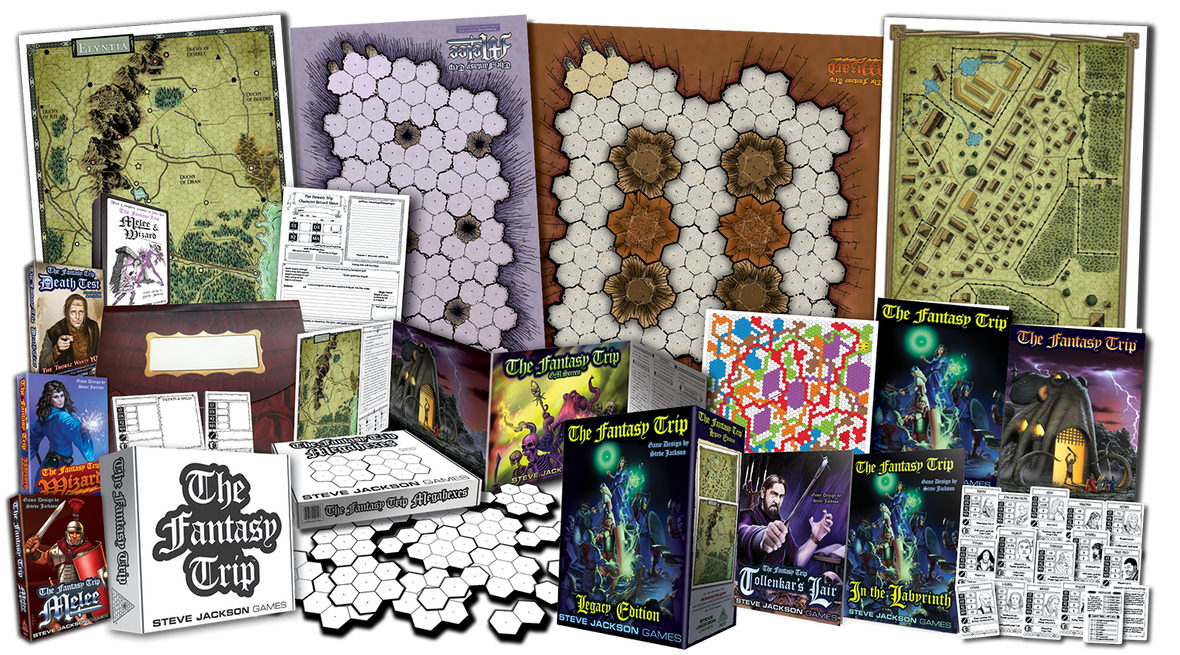
Mail Room: The Fantasy Trip "I Want it All Box"

The shipping box is 25" long by 14" wide by 8" deep. It weighs 15 pounds. It is like a miniature coffin being delivered to your door.

The game box is 14x11x5"sized. It took me 30 minutes to unpack, remove the plastic, and sort out all the pieces. You get two boxed games - Melee and Wizard - as the core games, plus the "RPG Rules" called In The Labyrinth that tie them together and give you the traditional RPG and campaign glue.

https://warehouse23.com/collections/the-fantasy-trip/products/the-fantasy-trip-i-want-it-all-box

The above link and image better describe everything you get - including a hard and soft cover of the rules and two nice rubber playmats. Of particular note are the hex tiles you can use to assemble dungeons, caves, or any other location - these can also be used in GURPS and Dungeon Fantasy.

One downside is that the Melee and Wizard games are in small booklets, the size of a Car Wars pocket box rulebook. Get the PDF and print them out if you are visually impaired. Melee's PDF is still free as I write this. They are small for my eyes, so I print the PDFs and put them in a binder. I also would like these in 8.5x11" POD books and the Wizard spell reference booklet - please make them PoD!

The companion is fun; they reprinted the original designer's notes, and Steve goes through how he saw D&D combat as boring, walking up and rolling dice until one side dies. Forty-plus years later, it is still a valid criticism of D&D.

Many record sheets are here; all are printable if you get the PDF. Hex paper. Papers for labyrinths, room record sheets, all types of character sheets, and many other valuable forms. Get the Legacy Edition PDF if you like printing things out, especially if you do binders for rules.

The hexes are large and perfect for showing off figures.

Two of the interior boxes are intended to be reused as storage.

Excellent GM screen.

It has folios for character sheets and other papers, with charts and rules printed. Nice touch.

This is the sort of game that Mordhiem or Advanced Heroquest wanted to be. A complete game with dungeon tiles, markers, dice, and a continuing linked-adventure system with slightly more in-depth character rules for campaign play. Fast playing and tactical. Random treasures. Missions with goals. Random crawls through holes in the ground to explore and clear out baddies harassing the locals. Story missions and modules. Open character progression and advancement. Simple rules.

This isn't a "theater of the mind" game style where you can ship broken rules and character options and hope the referee works it all out. This is based on skirmish wargaming; the rules must work, and the options must all be sound. The game has been played for decades, and all the exploits worked out.

The game works.

There is a clear difference between a classic game that has been out since the late 1970s and today's flavor of the week Kickstarter game that ships broken and takes 2 to 3 versions to work out the problems.

Bring your figures to make the game flashy and look fantastic.

I am looking forward to playing this one.

Shelf Shuffle: Early 2024, part 2

Frontier Space leaves the storage shelf and joins my most-played shelf for another chance. This is an excellent game if you love Star Frontiers. It completely replaces the need for that game and is better overall due to the action economy and fixes for high-ability scores. The only thing it could do better is the Knight Hawks part and starship combat, but it does an okay job on an abstract level. However, you could always use KH for the ship combat and FS for the task resolution since the games are mostly compatible.

White Star, I love you, but you may get moved to storage alongside C&C. Both Frontier Space and Cepheus Deluxe are heavy hitters that outdo their original inspirations. I like Cepheus Deluxe far better than Traveller since the game is removed from any official setting or timeline, and I am free to create whatever universe I want. It is generic 2d6 hard science fiction at its best, and I can hex-crawl the stars and not have to worry about what empire is over where, and a massive 1,000-ship fleet will end this sector conflict if it gets out of control. I can do two sectors at war, finish that arc any way I want, and make one space lizardman and the others humans; either side is the bad guy or whatever I want.

I can fly around the map, haul cargo, and break into ship combats to fight pirates. I can answer distress calls on the way in-system and get ambushed by space-lizard fighters. I can explore the lost temples of the ancients and not worry about the backstory being written. I can do military missions, mercenary contracts, exploration missions, transport missions, and investigate strange phenomena.

The Traveller universe is one of the best in sci-fi, but it is so massive, explored, time-lined, and all the history (past and future) known that I can't play in it. I want my own sides and factions, my own worlds, my own dozen-hex space empires, and my own space sandboxes. Can I make a neutral casino world that is a significant player in sector politics and allows ships from all sides of a conflict? Could I have a string of backwater worlds that become important in a space war because they are close together? I can do it.

The Imperium is a fantastic concept but crushes my freedom and imagination.

Frontier Space and White Star will suffer compared to Cepheus Engine. One is d100 gaming at its best, and the other is have-it-all B/X - but Cepheus has tables for anything I want to do, and it limits ship size. The maximum ship size is 10,000 tons in Cepheus, which is nice. A smaller cap on ship size makes players more critical. The largest ship designed in the book is a 1,000-ton cruiser with 16 troops. Small ships matter, and thus, adventurers and their vessels are essential.

And then don't ruin it by making the local space navy show up with a thousand 1,000-ton ships. Limit size and number, and keep your starship game "down" and realistic. A moderate-sized system may only have a dozen navy ships active (plus older in mothballs), which are constantly working.

The worst thing in sci-fi games is those 1,000,000-ton planet-destroying behemoth star battleships that require a dues-ex-machina to stop. The next worst thing is the space navies of thousands of ships that cruise around and solve every problem before the players arrive.

Why even have a ship?

This is Fleet Battles: Watch from the Sidelines the RPG. Traveller (with High Guard), please step into the penalty box with Space Opera, Space Master, and most Star Wars RPGs. The "space navy and large ship" syndrome breaks a sci-fi RPG for me, and I won't play one that puts fleets, battleships, and supercarriers first.

I need to give Frontier Space a chance, but it is hard to find something to do besides being a Star Frontiers emulator. I need to find the game space and a setting to excel in.

FATE got moved to the most played shelf to give it another chance. I like Cypher System better, but the FATE/FUDGE dice I collected are too cool not to use. The dice they make are some of the most beautiful I have ever seen, making me want to play the game.

I like the classic Core book better than the newer Accelerated version. You can't improve a classic.

My Aquilae books got moved to the shelf close to my GURPS and Dungeon Fantasy books. I last used this for a Pathfinder 1e game and wanted to use it for Dungeon Crawl Classics, but I will move it over to Dungeon Fantasy since I like that game for this world better.

I know, but it is just a map! A map can do anything!

My Pathfinder 1e game was a low-magic, low-fantasy game where survival and skills mattered. If you were a city character, your social and information-gathering skills were just as crucial to your survival. If the icy north, you don't want to get lost, get attacked by wolves, or freeze to death. In the city, you don't want to stand out, end up in a dangerous place, say the wrong thing to the wrong person, and get stabbed in the back.

DCC, Pathfinder, and 5E do not do those games justice. A GURPS-based game with a solo hero does, and I can buy advantages to make my characters shine in many situations. My city character can help my survival character. They can work together to survive and need each other. They won't be tied to an artificial class progression.

Kickstarter: HârnWorld: Kingdom of Tharda (Final Hours)

https://www.kickstarter.com/projects/columbiagames/harnworld-medieval-fantasy-rpg-setting-hardback

There are about two days left on the HârnWorld: Kingdom of Tharda campaign, and you can pick up the hardcovers for the published books here for the previous entries into the series (this is the 6th of 9 total).

I have heard a lot about this setting, and it has been around since the 1980s, so it has a long history in gaming. This is a High Middle Ages setting and is system agnostic, so it plays well with anything.

The writing, cartography, maps, and history are all best-in-gaming many say, so this looks interesting.

I backed this and look forward to seeing the world and the books.

Thursday, February 1, 2024

Shelf Shuffle: Early 2024

I moved Dungeon Crawl Classics from my most-played shelf to a storage shelf, as I was getting less use out of the game than I thought I would. I love DCC, but I get the feeling it relies too much on random charts as fun. Shadowdark also has this issue; the game's core is simple, and 80% of the book is random charts. I have books I got from Amazon with thousands of random charts, and they are disposable, low-content idea generators. The charts in DCC are a step above since they contain rules, but I feel I am losing interest in the "big rando" games of the early 2020s.

Shadowdark pushed me over the tipping point on this one. It's a great game, but I want a "lite" edition without the bloated charts. Or the rules in one book and the charts in another.

Random charts are filler.

They are not a game.

I still love DCC and the entire feeling and vibe; I am tired of random charts and I feel overloaded by them all. Go away for a while, I want a game that gives me depth and rewards creativity. I want something I can pour my imagination into, not page after page of roulette wheels.

Cypher System replaced DCC in its spot. This game is still a classic, and the ever-dwindling pool of player resources ramps the tension up as the session continues. The player-driven narrative using XP as currency is genius. This game does it all, and it feels like GURPS did back in the day.

Castles & Crusades is on a storage shelf. Another fantastic game with classic characters and incredible compatibility. The characters are 3x5 card simple, but I am just not into it now. Open 5E has replaced this since the developments in this area are hot right now, and I don't want to take time for the testing and games I will run for my big two Open 5E games.

C&C is a game I will never sell, but it is sidelined for a while as I sort out and sell off my Wizards of the Coast books and track Open 5E developments. I have this strange feeling in the back of my neck that no matter how much I love Level Up Advanced 5E, Tales of the Valiant will be amazing and save room on my plate for this game.

Dungeon Fantasy and GURPS are back on my most-played shelf. I can't replace this game. The character builds using the GURPS Character Sheet are just too fantastic. For a single-hero, solo-player game - there is no beating GURPS. Yes, your character is insanely deep and complex, but I don't know another game where you control entirely everything, and every character point matters. For optimizers, this game is like crack. Exploration and social abilities are purchased with the same points you use for combat, forcing you into hard choices. Disadvantages create conflict and roleplay.

I can support a fantasy game using this and another using Open 5E since, while the genre is the same, what the games do is the opposite. GURPS is more of a "character design system" with a roleplaying game attached. Open 5E is a role-playing game with preset level paths for each archetype. In GURPS, you build your character for the story you are telling - if you need a science character for a story, that is where you focus your improvement. If combat is a part of this story, you balance that with the necessary science skills. The fun is budgeting your character points to best fit the situations.

In Open 5E, the work is done for you, and you focus more on the story. For the times when I don't want a deep dive into budgeting and design, this fills the need. Otherwise, I love sculpting a character from nothing into something unique and paying attention to every detail and spot in the creation. When a master sculptor creates a life-sized statue, they spend time everywhere on the figure, and you can walk around it and be amazed at every part - like how every hair is chiseled out, the lines in the irises look real, the lips have creases in the skin, and even the fingernails are perfect.

That, to me, is GURPS. If I create one character, it will be the best design I can imagine and craft.

The Fantasy Trip joins my 2024 lineup. The game components can be directly used for GURPS and Dungeon Fantasy, strengthening all three games. Why did I buy into this game? The characters are far less complicated than GURPS, so the fantastic depth is missing. The characters are still point-buy, so the customization is there. There are two character types, melee and wizard, but those get customized through talents.

What use is a faster, simpler version of GURPS combat as a dungeon skirmish game?

The answer is simple, this looks like a fantastic solo-play dungeon party simulator. Where Dungeon Fantasy is more of a single-character game, I can manage 5-8 characters in TFT and run the whole party by myself. Since the characters are less complex, the "party" becomes the "character," and the collection of character cards and how I manage and level them up becomes like a "sports team."

TFT is the Dungeon Fantasy for party management.

I don't have a game like this, and the dungeon skirmish genre died when D&D 4E died, and I miss that game style. Compared to GURPS, combat is quick and easy. Character management is GURPS-like but heavily simplified. I can take a group of heroes through adventures, improve them point by point, and make sure the party's abilities and composition grow to meet the needs of each skirmish.

Dungeon Fantasy is my fantasy game for more sweeping stories with 1-3 characters, where character flaws matter and how a character is geared makes a huge difference. I can go for any genre or story type. This is the deeper, more story-oriented game where you optimize a character for an experience.

TFT is my "guild manager," where I can run a 6-person (or more) dungeon skirmish party efficiently, possibly multiple parties. People have done 300-figure battles with this game, so it scales linearly in complexity. The party is my character. TFT is my 4E replacement, and not like MCDM RPG, where the designer can say they loved 4E and want to replicate the experience from the bottom-up, but TFT does this from the top-down by creating the game I am looking for - the dungeon skirmish, party as player, game that we loved.

Other shelf changes? Cepheus Deluxe is back on my shelf as my sci-fi game of choice. It is a battle between this and the equally excellent White Star, but Cepheus is harder sci-fi without much goofy stuff in White Star. White Star is incredible, but Cepheus has the lower-level grit and economics I want in sci-fi. If I want to hex-crawl and explore worlds while taking cargo, fighting space pirates, and paying for ship repairs - that is classic sci-fi gaming.

Cepheus Deluxe has had a lot of development and play, and this version is highly refined. The random cargo merchant gameplay loop is solid here, and the ship combat is simple. Starfinder is MIA regarding economics and the merchant cargo game, and White Star is weak in this area. Cepheus Deluxe knows its fans and the gameplay loops they love, and it shows.

I moved D100 Dungeon from my storage shelf to my most played to give this game a chance.

Another one I moved to a most-played shelf, Shadow of the Demon Lord, another I want to revisit.

The ones I am waiting for? ACKS2 (my B/X replacement) and Tales of the Valiant (my other Open 5E game) are coming soon.

The "I Want it All" box for TFT will be here tomorrow.

Why I Play Open 5E

The above is a great book. It's too bad we won't likely see any more of them or PDFs. I would have loved to see Slave Lords and the GDQ series done like this. Alas, we got what we got, and I am happy for those, but nostalgia leads you down a road of disappointment and the eventual death of the imagination. Companies push nostalgia over original ideas since they can "own" your mind.

Far too many people surrender their free will to corporate obedience these days. These people will enable profit motives to destroy the world, and they won't question why - just get angry with the people pointing it out. Social media is the corporate mind control device mad scientists dreamed about in the 1950s.

So, why 5E? My brother wanted to play 5E as an alternative to Pathfinder 1e, but we only really started after life happened, and I shelved the game for a few years. This was 2014; 4E still had more to offer than the new system.

I used Hero Lab a year ago and tried messing around with the various sources and plug-ins, and the characters seemed fun to build. So, I started researching a few books and experimenting with the system. It seemed fun to try, but I was still wary about how hard the team Wizards dropped the ball on 4E, the game we loved. Still, with enough 3rd party content, the game was more of mine than theirs, and I could express characters and builds here well.

I was more interested in 3rd party content, and the options had significantly expanded. My interest in "D&D" was negligible, only using 5E to express character builds.

I bought a few monster books and accidentally bought the Level Up 5E one. Then I thought, oops, I bought a variant book for a strange reimplementation of 5E. My bad. Shelve it. Then, I liked what I saw and started exploring it more. This was a better system than base 5E. I loved how it placed characters in the world and linked different social abilities to game-world backgrounds.

Level Up Advanced 5E is a fantastic game. This feels like the AD&D of 5E, with depth in places you did not know it needed depth.

Then the OGL scandal happened, and I boxed up all my 5E games in disgust and put them in storage. 5E was dead. Time to move on. I gave Pathfinder 2 a chance, but the game did not work out for me since I play solo. That is boxed up, too, now, and heading to sell boxes.

Then the Open 5E movement started, and I backed Tales of the Valiant while pulling out my old A5E books to give those creators another chance. Tossing out 5E is unfair to 3rd party creators, but tossing out Wizards 5E is fine. Hasbro-Wizards needs a top-down change before I look at them again. But then again, this is Wall Street - nothing changes there and only worsens. My only hope for D&D is it gets sold to a smaller company that puts love and care into the products. That is likely a long time off.

But that is negativity, and I am permanently out of that market regarding the games I play.

The team that designed 5E, no longer at Wizards, designed one of the best level-based "character builder" games outside point-buy games like GURPS and Champions. Granted, the character-building in GURPS is vastly superior to 5E since if you have a specific power, build, or ability you want - you save up the points and buy it. I am still all over Dungeon Fantasy for realistic fantasy gaming; that is a great game.

But there is a market for those games, and they are like video games, where the build progression happens a certain way, and you have choices. Not everyone is creative or imaginative enough to play a point-buy game where anything is possible, and you need a high level of knowledge of rules to translate an idea into a power or specific build. It also takes a lot of play knowledge to understand mechanics and how they relate to builds.

This game is a keeper. If you start in 5E, GURPS (especially Dungeon Fantasy) is the logical progression to the ultimate level of character builds. No game designer is telling you what you can pick. You are not spending money on new options; one book is all you need. Want a specific power or disadvantage that only triggers in a specific combat, social, or exploration situation?

Design it yourself, and stop paying people to do a fraction of what you can imagine.

You are the game designer.

I know; sometimes, I just want to play a game. The GURPS argument is like telling people, "Want to play a game? Get GameMaker and program your own!" Sometimes, I want to experience other people's creativity and design ideas - so I play those games. One of the problems is those teams need a certain level of design experience and "design cred" to pull off a game I enjoy. Cypher System is one of these games; Monte Cook is a legend. Nothing deconstructs d20 like this game, and this is 20 years ahead of its time.

Some OSR games are too simple for my tastes. I tried them all, except for Dungeon Crawl Classics, most of which I played 40 years ago. DCC is the keeper in this group. ACKS 2 is doing its own thing, which sets it apart. I still love Castles & Crusades, but the others, even OSE, can go. You better do something radically different than B/X in 2024 to set yourself apart from the clones.

Iron Falcon and Basic Fantasy are my zero-cost and print-at-cost clones for everything else. It isn't a product but a community.

So, I play 5E to explore the designs of great design teams. I don't buy any "I play 5E so everyone can find a game" nonsense. I don't watch movies because everyone else is; I watch them because I enjoy them. I am interested in them. They appeal to me on a deeper level. This isn't junk food; it is appreciating artistry.

The Wizards team that designed 5E is gone, and nothing I read in any of the post-core-book expansions was anything I would want in my games - most of it is splat-book power gaming, which is popular because it allows broken builds. It is only fun how a cheat code for a video game is; it gets boring after a while. Not cheating is why I loved the game in the first place.

The Kobold Press team has done many fantastic class expansions, and they are a team that plays regularly and tests their stuff to ensure it is fun and not broken. This is a team I can get on board with and play their stuff. The Level Up Advanced 5E designers are like that, too; they have great ideas and a tightly-tuned game where the CR system means something.

The math in these games feels impressive. This is like the difference between a gaming laptop that creaks and pops when you pressure it like it will break and one with no flex and feels solid. The Open 5E games are made by players who are sick of the mess they must constantly deal with in their 5E games. That cheap laptop feeling every time a player shows up at the table with Tasha's and wants to build that multiclass exploit build again. And they smile like it is their idea, and all came up with it.

I read the same forums, buddy.

And no, this isn't denying a part of the game for you. This is about keeping everyone at the table feeling like they are contributing meaningfully instead of watching you kill encounters and not need anyone else. The rest of the players will get bored and leave the game, and I will, too.

Part of how good a dungeon master is relies on the "ban list" of official content they keep in their heads.

That is just wrong.

Ten years in, I am ready for a reset. I could return to the 2014 books and start again, but many classes are broken. I want another team to try improving the game and making it fun. Level Up A5E proves the point; this is the most "Pathfinder 1e" version of 5E, combining many of the best ideas in 3.5E and 4E into a 5E shell and delivering a fantastic game.

Tales of the Valiant looks the same, another excellent edition by a team with design skills and attention to detail. They care how the game plays. This is the "B/X meets 5E" version of the game, which I will use most of my 3rd party books.

Am I playing the 2014 version for the next ten years or moving on to something current?

I would rather play new things from new teams. 2014 is over, and bringing in 10 years of broken books on top of 2024 is a non-starter. That same guy with the cheater Tasha's build will be back. The ban lists will need to be updated with a massive incompatibility list.

Why?

It is easier to start over at this point.

Please give me a new game, and let me start fresh.

Wizards had a remarkable 10-year run, and they did their thing. Then, they screwed it up. People want to live in the past and ignore what they did; that is their right. But not me. Words and actions have consequences.

But like every previous generation and "big thing," it is time for them to step aside and let others show us what they can do. We are in a time like 2009 and the release of Pathfinder 1e.

People are ready for someone new.